Network Streamers in 2026: What Is Worth Paying For—and Where the Audiophile Tax Begins
A $99 streamer and a five-figure transport can both be the right purchase—or the wrong one. The deciding factor is not price. It is the job your system actually needs done.
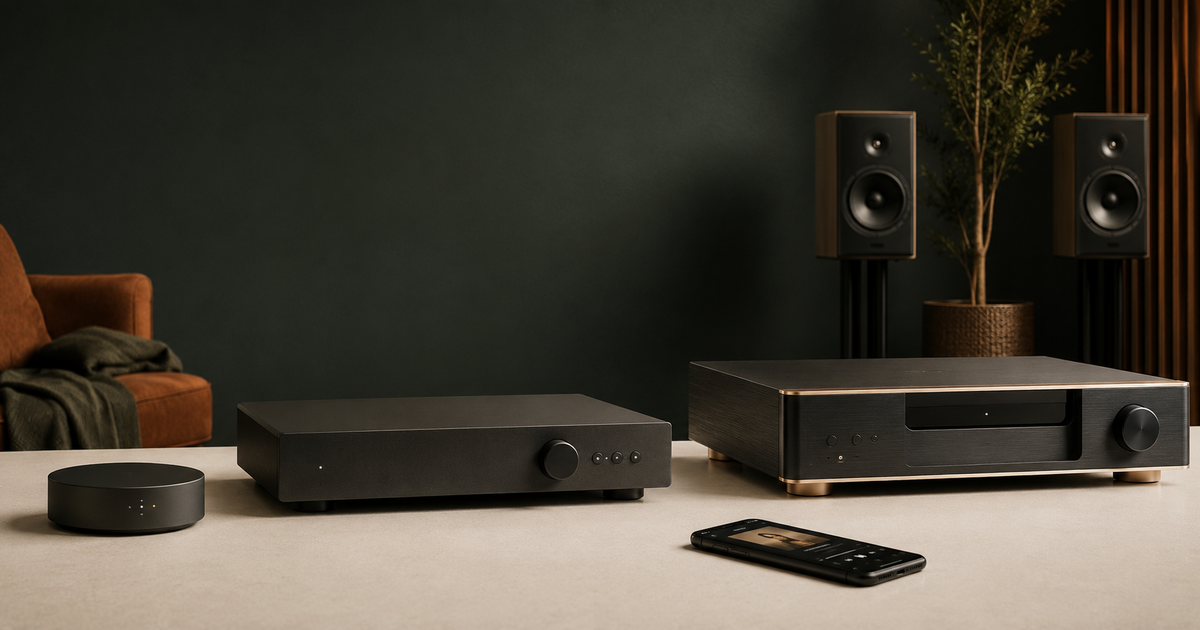
From a $99 plastic box to a five-figure digital transport with its own external power supply, nearly every network streamer promises the same basic miracle: choose a song on a phone and hear it through a serious audio system.
That creates an uncomfortable question. If two products can both send lossless music to the same DAC, what exactly are you buying when one costs 50 or 100 times more?
Here is the short answer:
Most network streamers are not scams. But many become an audiophile tax when they are purchased to solve a problem the owner does not have.
A premium streamer can be worth real money when it replaces a preamplifier, integrates a television and subwoofer, manages a large local library, provides reliable multi-room control, adds balanced outputs, or becomes the supported center of a complex system. It is much harder to justify when it is used only as a Spotify Connect bridge into a modern DAC.
For this guide, we examined 29 representative products from the current SoundPath Lab product baseline. Our editorial result is deliberately blunt:
| Editorial verdict | Products | What the verdict means |
|---|---|---|
| Clear value for a defined job | 9 | Easy to justify when the stated use case matches |
| Conditional value | 10 | Good hardware, but only worth the premium for a narrower need or ecosystem |
| High mis-buy / audiophile-tax risk for an ordinary streaming-only buyer | 10 | Not necessarily bad; the buyer must prove why the extra cost solves a real system requirement |
This is not an exhaustive list of every streamer sold worldwide, and the counts are not permanent league-table scores. They are a snapshot of how these products fit common systems as of August 14, 2026.
First, stop calling all of them “streamers”
Products in this market often look similar while doing very different jobs. Before comparing DAC chips or sample rates, identify which of these six devices you actually need.
| The real job | What it does | What must already exist in your system |
|---|---|---|
| Streaming adapter | Adds network playback to an old amplifier or powered speakers | An analogue input, or a DAC downstream |
| Streamer with DAC | Converts network audio to an analogue signal | An amplifier or active speakers |
| Streaming preamplifier / hub | Adds source switching, volume control and often HDMI, subwoofer or phono functions | A power amplifier or active speakers |
| Digital transport | Produces digital output only | A compatible external DAC; no exceptions |
| Music server | Stores, indexes and serves a large local library, sometimes with CD ripping | A DAC or an optional output module, depending on model |
| Streaming amplifier | Streams, converts and drives passive speakers | Passive speakers; usually no separate amplifier is needed |
The most expensive mistake is buying the wrong type. A transport-only product will not produce analogue audio. A compact adapter will not replace a true preamplifier. And if you own passive speakers but no amplifier, a separate streamer may add another box without completing the system.
What is genuinely worth paying for?
The following upgrades can create practical, repeatable value. They change what the system can do—not merely what the brochure can claim.
1. The software and ecosystem you will use every day
The app is not an accessory. It is the front panel. Search quality, queue editing, gapless playback, local-library indexing, multi-room grouping, alarm behavior, firmware support and recovery after a router change can matter more than the DAC logo on the circuit board.
If you live inside Apple Music, Qobuz, TIDAL or Spotify, check the exact path you intend to use: AirPlay 2, Google Cast, Spotify Connect, Qobuz Connect, TIDAL Connect, Roon, UPnP/OpenHome, or the manufacturer's own app. Similar-looking protocol lists are not interchangeable.
2. Inputs and outputs that remove another component
HDMI ARC/eARC, a genuine variable analogue output, balanced XLR, a headphone amplifier, phono input, subwoofer output, bass management and a 12 V trigger can justify a higher price when they allow the streamer to replace a preamplifier or TV hub.
Paying for those functions and then leaving them unused is not future-proofing. It is unused inventory.
3. Local-library and server capability
A household with thousands of ripped CDs, a NAS, several playback zones and carefully maintained metadata has different requirements from someone who only opens Spotify. Fast indexing, database resilience, internal storage, backup, CD ripping and server software may justify products from Innuos, HiFi Rose or FiiO.
If you do not own a local music library, server-grade hardware has little work to do.
4. Physical control, display and installation support
A good display, remote, front-panel source controls, rack integration, home-automation drivers and dealer support can be valuable in a shared living room or custom installation. A screen is less valuable if it only shows album art while every meaningful action still requires a phone.
5. A better analogue stage—when you actually use it
A streamer with a well-designed DAC and analogue output may outperform a weak DAC already in the system. But if you connect the streamer digitally to an external DAC, you bypass the internal DAC and analogue stage you paid for. Compare products based on the output path you will use, not the parts you will bypass.
Where the audiophile tax usually begins
The term “audiophile tax” should not mean “expensive product I dislike.” We use it more narrowly: money spent on a feature whose benefit is not established for the buyer's actual system.
Paying for 768 kHz and DSD512 when you only stream music
Apple Music, Qobuz and TIDAL currently top out at 24-bit/192 kHz, while Spotify Lossless is up to 24-bit/44.1 kHz. Support for PCM 768 kHz or DSD512 may matter for a specialist local library or deliberate upsampling workflow, but it is not a requirement for the major streaming catalogues.
The bigger number is real. The assumption that it will improve ordinary streaming is not.
Paying for a transport without testing the downstream DAC
Digital transports can differ in output options, electrical isolation, clock architecture, software and construction. None of those differences automatically proves a worthwhile audible change through every DAC. The downstream DAC's input design, the chosen connection and the rest of the system determine whether a change is meaningful.
For a transport costing several thousand dollars, “it has a linear power supply” is not enough evidence. Ask for a level-matched comparison in your own system and make sure the return policy is real.
Paying twice for the same function
Common examples include:
- buying a premium internal DAC, then using only the optical output;
- buying a music server when a NAS already handles the same library reliably;
- buying a streaming preamplifier, then feeding it into another preamplifier at variable volume;
- paying for room correction but never obtaining the required licence, microphone or measurement process;
- adding an external clock, linear power supply or “audiophile” network accessory before identifying a measurable or repeatable problem.
Buying a luxury chassis as though it were an audio format
Machining, display quality, switchgear, shielding and industrial design cost real money. They can improve ownership and long-term durability. They should be described honestly as build, interface and service value—not converted into an automatic promise of better sound.
The nine clear-value shortlists
These are not universal winners. Each has a job that is easy to explain and a price that is reasonably connected to that job.
1. Arylic LP10 — the low-cost protocol adapter
Best for: adding AirPlay 2, Google Cast, Connect services, Ethernet and optical output to an existing system at minimal cost.
The LP10 is a strong entry point because its $99 official price buys broad phone-first compatibility rather than an ornamental chassis. It also offers analogue input/output, optical output and USB-media support. The limitation is equally clear: this is an adapter, not a premium preamplifier, and its custom EQ applies to the analogue output rather than every path.
Do not buy it if: you need HDMI, a dedicated subwoofer output, balanced analogue output or a substantial front-panel interface.
2. WiiM Pro Plus — the safest conventional all-rounder
Best for: an older amplifier or powered speakers that need a mature streamer, capable internal DAC, analogue input and both analogue and digital outputs.
The Pro Plus remains one of the easiest recommendations because it covers AirPlay 2, Google Cast, Spotify and TIDAL Connect, Roon Ready operation, multi-room and parametric EQ without forcing the buyer into a large chassis. It can be used as a complete streamer/DAC or as an inexpensive digital source.
Do not buy it if: you need USB audio output, HDMI ARC, a screen, phono input or integrated subwoofer management.
3. Arylic LP20 — the inexpensive 2.1 and trigger-ready alternative
Best for: AirPlay 2 or Google Cast users who want RCA output, digital outputs, subwoofer output and a 12 V trigger without moving into a much higher price tier.
At an official price of $199 at last check, the LP20 fills a useful gap between a basic adapter and a full streaming hub. It supports AirPlay 2, Google Cast, Qobuz Connect, Spotify Connect and TIDAL Connect, while adding local/NAS playback and system-control connections.
Do not buy it if: your priority is HDMI ARC, room correction, phono input, a headphone amplifier or a large display.
4. WiiM Ultra — the value hub, with one major Apple warning
Best for: a TV-connected stereo or 2.1 system needing HDMI ARC, phono input, subwoofer management, headphone output, room correction and a touchscreen in one compact unit.
The Ultra earns its place by replacing other boxes. Its value is not merely its DAC; it is the combination of TV input, source switching, bass-management functions, USB-media support and physical control.
The trap is unusually important: WiiM states that the Ultra does not support AirPlay and cannot become an AirPlay receiver because of a hardware limitation. Apple-first users who assume every WiiM model includes AirPlay can easily buy the wrong product.
Do not buy it if: AirPlay is a hard requirement, or if your existing preamplifier already provides every hub function you would use.
5. Bluesound NODE NANO — the sensible BluOS entry
Best for: listeners who specifically want BluOS, Roon Ready playback, AirPlay 2, local-library support and analogue plus optical/coaxial/USB outputs in a compact device.
The NODE NANO is less feature-rich than the full NODE, but that is the point. It gives access to BluOS and a strong set of output paths without charging for HDMI eARC, an analogue input or a full headphone stage the owner may not need.
Do not buy it if: you need a universal wired subwoofer output, TV integration, analogue input or a headphone jack. Also note that the official US page showed it out of stock at the time of our check.
6. Cambridge Audio MXN10 — the compact StreamMagic choice
Best for: buyers who value the StreamMagic ecosystem, AirPlay 2, Google Cast, Roon Ready support and a conventional hi-fi brand format without paying for a display.
The MXN10 is a clean solution for systems that need streaming and analogue/digital outputs but not source switching. It is especially rational when the owner wants Cambridge's software platform in a small chassis.
Do not buy it if: you expect HDMI, analogue or USB-B audio inputs, balanced outputs, preamp controls or a front display.
7. Bluesound NODE — worth the step up when the extra sockets matter
Best for: BluOS users who need HDMI eARC, analogue/optical input, headphone output, wired subwoofer integration and more complete hub behavior.
At $849 on the official US store at last check, the NODE is no longer a casual upgrade over budget streamers. Its value rests on the features absent from the NODE NANO—not on the idea that every owner automatically receives a proportionate sonic upgrade.
Do not buy it if: you only need fixed digital output into an existing DAC. In that role, much cheaper products may provide the same practical result.
8. Cambridge Audio CXN100 — the rational full-size network player
Best for: a traditional component system needing a clear front display, tactile control, USB audio input, digital inputs, balanced XLR output and optional preamp mode.
The CXN100 makes its premium visible and usable. It is not merely a compact streamer in a bigger case; it can accept additional digital sources and function as a more complete digital control center. Cambridge listed the CXN100 family at $1,099 in the US at last check.
Do not buy it if: you will hide it in a cabinet, use only one fixed digital output, or require HDMI eARC.
9. FiiO S15 — strong value for a screen and local library
Best for: buyers who want a large touchscreen, Android-based app access, local or network storage, HDMI ARC, DAC and preamp functions in one desktop component.
The S15 is compelling around the $999 class because it competes on interface and local-media flexibility, not just a DAC-chip claim. It suits listeners who want to browse and operate the device directly rather than treating it as an invisible endpoint.
Its strength is also its risk. Android flexibility introduces a different maintenance question from a closed streaming appliance: app compatibility and long-term OS support should be checked, not assumed.
Do not buy it if: you want a tiny set-and-forget endpoint, or if a phone-only Connect workflow already meets every need.
Ten products that are valuable only under the right conditions
These products can be excellent purchases. The condition in the final column is what prevents them from becoming an expensive mismatch.
| Product | Real job | Buy only when… |
|---|---|---|
| Sonos Port | Sonos bridge for an existing stereo | the household is already committed to Sonos multi-room |
| Bluesound NODE ICON | BluOS preamp, balanced DAC and headphone hub | XLR, the 5-inch display, headphone stage, HDMI eARC or Dirac readiness are genuinely useful |
| Cambridge Audio EXN100 | Full-size StreamMagic preamp with eARC and XLR | it replaces a digital preamp/TV hub rather than duplicating one |
| Primare NP5 Prisma MK2 | Compact digital-only bridge | a compatible external DAC already exists and embedded Qobuz/TIDAL operation suits the owner; it does not provide Qobuz Connect or TIDAL Connect |
| LUMIN D3 | Premium streamer with internal DAC | the LUMIN app/ecosystem and analogue stage are part of the reason to buy |
| LUMIN P1 Mini | Streaming preamplifier and input hub | HDMI/source switching and preamp functions replace other hardware |
| Matrix Audio TS-1 | Streamer, DAC, headphone amp and active-speaker hub | HDMI ARC, XLR/RCA variable outputs, headphone drive and the fixed subwoofer low-pass behavior match the system |
| HiFi ROSE RS250A | Screen-led network player with internal storage support | the large interface and local-media workflow will be used regularly |
| Innuos STREAM1 | Modular streamer/server | local-library/server duties or optional output modules justify the €2,800-class starting point |
| Naim NSS 333 | Premium network player in a Naim ecosystem | system integration, service and the Naim analogue path matter more than feature-per-dollar value |
Ten high mis-buy-risk products for an ordinary streaming-only user
This is the section most likely to be misread. “High mis-buy risk” does not mean fake, defective or incapable. It means the product's price is difficult to justify when the buyer merely wants Spotify, Qobuz or TIDAL delivered to a competent modern DAC.
| Product | Why ordinary users should pause | A defensible reason to buy |
|---|---|---|
| LUMIN U2 Mini | Digital-only; the external DAC determines the analogue result | you need LUMIN's transport workflow and its specific USB/SPDIF output set |
| LUMIN U2 | Premium transport pricing with no DAC or analogue output | fibre networking, dedicated outputs and LUMIN processing are required and verified in the target system |
| LUMIN U2X | Flagship transport, external PSU and 10 MHz clock ecosystem can create a very expensive chain | a reference system uses its isolated USB, clock I/O and multiple digital paths, with an in-system comparison |
| Matrix Audio NT-1 | Transport-only architecture and specialist interfaces can be wasted on a single conventional DAC | SFP, IIS-LVDS, AES/EBU or isolated USB solves a documented integration requirement |
| Matrix Audio TT-1 | Optional storage and broad digital outputs add cost without analogue playback | it is being built as a local-library transport rather than a simple streaming endpoint |
| HiFi ROSE RS130 | Large screen, storage and extensive digital I/O are expensive if the unit stays hidden and plays one Connect service | the interface, storage and transport connections are central to daily use |
| Innuos STREAM3 | Server-grade modularity is unnecessary without a serious local library | the owner needs server, storage, ripping or modular output functions and prefers the Sense ecosystem |
| Innuos ZEN Next-Gen | The official no-storage/no-output-board price is in five figures in several regions | a very large library, server role, upgrade path and dealer support justify the system architecture |
| Innuos NAZARÉ | Flagship server construction is far beyond the needs of cloud-only streaming | it anchors a no-compromise local-library system where cost is secondary and comparison is possible |
| Naim ND 555 | Requires at least one external NAPS 555 DR power supply and sits at reference-system pricing | it completes a high-end Naim system and the buyer has validated the complete analogue result |
The most common traps—before sound quality is even discussed
Trap 1: assuming every model in a brand supports the same protocol
The WiiM Ultra/AirPlay issue is the clearest example. Product families evolve, chipsets change and certifications do not automatically carry across models. Check the exact model—not the brand reputation.
Trap 2: treating “USB” as a complete specification
USB-A may be for storage, audio output, service or accessories. USB-B is commonly an audio input from a computer. USB-C may supply power, carry audio or do both. A port shape does not tell you the signal direction.
Trap 3: assuming a digital transport includes a DAC
Primare NP5 Prisma MK2, the LUMIN U series, Matrix NT-1/TT-1 and HiFi ROSE RS130 require an external DAC for analogue playback. Budget for the complete chain and confirm the DAC accepts the transport's chosen output.
Trap 4: confusing “Roon Ready,” “Roon compatible” and generic network playback
If Roon is essential, check the current certification status of the exact model. Do not infer it from UPnP, AirPlay or Chromecast support.
Trap 5: buying a future feature
“Ready,” “planned” and “available via a future update” are not the same as working today. Buy on current functions. Treat future firmware as a bonus.
Trap 6: forgetting volume safety
Before connecting a streamer directly to a power amplifier or active speakers, confirm whether its analogue output is variable, what happens after reboot, and whether a fixed-output mode can be enabled accidentally. Start at low gain.
Trap 7: assuming more resolution means more music
The major lossless streaming services do not require PCM 768 kHz or DSD512. Those formats belong to particular local-file and processing workflows. They should not be used as a universal quality ranking.
Which streamer is right for you?
| Your actual situation | Start with | Avoid first |
|---|---|---|
| Old amplifier, no modern streaming, no external DAC | Arylic LP10, WiiM Pro Plus, Bluesound NODE NANO, Cambridge MXN10 | expensive digital-only transports |
| Good external DAC already installed | WiiM Pro Plus digital output or Primare NP5 Prisma MK2; audition higher transports only after these | paying for an internal DAC you will bypass |
| TV, active speakers and subwoofer | WiiM Ultra, Bluesound NODE/NODE ICON, Cambridge EXN100 or Matrix TS-1 | adapters without HDMI or bass-management functions |
| Apple/AirPlay-first household | Arylic LP10/LP20, WiiM Pro Plus, Bluesound NODE family or Cambridge StreamMagic models | WiiM Ultra as the sole AirPlay target |
| Roon-centered system | Verify Roon Ready status, then shortlist WiiM Pro Plus, Bluesound, Cambridge, Primare, LUMIN or Naim according to output needs | assuming UPnP alone equals Roon Ready |
| Large ripped-CD or local high-resolution library | FiiO S15, Innuos STREAM1, HiFi ROSE or an existing NAS plus a simpler endpoint | server hardware when the library lives entirely in the cloud |
| Existing Sonos household | Sonos Port | buying a second ecosystem without a reason |
| Passive speakers and no amplifier | A streaming amplifier such as WiiM Amp, Bluesound POWERNODE or another correctly matched amplifier | buying a streamer that cannot drive speakers |
| You only use Spotify Connect | A stable low-cost endpoint with the output you need | a five-figure server or transport justified by file-format numbers |
A five-minute pre-purchase test
Do this before reading another DAC-chip comparison.
- Write down the exact music app you open most often.
- Write down the exact connection into the next component: RCA, XLR, optical, coaxial, USB, HDMI ARC/eARC or speaker cable.
- Decide whether the streamer must control volume.
- Decide whether AirPlay 2, Google Cast, Roon or a specific Connect service is mandatory.
- Count the non-streaming jobs the new box will replace: preamp, phono stage, TV input, headphone amp, subwoofer control, server or amplifier.
- Ignore every feature you cannot connect to a real requirement.
- If the remaining job is simply “send Spotify to my DAC,” begin at the inexpensive end of the market.
Final verdict
The network-streamer market is not divided cleanly into honest products and scams. It is divided into products with clearly priced functions, products whose value depends on an ecosystem, and products whose cost can outrun the problem they solve.
For most systems, the rational stopping point arrives earlier than the industry suggests. Arylic LP10/LP20, WiiM Pro Plus/Ultra, Bluesound NODE NANO/NODE, Cambridge MXN10/CXN100 and FiiO S15 already cover an enormous range of real-world needs.
Spend more when the money buys a function you can name, connect and use: better control, the right inputs and outputs, a local-library server, balanced preamp integration, home-automation support, a display you operate, or dealer service you value.
If the justification is only “cleaner digital data,” a larger sample-rate number, an external clock or a more elaborate power supply, the burden of proof should rise with the price.
The best streamer is not the one with the most impressive inside photo. It is the least expensive reliable product that performs every job your system actually needs—and no expensive jobs it does not.
Evidence / Sources
Product capabilities and classifications were cross-checked against the SoundPath Lab System Builder v2.3 product baseline and current manufacturer information. Key public sources include:
- Arylic LP10 official product and store page
- Arylic LP20 official product and store page
- WiiM Pro / Pro Plus official overview
- WiiM Ultra official overview
- WiiM support: using Apple devices with Ultra without AirPlay
- Bluesound NODE NANO official product page
- Bluesound NODE official product page
- Bluesound NODE ICON official product page
- Cambridge Audio MXN10 official product page
- Cambridge Audio CXN100 official product page
- Cambridge Audio EXN100 official product page
- FiiO S15 official product page
- Primare NP5 Prisma MK2 official product page
- LUMIN product-family differences
- LUMIN U2X official product page
- Matrix Audio TS-1 official product page
- Innuos STREAM1 official product page
- Innuos STREAM3 official product page
- Innuos ZEN Next-Gen official product page
- Naim NSS 333 official product page
- Naim ND 555 official product page
- Apple Music lossless-resolution support
- Qobuz streaming catalogue resolution
- TIDAL HiRes FLAC support
- Spotify lossless quality support
Evidence labels
- Verified fact: a capability, connection or price observed in the current manufacturer record at the stated check date.
- Manufacturer claim: descriptions of sonic or engineering benefit supplied by the manufacturer and not independently treated as proof of audibility.
- Editorial judgment: the Clear Value, Conditional Value and High Mis-buy Risk classifications in this guide.
Tested firmware / app / hardware revision
This is a source-backed buying guide, not a simultaneous hands-on test of all 29 products. No single firmware or app version applies across the comparison. Protocols, regional services, certifications, prices and promised features can change through firmware or commercial agreements.
Last checked
August 14, 2026. Prices are manufacturer list/store references where available, before tax and subject to region, stock and promotion changes. Do not interpret a price mentioned here as the current lowest price.
Limitations
- The 29-product audit is representative, not exhaustive.
- We did not perform controlled, level-matched listening tests of every product in the same downstream system.
- High-end transport performance is system-dependent; this guide does not claim that all transports sound identical or that a specified engineering difference must be audible.
- App quality, server behavior and long-term support require continued observation and may change after publication.
- EMiUZEK and iEAST products are present in the wider product baseline but were not awarded a main-pick position here. Their current evidence grade requires especially conservative ranking.
Retailer link disclosure
Retailer availability, stock position and commercial status had zero weight in the verdicts. Some published buying links may generate revenue at no additional cost to the reader. Official product sources are shown separately from third-party buying options, and retailer links do not convert manufacturer claims into verified facts.
New model-to-model comparison guides
- WiiM Ultra vs WiiM Pro Plus — choose between AirPlay reception and expanded HDMI/phono/headphone/subwoofer integration.
- WiiM Amp vs Amp Pro vs Amp Ultra — compare AirPlay support, display and published output platform.
- Arylic LP10 vs LP20 — compare a simpler streamer with a broader system-control hub.
Update: Comparison links added 1 September 2026. No QA403 measurement claim is included.
Continue the research
Move from this article to a verified product decision
Use descriptive links to move between product records, brand evidence, comparisons, setup or issue guidance, and compatible-system tools. Inclusion reflects subject relevance, not a score or endorsement; product facts, recommendation eligibility, and commercial links remain separate.
Product page
Verify the exact model
- EMiUZEK R10 product profile
- EMiUZEK R20 product profile
- iEAST AMP-i20 product profile
- iEAST AMP80 product profile
- iEAST ePlay 2 product profile
- iEAST ePlay 2 Pro product profile
- iEAST M50 product profile
- iEAST olio product profile
- WiiM Amp product profile
- WiiM Amp Pro product profile
- WiiM Amp Ultra product profile
- WiiM Mini product profile
- WiiM Pro product profile
- WiiM Pro Plus product profile
- WiiM Ultra product profile
- ZIDOO UHD5000 product profile
- ZIDOO UHD8000 product profile
- ZIDOO Z9X 8K product profile
- ZIDOO Z9X PRO product profile
- ZIDOO Z30 PRO product profile
- ZIDOO Z3000 PRO product profile
Brand center
Check the wider platform
Related comparison
Compare the system role
Setup, firmware & problems
Check behavior before buying
System Builder & compatibility