WiiM vs BluOS vs Eversolo vs Volumio in 2026: Choose the Ecosystem, Then the Hardware
Choose a streaming ecosystem by the playback route you need. Clear diagrams explain Apple Music, multiroom, correction and TV/DAC limits—and when to keep your system.
Comparative Analysis · Documentation checked 27 October 2026 · Not a four-platform hands-on test
A streamer can have the right sockets and still be the wrong purchase. If the household cannot find its music, move playback between rooms or recover after a network interruption, a higher-resolution DAC specification will not fix the experience.
WiiM, BluOS, Eversolo and Volumio offer different ways to organize that experience. The useful comparison is not “which operating system sounds best?” It is which complete playback path meets your requirements with the fewest compromises?
Start here: the 30-second answer
There is no universal winner. These are starting points for different requirements—not sound-quality or reliability rankings:
- WiiM: a compact add-on for an existing stereo. Choose the model carefully: Pro Plus receives AirPlay 2; Ultra offers broader TV/USB/source-hub functions but not AirPlay 2.
- BluOS: one native multiroom system across compatible hardware brands. Check the exact player’s ports and Dirac eligibility; Dirac does not cover USB output on the Bluesound path discussed here.
- Eversolo: a screen-led library and music-app workflow. Treat integrated Apple Music, the installed app and Play-series multiroom as different capabilities.
- Volumio: a choice between configurable DIY software and finished hardware. Check Premium entitlements, external-DAC compatibility and how much maintenance you want to own.
- Already satisfied? Keep your system. Upgrade only when a verified missing function matters in daily use.
Jump to your question: Apps & Apple Music · Protocols & formats · Multiroom · Room correction · USB DACs & TV · Known limitations · Buy or keep?
This is a desk-research comparison, not a four-platform listening or reliability test. SoundPath Lab's existing hands-on records cover the HiFiMuse Q7, WiiM Pro Plus and WiiM Ultra, and only their documented scopes. No new tests are claimed here; BluOS, Eversolo and Volumio have not been tested as a controlled group by SPL. Our existing labels apply: Primary-source Verified means the documentation was checked; SoundPath Lab Tested is reserved for recorded observations; Editorial Inference identifies our recommendations; and Unknown / Awaiting verification remains an evidence gap. Read the evidence scope.
The decision matrix
These are representative configurations, not promises that every product carrying the platform name has the same features. Detailed conditions and sources follow.
| Decision | WiiM | BluOS | Eversolo | Volumio |
|---|---|---|---|---|
| Everyday control | WiiM Home and supported service apps; model-specific physical controls | BluOS Controller across compatible brands; native service browsing | On-device touchscreen plus Eversolo Control; integrated and installed-app paths differ | Browser/app control; DIY installations and finished appliances are different ownership choices |
| Apple Music / Apple devices | Verify the path: Ultra has no AirPlay 2 receiver; Pro Plus supports AirPlay 2 | Native Apple Music added in October 2026; subscription required; native codec/ceiling not established here | Integrated service documented at 44.1 kHz; installed Apple Music app advertised up to 24/192 with required settings | Native Apple Music is not integrated; an AirPlay alternative is documented, not SPL-verified bit-perfect delivery |
| Multiroom | WiiM grouping; AirPlay/Cast grouping depends on each model and source | Native BluOS groups across compatible products; not a universal group with other ecosystems | Play-to-Play grouping documented; do not assume every DMP model joins it | Multiroom is a Premium feature; installation, entitlement and playback mode matter |
| DSP / correction | EQ and RoomFit; confirm model, output and microphone workflow | Dirac only on eligible hardware with required licence; USB output is a critical exclusion | EQ, FIR/room-correction features vary by product and path | FusionDSP and optional correction tools are not one universally included automatic-calibration system |
| External DAC / TV | Ultra: USB audio out and ARC; Pro Plus: neither USB audio nor ARC | NODE N132: USB audio out and eARC; other models vary; Dirac excludes USB output | Check exact USB input/output and ARC socket; an HDMI/I2S output is not ARC | Hardware-dependent USB output; an HDMI video or I2S output does not establish an ARC input |
Unsupported means an explicit documented exclusion. Conditional means the feature requires a particular model, licence, setup or signal path. Unknown means the available evidence cannot establish it—not that it is absent. This follows SPL's existing compatibility framework.
Apps and Apple Music: choose the playback path
There are two different purchases hiding inside “good app.” One buyer wants a manufacturer app for a local library, queues, settings and room grouping. Another wants to stay in Spotify, Qobuz or TIDAL and use a Connect endpoint. Those workflows can succeed or fail independently.
WiiM is a sensible starting point when a compact endpoint and familiar service-app control are the priority. However, the platform is not a guarantee of identical protocol support. WiiM Ultra does not receive AirPlay 2, while Pro Plus supports AirPlay 2. Buying the Ultra as an assumed Apple-first upgrade can remove a required function. Its other streaming paths do not make that missing receiver reappear. WiiM model support
Desktop control also needs qualification: WiiM Home for Windows/macOS is explicitly Beta, with a separate release history from the mobile app. Availability does not establish feature parity or measured responsiveness. WiiM desktop release notes
BluOS combines a control application with compatible players from several manufacturers. That offers a practical route for a household whose rooms use different hardware brands but share one supported control system. It does not prove better search, fewer crashes or greater reliability than the alternatives; those require comparative use, not a partner list. BluOS platform
An important October change invalidates older comparison tables: BluOS now offers native Apple Music integration. The 20 October announcement says the player streams directly rather than relying on the phone to carry the audio, with an active Apple Music subscription and a free firmware update on compatible products. The announcement does not establish the native stream's codec or resolution ceiling. We therefore do not label that path lossless or hi-res, and we do not substitute a separate AirPlay specification for it. BluOS announcement
Eversolo provides a different attraction: a substantial on-device interface, remote control and, on supported hardware, installed music apps. But “Apple Music on Eversolo” is not one path. Its official guide limits the integrated service to 44.1 kHz without establishing bit depth or codec in that statement. It separately advertises the installed Apple Music app at up to 24-bit/192 kHz after enabling Lossless and Hi-Res Lossless Wi-Fi streaming. Neither statement is an SPL bit-perfect measurement. Eversolo Apple Music guide
Eversolo Control’s screen-mirroring function is remote screen control, not evidence of Google Cast support. Do not confuse similar names with the same protocol. Eversolo Control
Volumio is especially relevant when the buyer wants to keep an existing computer, Raspberry Pi or USB DAC, rather than buy an inseparable streamer/DAC package. Its software, Volumio-branded hardware and third-party OEM implementations must be evaluated separately. Standard provides local/NAS/UPnP and AirPlay functions; Premium adds features including native TIDAL/Qobuz Connect and multiroom. Bundled hardware Premium is tied to that device, not transferable to unrelated DIY endpoints. Volumio plans Hardware entitlements
Volumio’s current help states that Apple Music is not natively integrated and documents an AirPlay alternative at 16-bit/44.1 kHz. This is not an SPL verification of every sender or a reason to label it AirPlay 2. Volumio Apple Music
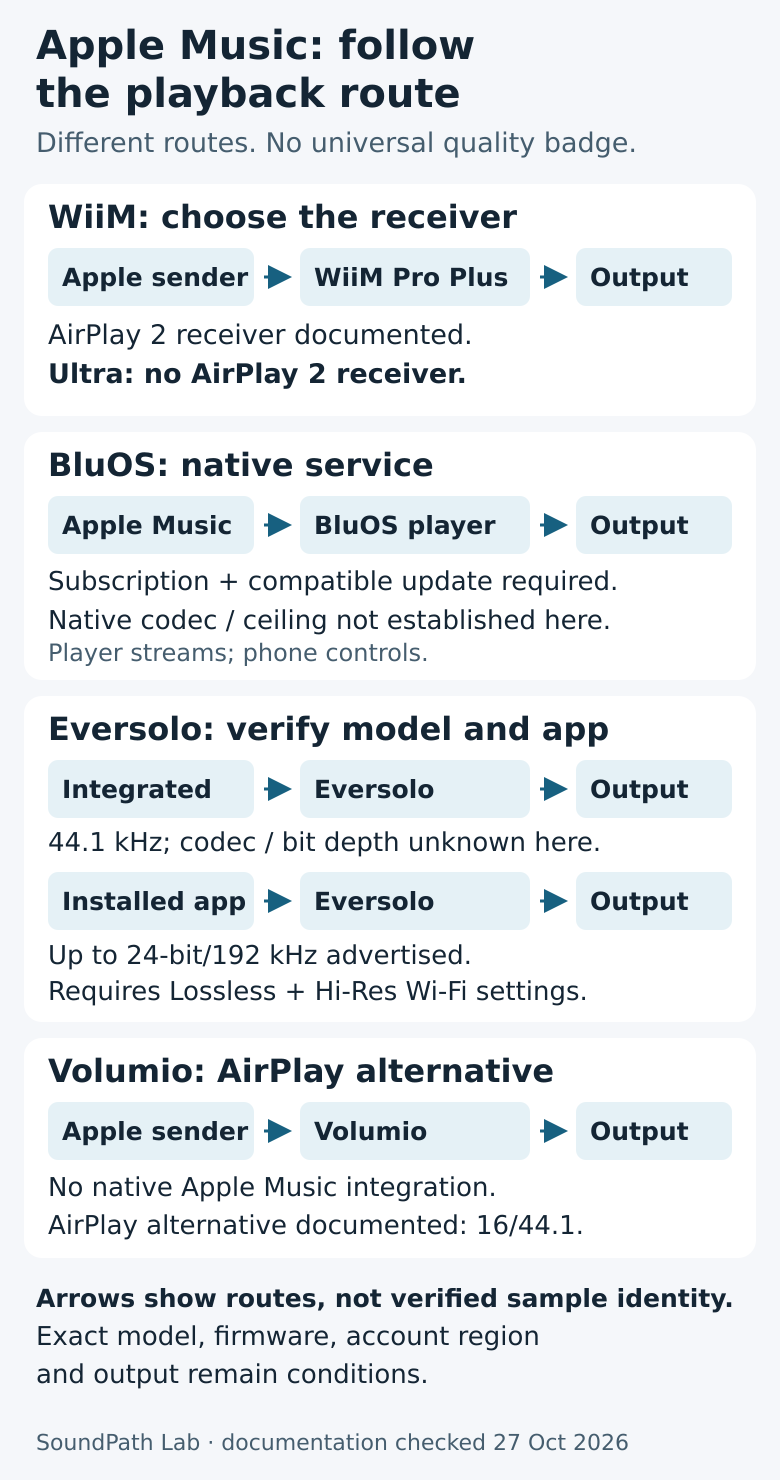
Text alternative: Choose the exact route: Pro Plus can receive AirPlay 2; Ultra cannot. BluOS now has native Apple Music but its native codec/ceiling is unknown here. Eversolo integrated and installed-app modes have different documented limits. Volumio uses a documented AirPlay alternative, not native integration. No path establishes bit-perfect output.
Our inference: choose the control workflow first, then the endpoint. For all four platforms, verify service availability in your account's country, the required service subscription and the exact app/firmware combination. A catalogue logo is not a demonstration of search, queue editing or recovery in your household.
Protocols and formats: follow the signal to the DAC
Representative protocol and format paths
Documented below means manufacturer/protocol-owner documentation, not an SPL interoperability pass. Service accounts, region, firmware and downstream hardware remain conditions. These four configurations do not certify their entire ecosystems.
| Path | WiiM Ultra | BluOS: NODE N132 | Eversolo: DMP-A6 Gen 2 | Volumio: Rivo / Rivo+ |
|---|---|---|---|---|
| AirPlay receiver | AirPlay 2 unsupported | AirPlay 2 documented | AirPlay documented; version 2 unknown here | AirPlay documented; version 2 unknown here |
| Google Cast receiver | Documented | Unknown here | Unknown; screen mirroring is different | Unknown; sending to Cast is different |
| DLNA / UPnP | Documented | Unsupported | Documented | Documented |
| Roon Ready | Documented | Documented | Documented by Roon | Documented; not generic DIY certification |
| TIDAL Connect | Documented | Documented | Documented | Documented; Premium bundled |
| Spotify Connect | Documented | Documented | Documented in manual | Documented |
| Apple Music | Native integration not established here; no AirPlay 2 | Native, subscription required; codec/ceiling unknown here | Integrated 44.1 kHz / installed-app route up to 24/192; conditions above | No native integration; AirPlay alternative |
| PCM / DSD output | PCM up to 24/192; DSD converted to PCM | PCM up to 24/192; DSD converted, no DoP | USB native DSD and PCM documented; output-specific limits | USB PCM/DSD documented; advertised maxima require multiroom off |
Sources: Ultra, AirPlay exclusions, NODE N132, BluOS DSD, BluOS network boundary, DMP-A6 Gen 2 manual, Roon’s exact-model listing, Eversolo Apple Music, Rivo/Rivo+ and Volumio Apple Music. Roon needs its own subscription/server; service support does not establish the format delivered on every route.
MQA is a separate verification question, not an ecosystem-wide tick. Distinguish available source content, decoding/rendering in the player or DAC, and the selected digital output. The A6 Gen 2 manual lists MQA, but that badge does not establish today’s catalogue availability, every output mode or a benefit for ordinary PCM streaming. No current service-MQA availability claim or four-way MQA validation is made here. Buy for an actual library requirement, not the logo. Model-specific MQA documentation
For local-network libraries, BluOS explicitly does not support UPnP/DLNA; it uses network file sharing instead. That differs from WiiM and Volumio’s documented DLNA/UPnP routes, so an existing server workflow may need changing. BluOS network-library boundary WiiM paths Volumio Standard
File decoding, network transport and physical output limits are different specifications. A device may read a DSD file but convert it to PCM; an output may support a high sample rate that the chosen service never sends.
For the Ultra, WiiM documents optical, coaxial and USB audio output up to 24-bit/192 kHz. Its DSD support involves conversion to PCM rather than native DSD output. That can be perfectly useful, but it is not the same capability as transporting native DSD to an external DAC. Ultra outputs WiiM DSD
BluOS likewise documents DSD-to-PCM conversion on a specified supported-model list; its digital output is PCM and DoP is unsupported. “BluOS plays DSD” must retain those boundaries. Older or different BluOS hardware should not inherit support merely because a recent NODE appears in the list. BluOS DSD scope
Eversolo and Volumio can suit specialist high-rate local-file libraries, but the output and operating mode remain decisive. A DMP product's USB ceiling is not its optical ceiling; Volumio’s Rivo/Rivo+ comparison explicitly conditions its maximum USB rates on multiroom being disabled, rather than promising those rates for every mode or DIY board. Verify the DAC's accepted PCM rates, native-DSD/DoP modes and the actual output settings. Eversolo hardware paths Volumio transport paths
The EOS label, a hi-res badge or a DAC display showing 192 kHz cannot alone prove bit-perfect delivery. The display may reveal rate, not whether samples changed. Volume processing, EQ, correction and conversion must be accounted for. Conversely, intentionally changing samples with room correction is not a playback defect: it is the job the DSP was asked to do.
Multiroom: check the group, not just the logo
WiiM groups, BluOS groups, Eversolo Play groups and Volumio groups should not be treated as one interoperable network. Third-party routes such as AirPlay, Google Cast or Roon introduce their own endpoint requirements; sharing one logo does not establish identical behavior for every input or output.
WiiM documents native grouping and separate protocol-specific approaches. Sharing Ultra’s phono, line, optical, ARC or Bluetooth inputs requires an all-WiiM group—not an assumed cross-brand Cast group. Choose the group method before adding another room, particularly where an Ultra's lack of AirPlay 2 reception changes the available route. BluOS's main structural advantage is native grouping among compatible BluOS products across its hardware partners. Neither manufacturer's synchronization claim is an independent SPL latency measurement. WiiM grouping BluOS grouping
Eversolo now explicitly documents multiroom for the Play series. That is a meaningful capability, but it must not become a blanket assertion that any DMP-A6, DMP-A8 and Play combination forms the same native group. Compatibility for an unlisted combination stays unknown. Volumio documents up to six eligible endpoints on the same home network. Multiroom is tied to Premium; one hardware purchase does not license unrelated DIY units. Eversolo Play Volumio multiroom
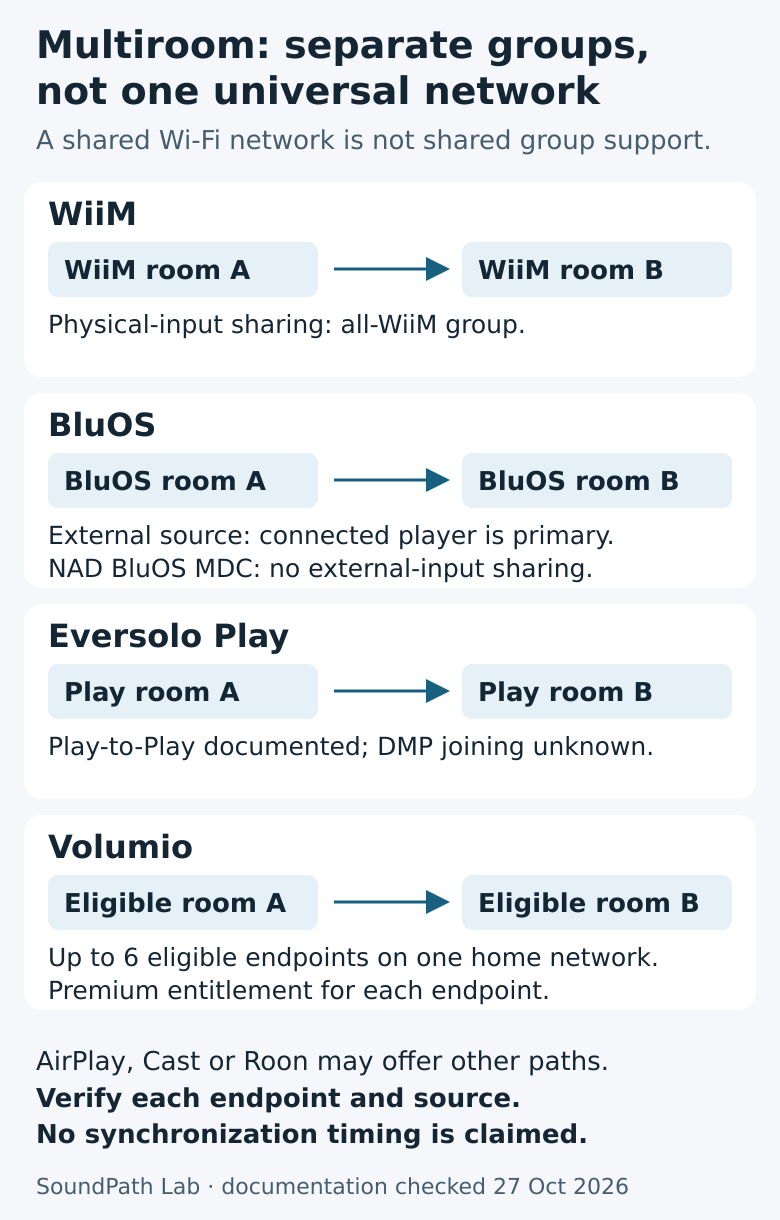
Text alternative: Keep native groups separate: all-WiiM for shared physical inputs; compatible BluOS players with the source player primary and the NAD MDC exception; Play-to-Play for Eversolo; up to six eligible Premium Volumio endpoints on the home network. Cross-platform synchronization remains untested.
For adjacent rooms, what matters is audible alignment and recovery—not only whether every device appears in the app. For TV, the acceptable delay is different again. We have no common four-platform measurement of start time, inter-room skew or lip-sync, and no basis for a millisecond league table. SPL's existing methodology separates discovery, first audio, worst-zone behavior and recovery to alignment, preserving failed attempts instead of timing only successes.
DSP and room correction: verify the output path
Manual EQ, automatic measurement, filter generation and bass management solve related but different problems. Comparing their feature names alone is not a correction-quality test.
WiiM offers EQ and RoomFit workflows on supported devices. That can make a compact streamer useful beyond simple transport duties. Before choosing it for correction, confirm the microphone/phone workflow. The reviewed guide establishes input-source coverage, but does not establish RoomFit on every output; the intended USB-correction path remains unknown, not documented as unsupported. SPL has not established RoomFit accuracy through a controlled common-room comparison, and the Ultra's existing L3 label does not certify it. WiiM RoomFit
Dirac is not a universal BluOS feature. Eligibility, licence and measurement hardware must be checked for the exact product. More importantly for external-DAC buyers, Bluesound's official Dirac guidance says correction is available through the supported optical/coaxial paths but not USB audio output. Buying a compatible NODE, a Dirac licence and a USB DAC does not establish that all three work together with correction active. Dirac requirements and output limits
Eversolo's DSP also needs a model-specific reading. The published DMP room-correction guide describes measurement and FIR configuration and requires the matching DSP configuration to be active. That should not be transferred automatically across the DMP and Play families or every input/output. Ask where the filter runs, which sources it processes and whether the intended digital output retains it. We have not established that its correction outperforms RoomFit or Dirac. Eversolo DSP scope
For Volumio, distinguish FusionDSP’s processing functions from external measurement/filter tools. Plugin availability and music-service subscriptions are separate questions. A plugin with EQ/filter capability is not evidence of an included, universal one-button room-calibration process. DIY hardware also makes configuration part of the purchase: a demonstrated setup is stronger evidence than assuming every board, DAC and plugin combination behaves alike. Volumio DSP
Our inference: if the existing amplifier already provides effective room correction, keep that processing there unless moving it solves a specific problem. If correction is the main reason to buy a streamer, verify the complete corrected signal path before comparing DAC chips.
USB DACs and TV audio: get the direction right
“USB supported” is not enough. Identify storage host, USB audio output to a DAC, USB audio input from a computer and power-only connections separately. Ultra offers USB audio output; Pro Plus does not. Selected Bluesound NODE generations offer it, but enabling that output changes which other outputs remain active. The model and intended routing matter more than the ecosystem name. WiiM output roles Bluesound USB output
For Eversolo, the DMP-A6 Gen 2 manual documents an ARC input; do not transfer it to the original DMP-A6. Verify each USB port’s role and the downstream DAC’s compatibility. For Volumio, specify both the hardware and software image. A finished Rivo-family transport and a DIY installation are not interchangeable compatibility evidence. Eversolo hardware paths Volumio transport paths
HDMI needs the same discipline. ARC/eARC input, HDMI audio output and I2S over an HDMI-shaped connector are different functions. An I2S connection is not a television ARC input, and compatible pin assignments cannot be assumed. Nor does an HDMI video output on a computer turn a Volumio installation into an ARC receiver.
For a TV-connected stereo, start with an exact ARC/eARC-equipped model, such as Ultra, NODE N132, DMP-A6 Gen 2 or Play—not a platform-level promise. Eversolo Play interfaces Check the television's output format, CEC volume/power behavior, wake recovery and lip-sync. Ultra documents stereo PCM and Dolby Digital at ARC, not DTS support or arbitrary multichannel passthrough. If the TV can provide a suitable stereo PCM optical feed and you do not need CEC, keeping that simpler connection may avoid buying a new hub. Ultra TV formats NODE hardware scope
Before connecting any variable-output streamer directly to powered speakers or a power amplifier, establish one master volume control, mute during rewiring and begin at low gain. Do not test a suspected volume fault at high acoustic output.
Known limitations: use the existing evidence records
SPL's Product Issues & Limitations remains the canonical issue record. Its entries are not equally strong evidence and must not be added up into a brand ranking:
- WiiM Ultra — scoped SPL observation: one TIDAL Connect interruption in the recorded 60-minute session on 3 October, firmware 5.2.829661 and WiiM Home 3.6.10.092711. Next-track playback recovered; cause and repeatability remain unknown, with no verified fix. Dated Ultra record.
- WiiM Pro Plus — scoped SPL observation: recovery/DLNA handoff required intervention, and the fixed-output check was inconclusive on firmware 4.8.827634. These need controlled retesting, not a universal defect claim. Pro Plus scope.
- NODE ICON and DMP-A6 — owner evidence, not SPL reproduction: the registry retains display/standby reports and a single heat/dropout report associated by its owner with BluOS 4.16.22 on NODE ICON, and an Apple Music album-playback report on DMP-A6 public beta 1.6.01. Their uncertainty is preserved; neither describes every current unit or account.
An absence of a comparable Volumio entry does not establish better reliability. More testing can generate more recorded problems; less testing can leave more unknowns. Check the existing compatibility relationships for direction and conditions, then verify the actual chain.
Release notes: traceable claims, not a six-month “fix rate”
The reviewed checkpoints include WiiM's separate model/app histories, BluOS's firmware/controller release index, Eversolo's model-specific downloads and Volumio's software changelog. Eversolo’s DMP-A6 Gen 2 page lists V1.6.01 with beta-OTA participation instructions; it is not verified here as a stable release. A staged WiiM rollout likewise does not prove installation on every device.
Documentation snapshots—not tested configurations: Ultra 5.2.829661; WiiM’s general app log 3.6.12, independently confirmed for iOS—not established for Android—plus desktop 0.2.9 Beta; BluOS player 4.18.18, controllers 4.18.0; DMP-A6 Gen 2 V1.6.01 with beta instructions; Volumio 4.231. Volumio’s download page dates 4.231 to 12 October while its changelog dates it to 21 October; we retain that discrepancy rather than invent a single release date. WiiM general app notes iOS listing Android listing: version parity unknown WiiM desktop notes Volumio downloads WiiM release records BluOS release records Eversolo download channel Volumio changelog
We did not obtain a complete, consistently defined six-month issue cohort with affected-device denominators and independent retests across all four platforms. We therefore compare log traceability, not repair percentages, complaint shares or a “stability champion.” A manufacturer's fixed-in-version statement remains a Brand Response until the relevant outcome is independently checked. Follow SPL's existing firmware tracker rather than treating this article as a parallel issue database.
Which ecosystem fits—and when should you keep what you own?
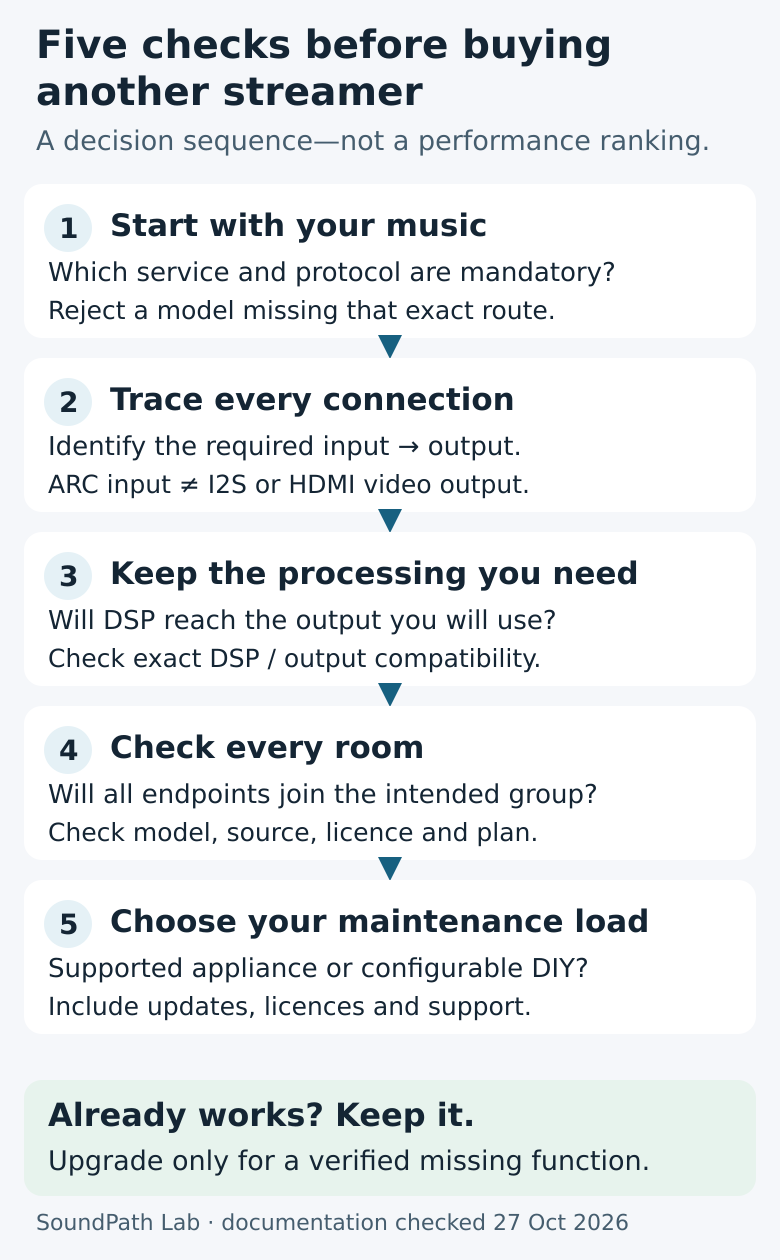
Text alternative: Before buying, name the mandatory service/protocol, required input-to-output route, DSP path, group membership and maintenance preference. If the current system passes these checks, do not upgrade.
These are editorial inferences from the documented capabilities, not performance rankings:
- A compact endpoint for an existing stereo: start with the WiiM model whose protocol and output actually fit. Pro Plus can be the more appropriate choice than Ultra when AirPlay is essential and the amplifier already handles everything else.
- Several compatible rooms and brands under one controller: shortlist BluOS. Check generation-specific interfaces and Dirac costs/output restrictions before buying the hardware.
- A screen-led local-library and installed-app experience: shortlist an appropriate Eversolo DMP model. Treat Play multiroom and model-specific TV/DSP features as separate requirements, not automatic family benefits.
- Reuse a computer or external DAC, with configuration flexibility: consider Volumio. Budget for the required plan and distinguish DIY maintenance from the support expectations of a finished appliance.
For a two-model WiiM decision, continue with the existing Ultra vs Pro Plus comparison. For broader hardware roles and upgrade value, use the network streamer buying guide.
Do not upgrade if the present system already provides the services, output, volume control and room behavior you need. A working optical/coaxial connection does not become inadequate because another streamer advertises a larger USB number. An existing DAC need not be replaced to change the control interface. Adding a second ecosystem can make household use harder without improving the sound.
No ecosystem-wide value score is justified: regional total costs and long-term comparative evidence remain incomplete. The rational upgrade is the smallest verified change that removes a real constraint. If no constraint can be named, keeping the current system is the successful outcome.
Continue the research
Move from this article to a verified product decision
Use descriptive links to move between product records, brand evidence, comparisons, setup or issue guidance, and compatible-system tools. Inclusion reflects subject relevance, not a score or endorsement; product facts, recommendation eligibility, and commercial links remain separate.
Product page
Verify the exact model
Brand center
Check the wider platform
Related comparison
Compare the system role
Setup, firmware & problems
Check behavior before buying
System Builder & compatibility