WiiM Ultra vs Bluesound NODE: When Is Paying More Worth It?
Ultra’s display and phono input versus NODE N132’s BluOS, AirPlay 2 and optional Dirac: a system-first comparison with current Apple Music and output-path limits.
Comparative Analysis · WiiM Ultra vs Bluesound NODE N132 · Documentation checked 27 October 2026
The WiiM Ultra and Bluesound NODE are not a simple good–better pair. Ultra puts a display, phono input and flexible system controls into a relatively affordable hub. NODE makes more sense when its particular playback routes, BluOS integration or optional Dirac Live solve a problem that Ultra cannot.
Our recommendation is therefore conditional: start with Ultra when its connections and services meet your needs; pay more for NODE only when you can name the feature or workflow you will actually use. If your existing streamer already does the job, keep it.
This article compares NODE N132, the generation identified on Bluesound's current product page—not NODE N130 from 2021, NODE X, NODE NANO or NODE ICON. SoundPath Lab has a dated, limited functional record for Ultra, but has not tested NODE for this comparison. This is not a level-matched listening test, a measurement shoot-out or a reliability ranking. Model identification; SPL hands-on coverage.
The short answer
- Choose Ultra if you want a screen, direct turntable connection, Google Cast or a compact TV-and-music control centre, and AirPlay 2 is not required.
- Consider NODE N132 if you need AirPlay 2, native Apple Music within BluOS, integration with an existing BluOS household, or a supported Dirac Live output path with the extra licence and calibration hardware budgeted.
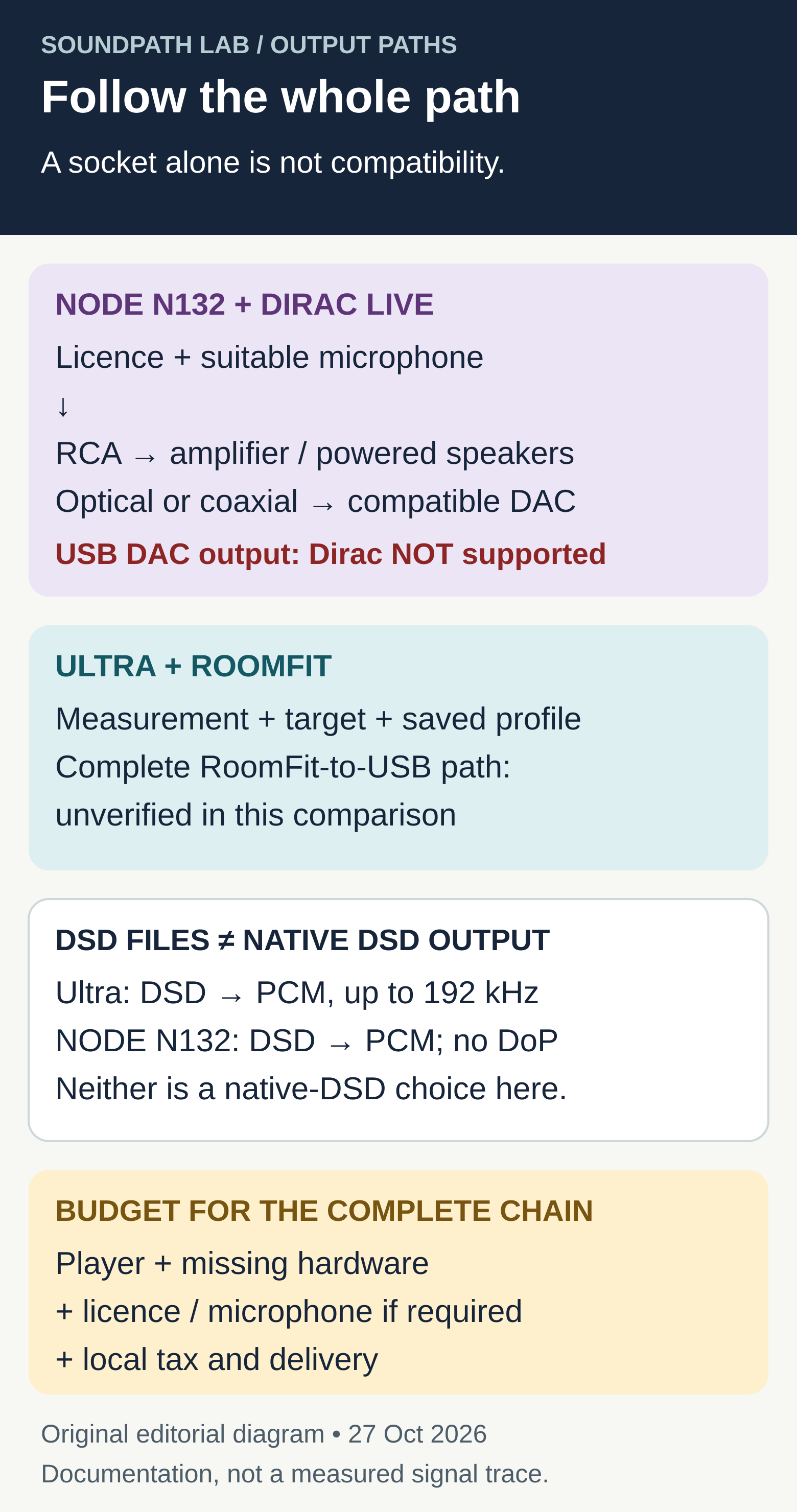
- Do not buy NODE for Dirac through USB. Bluesound explicitly excludes USB DAC output from its supported Dirac paths.
- Buy neither as a native-DSD transport. The documented DSD workflows convert to PCM.
- Keep your current streamer if neither product removes a specific limitation. A more expensive DAC chip or a longer feature list is not evidence of an audible upgrade.
The factual gates above come from WiiM's product overview, Bluesound's N132 specifications, BluOS's Apple Music announcement and the detailed format/output sources below. The buying choices are editorial inference, not test outcomes.
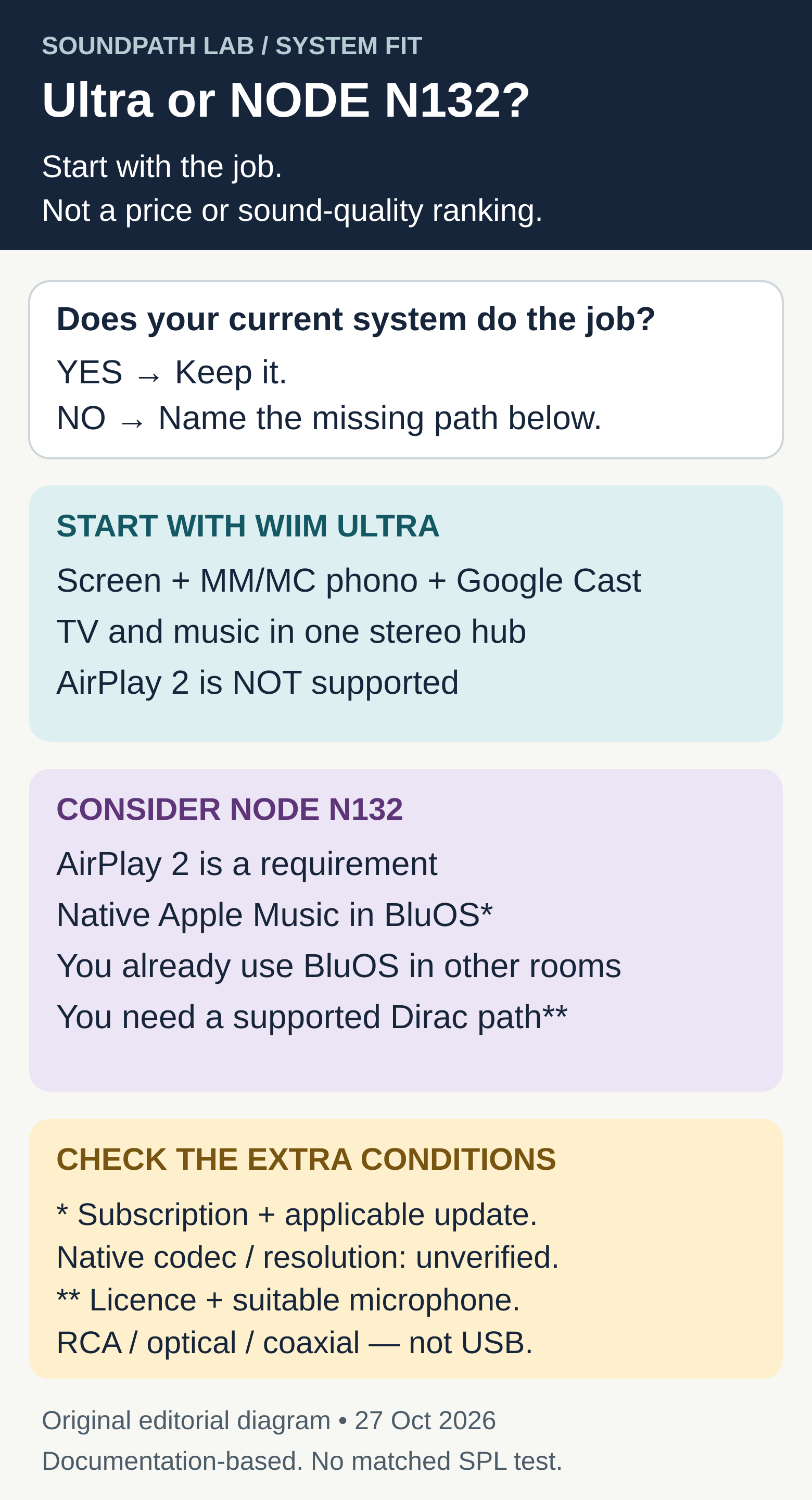
Compare the job, not the specification count
| Requirement | WiiM Ultra | Bluesound NODE N132 |
|---|---|---|
| Television input | HDMI ARC | HDMI eARC |
| Turntable without a phono stage | Built-in MM/MC phono input | External phono stage required |
| On-device display | 3.5-inch touchscreen | Touch controls; no album-art screen |
| AirPlay 2 receiver | Not supported | Supported |
| Apple Music inside the platform | Not natively integrated | Native BluOS integration announced 20 October 2026 |
| Google Cast / DLNA | Documented | Do not assume Cast; BluOS explicitly excludes UPnP/DLNA |
| External-DAC outputs | Optical, coaxial, USB | Optical, coaxial, USB |
| Room correction | RoomFit; setup-dependent | Optional paid Dirac Live; supported paths only |
| USB audio direction | Output, not computer-DAC input | Output to a compatible USB DAC |
| Direct passive-speaker drive | No | No |
| Evidence in this comparison | Dated, scoped SPL functional session | Documentation review; no SPL hands-on test |
Hardware rows are drawn from the Ultra setup guide, Ultra input guide, NODE specifications, WiiM AirPlay list and BluOS's UPnP/DLNA policy. “Not established” is different from “unsupported”; Google Assistant compatibility, for example, is not proof of Google Cast reception.
What does the price premium actually buy?
Price example, not a live quote: if your local offers are US$349 for Ultra and US$749 for NODE N132, the hardware premium is US$400. That arithmetic does not establish today's official US price, a promotion or the total at checkout. Confirm the exact model, currency, seller, tax and delivery before comparing; add any required Dirac licence and calibration equipment separately. The actual difference is market- and offer-dependent.
Do not compare the two boxes in isolation. Compare the cost of reaching your desired system:
Complete cost = streamer + missing adapters or source hardware + required software licences + calibration equipment + any amplifier or DAC you still need.
That is a planning formula, not an estimate of what every buyer will spend. A turntable owner might avoid a separate phono stage with Ultra. A NODE buyer intending to use Dirac must add the relevant licence and a suitable microphone unless already owned. Neither product powers passive speakers. An external DAC is optional for an analogue-output system, but essential if your chosen path depends on it.
A premium can also buy continuity. If the rest of the house already uses BluOS, staying in the same control environment may matter more than adding a touchscreen in one room. Conversely, if all listening happens through one supported service's own app and there is no multiroom requirement, an ecosystem premium may do little for you. These are workflow judgments; we have not measured a time-saving advantage for either platform.
Apple Music changes the comparison
An older comparison that says Apple Music reaches NODE only through AirPlay is now out of date. BluOS announced native Apple Music integration on 20 October 2026: a compatible player retrieves the music directly, while the phone or tablet controls playback. An active Apple Music subscription and the applicable update are required. Confirm the feature is available on your player and account before buying. BluOS announcement.
That announcement does not specify the native stream's codec, bitrate or maximum resolution. We therefore do not label native BluOS Apple Music as lossless, hi-res or bit-perfect here. AirPlay documentation cannot fill that separate evidence gap.
WiiM's current support page says Apple Music is not natively integrated into WiiM Home. Ultra also lacks AirPlay 2. WiiM documents Google Cast from Android or a Chrome-browser route, Bluetooth and wired alternatives; these are not interchangeable with native integration. In particular, the Apple Music iOS app does not offer Google Cast, so “I use an iPhone” is an important setup condition, not a minor footnote. WiiM service status; documented Apple Music routes; sender limitation.
When NODE is worth considering: Apple Music is your main service and you want it in the player's control environment, or AirPlay reception is a non-negotiable household requirement. If another existing device already supplies the desired route satisfactorily, neither fact makes replacing it necessary.
TV, vinyl and everyday control: where Ultra can be enough
For a stereo system that needs streaming, a television input and a turntable connection, Ultra can remove useful boxes rather than merely add a newer one. Its phono input supports MM and MC settings; select the setting for the cartridge. A turntable with its own enabled phono stage belongs on line input instead. That is a connection capability, not a claim that the internal phono stage outperforms an external one. WiiM's turntable instructions.
NODE has HDMI eARC rather than Ultra's ARC, but the newer interface label alone is not a reason to pay more for a two-channel system. Before choosing, check the television's output format, volume control and wake/sleep sequence with the intended streamer and downstream equipment. Neither product should be treated as a full surround receiver just because it has HDMI. WiiM's input guide excludes Dolby Atmos and DTS; format handling must be checked separately from the number of speakers in a wider system. Ultra input formats.
The display is a preference with practical consequences: Ultra is the candidate if visible track information or local screen control matters at the equipment rack. Do not mistake a display for a guarantee that every service, library and setup task can be completed without a phone.
For either device, decide which component owns the master volume before connecting powered speakers or a power amplifier. Begin at a low level and confirm mute, input switching and restart behavior. An already-working amplifier with the right inputs may make either streamer's extra control functions redundant.
RoomFit versus Dirac: follow the signal to the output
WiiM documents RoomFit as a measurement-and-correction workflow and recommends an external microphone for more accurate measurements. It does not list a separate RoomFit licence charge in the inspected guide. “Included software” does not mean every phone microphone, room or measurement attempt will give the same result. RoomFit guide.
NODE N132 is eligible for Dirac Live with a purchased licence and suitable calibration microphone. Bluesound's instructions require current firmware and document RCA, coaxial and optical paths, but not USB DAC output. Check the exact licence package and local price; do not assume a different Bluesound or NAD model's entitlements apply to N132. Bluesound calibration guide.
This creates a decisive buying condition. If your DAC must be connected by USB, paying for NODE specifically to obtain Dirac in that chain does not meet the documented requirement. If the DAC accepts a supported coaxial or optical path, the proposed system is different and worth checking. If you will use NODE's analogue output, external-DAC limitations may not concern you.
For Ultra, do not turn the RoomFit guide's statement about coverage across inputs into an unqualified promise about every output configuration. The full current RoomFit-to-USB processing path remains unverified in this comparison. WiiM separately documents simultaneous USB and subwoofer output in firmware 5.2.704152; that does not by itself settle all correction and output combinations. Ultra firmware history.
Dirac’s exact N132 listing marks Bass Control and ART as unsupported; do not count those features in its value proposition. Existing NODE N130 owners should also check before replacing hardware: Bluesound’s current eligibility list includes N130, so obtaining Dirac is not automatically a reason to upgrade to N132. N132 licence scope; eligible hardware.
We have not measured either correction system in the same room. A defensible comparison would preserve speaker position, microphone placement, target curve, playback level and output path, then compare both corrected and uncorrected results. No acoustic winner is declared here.
Already own a good DAC? The transport rules matter more
Both players offer digital outputs, but “USB” needs a direction. Ultra sends USB audio to an external DAC; it is not a USB audio input for turning the Ultra into a computer DAC. WiiM's guide also asks owners to check the DAC's power needs and use a powered hub when necessary. Ultra USB limitation; USB setup.
On supported NODE models including N132, enabling USB output disables the analogue, coaxial and optical outputs; connecting headphones takes precedence over USB. Do not draw a system diagram that requires those outputs to remain active together without checking the actual operating mode. Bluesound USB-output guide.
DSD is another common trap. WiiM describes conversion to PCM up to 192 kHz. BluOS's current guide includes N132 in its real-time DSD-to-PCM workflow, with PCM on the digital outputs and no DoP support. That is DSD-file playback, not native DSD transport. WiiM DSD guide; BluOS DSD guide.
If an external DAC does the conversion, do not pay for an internal DAC upgrade you will bypass. Compare the supported service, output, volume behavior, correction requirements and recovery in your real chain instead. We have not demonstrated an audible transport advantage for either product.
Multiroom and local libraries: buy the workflow you need
Existing BluOS equipment is a concrete reason to consider NODE. BluOS documents grouping through mobile and desktop controllers. When sharing an external input, the player physically receiving it must be primary; the source and hardware combination still matters. BluOS grouping instructions.
Ultra can distribute its physical inputs within WiiM multiroom. That does not make every WiiM, AirPlay, Google Cast and BluOS device one interchangeable synchronized group. Choose the actual grouping method before assuming that a turntable or television will play throughout a mixed-brand home. WiiM input-sharing guide.
For a local collection, bring a representative library to a demonstration: compilations, multi-disc albums, unusual tags, long filenames and newly added files. Test search, indexing and rescanning rather than accepting “NAS support” as a usability verdict. BluOS explicitly does not support UPnP/DLNA, so an existing DLNA-only workflow needs particular attention. WiiM's desktop app is labelled beta; the existence of a desktop download does not establish mobile-feature parity. BluOS library-policy boundary; WiiM PC beta notes.
What SoundPath Lab actually tested
Rojas tested one Ultra on 3 October 2026, using firmware 5.2.829661, WiiM Home 3.6.10.092711 and a TP-LINK TL-WDR5620 on 2.4 GHz Wi-Fi. The session recorded uninterrupted Google Cast playback for 30 minutes and a 30-minute Ultra/WiiM Amp group without a reported group drop; synchronization was assessed by ear, not instrument.
It also recorded one TIDAL Connect interruption in 60 minutes: the phone played while Ultra was silent, and advancing to the next track restored playback. The count was corrected and confirmed on 7 October. Cause and repeatability remain unknown. A separate DLNA phone-reconnection anomaly is retained in the record. Dated source record.
The session does not supply calibrated analogue measurements, loaded headphone measurements, a RoomFit accuracy test, complete USB/phono verification, or long-term reliability evidence. Its L3 status applies only to that documented scope. Ultra product record.
There is no matched NODE session here. It would be unfair to interpret Ultra's visible issue record as proof that an untested NODE is more reliable—or to use Ultra's successful checks as proof that it is universally more reliable. We make no comparative failure-rate, return-rate or sound-quality claim.
Three purchase decisions—and one reason not to upgrade
A first streamer for a TV-and-vinyl stereo: Ultra is the more relevant starting point if you will use its phono input or display and its service routes fit the household. Check the full chain; extra sockets do not prove tested compatibility.
An Apple-focused or established BluOS household: NODE N132 is a candidate when AirPlay reception, native Apple Music or keeping rooms in BluOS removes a daily inconvenience. Verify your account, update and intended grouping route before committing.
A system being built around Dirac: Price the licence and microphone, then choose a supported output. Do not purchase a USB-only DAC chain on the assumption that NODE will provide Dirac through USB.
An owner whose present setup already works: Keep it. Moving sideways for a screen, chipset or unused feature creates cost and setup work without an established benefit. Upgrade when you can complete the sentence: “My current system cannot do ___, and this documented connection solves it.”
Checks to make during the return window
Use your own phone, service, television, DAC and network. Record the exact model and software versions. At moderate volume, check discovery after sleep, cold start, router restart, input switching, mute, volume retention and the intended digital output. If multiroom matters, check every required room and recovery after an interruption—not merely whether the players appear in an app. For calibration, follow the manufacturer's level and microphone instructions; do not improvise maximum-volume tests.
Retain successes, failed attempts and unresolved conditions. Send reproducible observations to the existing Issues & Limitations record, and check the Firmware & App Tracker and Compatibility reference. A manufacturer fix claim is not an independently verified fix.
Evidence and update note
Official documents support the specified capabilities and restrictions; SPL's dated Ultra session supports only its recorded observations. The scenario recommendations are editorial inference. No third-party listening opinion is converted into an SPL result, and no new issue-evidence grade, product-maturity promotion or resolved issue is created by this comparison. The site's existing disclosure policy remains applicable.
27 October 2026: documentation-based comparison prepared with the 20 October native Apple Music announcement included. Original Ultra test dates and conditions are unchanged. Recheck regional prices, delivered features and account availability at purchase.
Continue the research
Move from this article to a verified product decision
Use descriptive links to move between product records, brand evidence, comparisons, setup or issue guidance, and compatible-system tools. Inclusion reflects subject relevance, not a score or endorsement; product facts, recommendation eligibility, and commercial links remain separate.
Product page
Verify the exact model
Brand center
Check the wider platform
Related comparison
Compare the system role
Setup, firmware & problems
Check behavior before buying
System Builder & compatibility