Sony WH-1000XM6 vs Bose QuietComfort Ultra (2nd Gen) vs Sennheiser Momentum 5 Wireless
A source-based comparison of the exact headphone generations: ANC evidence, USB and phone paths, battery-rating conditions, fit and repair questions—without a fabricated SPL test winner.
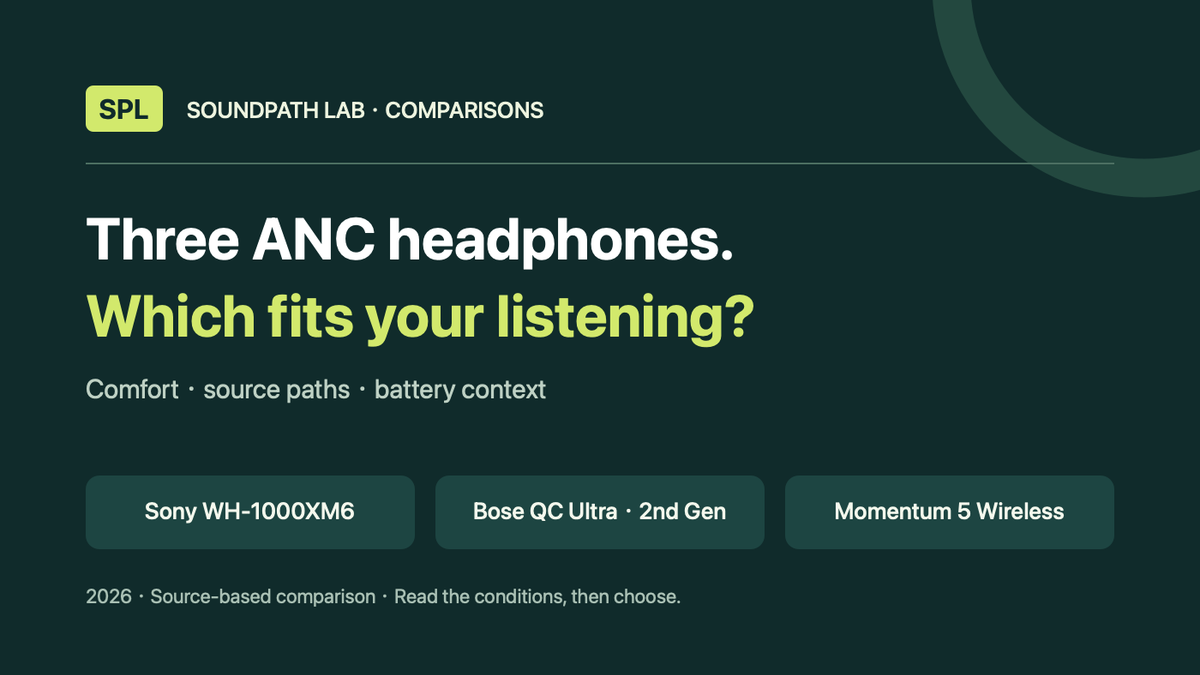
Three premium ANC headphones. Start with your connection, your noise and your fit—not a winner’s podium.
Evidence scope: This is a source-based Comparative Analysis. SoundPath Lab has not hands-on tested these three models. Manufacturer specifications, named independent tests and our editorial buying judgments are distinguished below. There are no SPL listening impressions, numerical scores or failure-rate estimates. This follows our review methodology.
The most useful differences are not all on the front of the box. Sony’s WH-1000XM6 supports LDAC and LC3, but its USB socket is not a digital audio input. Bose’s second-generation QuietComfort Ultra adds USB listening, but it is not the only USB-audio headphone here: Momentum 5 also supports it. Sennheiser’s replaceable battery changes the ownership question, but does not guarantee years of trouble-free service. Those distinctions matter more than declaring a universal champion.
The short answer
These are editorial shortlists, not SPL test verdicts:
- Start with Sony if calls, commuting and a folding design lead your checklist. Its documented connection options and independent test evidence make it a sensible candidate. Do not choose it for direct USB music playback.
- Start with Bose if long-session comfort and wired digital listening are priorities. Try it with your own glasses and watch whether its movie processing suits you; neither comfort nor dialogue preference is universal.
- Start with Momentum 5 if charging intervals and a documented battery-replacement route matter most. USB audio is another reason to consider it. Check local replacement-part availability rather than assuming a replaceable design means parts are always in stock.
- Keep your existing headphones if they already solve your problem. A new codec, more microphones or a newer generation is not itself a reason to spend again.
The differences that change a purchase
The table contains manufacturer-documented capabilities, not matched performance measurements. Price evidence was checked on 27 October 2026 in the U.S.; the price types are deliberately not mixed.
| Decision | Sony WH-1000XM6 | Bose QC Ultra Headphones (2nd Gen) | Sennheiser Momentum 5 Wireless |
|---|---|---|---|
| Price evidence | $449.99 launch MSRP; current shop price not confirmed | $449 displayed for the checked Cherry Chocolate variant | $399.95 displayed; launch announcement said $399.99 |
| Bluetooth version | 5.3 | 5.4 | 5.4; do not count promised 6.0 as delivered |
| Relevant Bluetooth codecs | SBC, AAC, LDAC, LC3 | SBC, AAC, aptX Adaptive; advanced modes need a compatible source | SBC, AAC, aptX family including Adaptive and Lossless |
| Direct USB audio | No | Yes | Yes |
| Analog cable listening | Yes | Yes | Yes; see power-state caveat below |
| Manufacturer battery headline | Up to 30 h with ANC | Up to 30 h Quiet; 23 h Immersive | Up to 57 h with ANC |
| Approximate weight | 254 g | 264 g | 290 g |
| Ownership distinction | Folding design | USB playback and Cinema Mode | User-replaceable battery |
Sources: Sony specifications, Sony U.S. launch, Bose U.S. product page, Bose announcement, Sennheiser U.S. product page and Sennheiser U.S. announcement.
Before checkout, compare the actual delivered prices for the correct generation, color, warranty and return terms. The table is not a live offer and a launch MSRP is not today’s street price.
1. Get the source-to-headphone path right
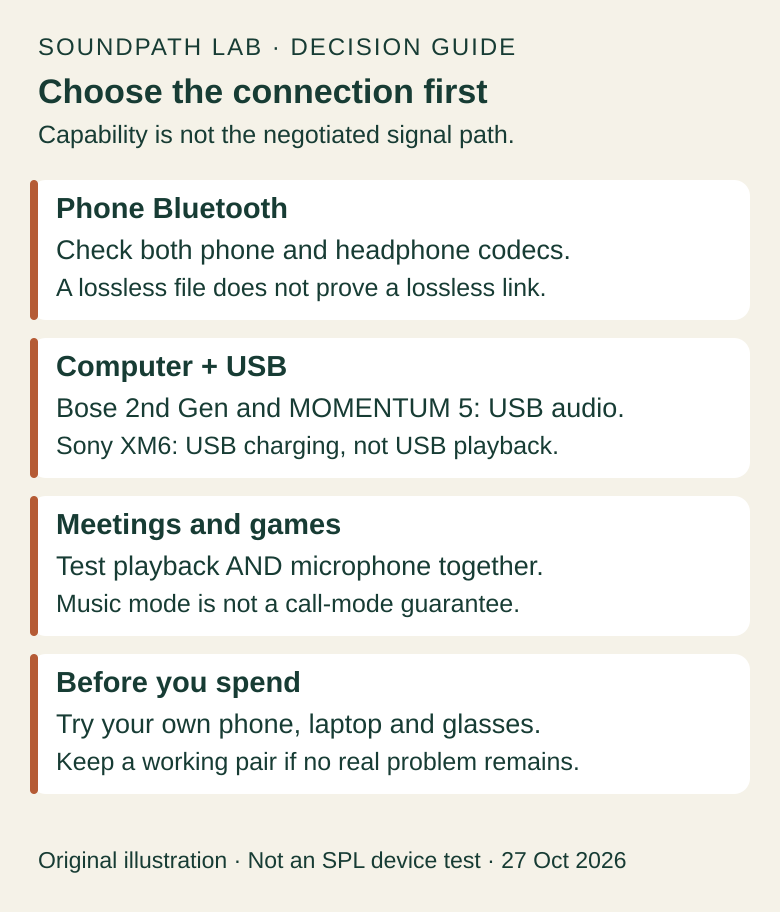
A lossless badge in an app is only the beginning
The streaming file, phone output, Bluetooth codec and headphone processing are different stages. Selecting a lossless file does not establish a lossless Bluetooth connection. Apple documents wired routes for lossless playback on iPhone and iPad; do not treat an Apple Music badge as confirmation of what reaches these headphones. Apple’s playback requirements.
For ordinary direct iPhone Bluetooth use, these models’ AAC support is relevant; paying specifically for LDAC or aptX does not make an iPhone’s built-in Bluetooth acquire those codecs. An external transmitter is a different signal path and must be assessed separately, including its connector, power requirements and microphone behavior.
On Android, check the exact phone rather than the word “Android.” A receiver’s LDAC, LC3 or aptX entry is useful only if the source and selected connection mode support it. Multipoint, call mode and quality settings should be checked on the intended combination, not assumed from a logo.
On Windows, a headphone codec list is likewise not a laptop capability list. Hardware, drivers and the Windows version matter. Microsoft specifically warns that Bluetooth LE support alone does not establish LE Audio support. Its documented check is more useful than guessing from the Bluetooth version number. Microsoft’s compatibility checklist.
USB changes this comparison
Bose documents USB playback at 16-bit/44.1 or 48 kHz. Momentum 5’s official support page documents up to 24-bit/96 kHz for playback-only USB use, with a warning that using its microphone can change the available format. Its manual explicitly describes USB playback and recording on a computer or mobile device. This is a genuine distinction—not a conclusion inferred from a USB cable in the box. Bose product documentation, Sennheiser connection FAQ.
Sony offers analog wired listening instead; SoundGuys explicitly confirms that the XM6’s USB-C connection does not carry audio. SoundGuys XM6 review.
Buying implication: for a laptop-first buyer, Bose and Sennheiser deserve attention before codec shopping. But a higher accepted USB sample rate does not prove better audible sound. Test your meeting app with playback and microphone active together. Check whether your phone needs an adapter and whether a cable is practical on your commute.
Momentum 5 analog caveat: its current support FAQ says it must be powered on for analog use, whereas the manual’s audio-cable section mentions an empty battery as a reason for wired use. We have not resolved that documentation conflict on hardware. Do not buy it on the assumption that it will work passively after the battery dies.
2. ANC: use independent evidence without manufacturing a league table
Low rumble, nearby speech and higher-frequency noise are not one test. Neither a percentage reduction nor an overall score tells the complete story, and numbers from different laboratories cannot be arranged as if they used an identical fixture and method.
There are model-specific independent tests for both Bose’s second generation and Momentum 5. RTINGS published its Momentum 5 review on 31 July 2026 and updated it on 22 October. Its publicly readable comparisons favor Sony and Bose for isolation over Momentum 5, while noting Sennheiser’s battery and USB advantages. Detailed numerical results are member-restricted; we have not reconstructed them or treated placeholder scores as real measurements. RTINGS Momentum 5 review.
TechGearLab’s Bose second-generation test reports 32.3 dB average attenuation in its method. That is a named lab result—not a guaranteed reduction in your cabin, nor enough by itself to declare a tie with Sony. Its Sony page separates low-, mid- and high-frequency results, illustrating why a broad “best at voices” claim needs more care than a single headline. TechGearLab Bose test, TechGearLab Sony test.
Sennheiser’s claimed improvement over Momentum 4 is a manufacturer comparison, not proof that Momentum 5 beats these rivals. We do not convert that claim into a cross-brand ranking.
A practical audition: identify your actual troublesome noise, check the seal at a comfortable listening level and compare the same scene. Do not turn up music to mask a poor fit. If an office conversation is the problem, an engine-rumble demonstration is not a substitute.
3. Comfort and calls: shortlist, then verify your own fit
TechGearLab’s Bose tester reported wearing the headphones for more than ten hours without needing a break; its comparison table records seven comfortable-listening hours for Sony. Those are useful attributed experiences, not probability estimates for glasses wearers or a promise that your head will tolerate the same duration. The shape and seal deserve a trial, not an invented universal comfort score. Bose test, Sony test.
RTINGS also reports that Momentum 5’s sound can vary with seating and an interrupted seal, including glasses. That supports a simple buying rule: wear your usual glasses during the trial and readjust before deciding that an unfamiliar sound is the product’s fixed character. RTINGS.
For calls, more microphones are not an outcome measurement. Your voice, background noise, phone processing and conferencing application all participate. Use a short call on your real equipment, ask the other person about intelligibility, and check whether switching between laptop and phone behaves as you expect. A clear music connection is not evidence of a clear microphone connection.
There is no SPL tonal winner here. EQ can help tailor a preference, but cannot promise a good fit or solve every isolation limitation. Likewise, Cinema Mode’s existence is documented; whether its processing improves a particular film for you is a preference to try, not a verified universal advantage.
4. Battery life: separate ratings, tests and ownership
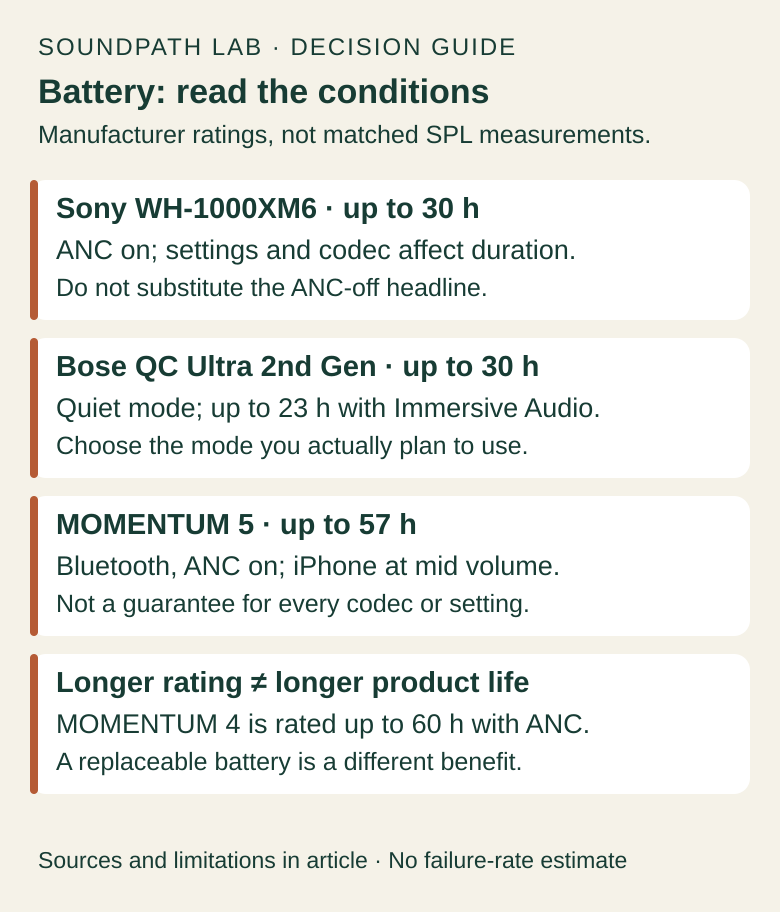
Bose’s manual distinguishes 30 hours with ANC on and Immersive Audio off from 23 hours with both on. Its 15-minute quick-charge claim is up to three hours in the former mode. Use the mode relevant to your trip. Bose manual, battery section.
Momentum 5’s manual specifies its 57-hour claim as Bluetooth playback, ANC active, an iPhone and a middle volume setting. It also says about seven hours from ten minutes’ charging. The current FAQ instead says approximately ten hours from ten minutes: the official sources conflict, so this article does not present a single settled quick-charge promise. Momentum 5 manual, pages 14 and 43, support FAQ.
For independent context, SoundGuys reports 37 h 14 min for Sony and 27 h 12 min for Bose. We verified those numbers in the original reviews, but did not fully establish a matched codec, level and processing configuration for this comparison. They are not a controlled SPL head-to-head, nor evidence that one brand overstates its rating. Sony original test, Bose original test.
Momentum 5 has the longest manufacturer-rated ANC runtime of this trio. That does not make it a battery-life upgrade over Momentum 4, which Sennheiser still rates at up to 60 hours with ANC. Nor does 57 hours justify a promise of months without charging. Your daily hours and settings decide the interval.
5. The replaceable battery is useful—but check the whole repair route
Momentum 5 has a documented user-replacement procedure for its BA 500 battery. Sennheiser identifies the required screwdriver and warns about incompatible cells and cable damage. Follow the official procedure rather than an improvised replacement tutorial. Official replacement guide.
A support notice updated on 21 October says replacement with official parts does not affect warranty coverage on the rest of the headphones. That is a manufacturer policy statement, not an SPL-completed repair. Warranty guidance.
Before buying for longevity, check four things locally: the approved part, whether it can actually be ordered, its delivered cost and what happens if a different component fails. Replaceability and available repair are related but different. We have not verified a five-year service life, future parts inventory or a lower failure rate for any of these headphones.
Do not interpret a lack of an IP rating as a measured sweat-damage rate. Follow each maker’s handling guidance; these specifications do not establish suitability for wet-weather or sweaty exercise.
6. Should existing owners upgrade?
- XM5 owners: ask whether the XM6’s folding design or another verified feature solves a recurring problem. If comfort and calls already work, novelty alone is a weak reason.
- First-generation QC Ultra owners: USB audio and the newer feature set can change a desktop workflow. Confirm that the listing really is the second-generation headphone, not earbuds or the original Ultra.
- Momentum 4 owners: the repair route and other new features may matter, but longer rated runtime is not the upgrade case. Do not replace a healthy pair just because the number on the box increased.
- Owners of an older or cheaper pair: first name the limitation—fit, battery, intelligibility or connection. If none of these three specifically fixes it, keep looking or keep what you have.
Momentum 4 remains worth checking as an alternative, but we do not carry forward an unverified $290 “clearance” claim or pronounce a universal best value. Compare current regional offers and warranty terms at the time you buy.
Firmware and the next revision
Sennheiser’s current material documents Dolby Atmos features, while its announcement described a firmware requirement for immersive audio and head tracking. Bluetooth 6.0 remains described as a later upgrade in the checked support material. We have not verified an installed build that completes that upgrade; it is not counted as available here.
Before purchase, check exact model support and current release notes. After an update, a manufacturer’s fix statement is not an independent retest. Use the existing Firmware & App Tracker, Product Issues and Compatibility resources where relevant. Their existence does not mean all three headphones already have a verified SPL firmware record.
This comparison should change when a documented connection mode changes, the unresolved Sennheiser documentation conflicts are clarified, repair-part access changes or directly comparable independent evidence materially alters the advice. A coupon alone does not create a better fit.
Bottom line
Choose the path before the badge: Sony for a shortlist centered on wireless use and calls; Bose for a shortlist centered on fit and USB use; Momentum 5 for a shortlist centered on long rated runtime, USB flexibility and battery replacement. These are starting points for an informed trial, not guarantees or brand awards.
Tell us the exact model, phone or computer, connection, firmware and what changed your decision. Include whether you kept your existing pair. A decision not to upgrade is a useful result too.
Source check: 27 October 2026. Original information graphics replace unlicensed retail-photo placeholders. No product photography, independent measurement plot or hands-on test is implied by those graphics.
Continue the research
Move from this article to a verified product decision
Use descriptive links to move between product records, brand evidence, comparisons, setup or issue guidance, and compatible-system tools. Inclusion reflects subject relevance, not a score or endorsement; product facts, recommendation eligibility, and commercial links remain separate.
Product page
Verify the exact model
Brand center
Check the wider platform
Related comparison
Compare the system role
Setup, firmware & problems
Check behavior before buying
System Builder & compatibility