Fosi S3 vs WiiM Pro Plus: Which $250 Streamer Should You Buy?
At $259.99 and $249, Fosi S3 and WiiM Pro Plus now compete directly. Compare XLR, HDMI eARC, Roon, apps, DSP, measurements and limitations.
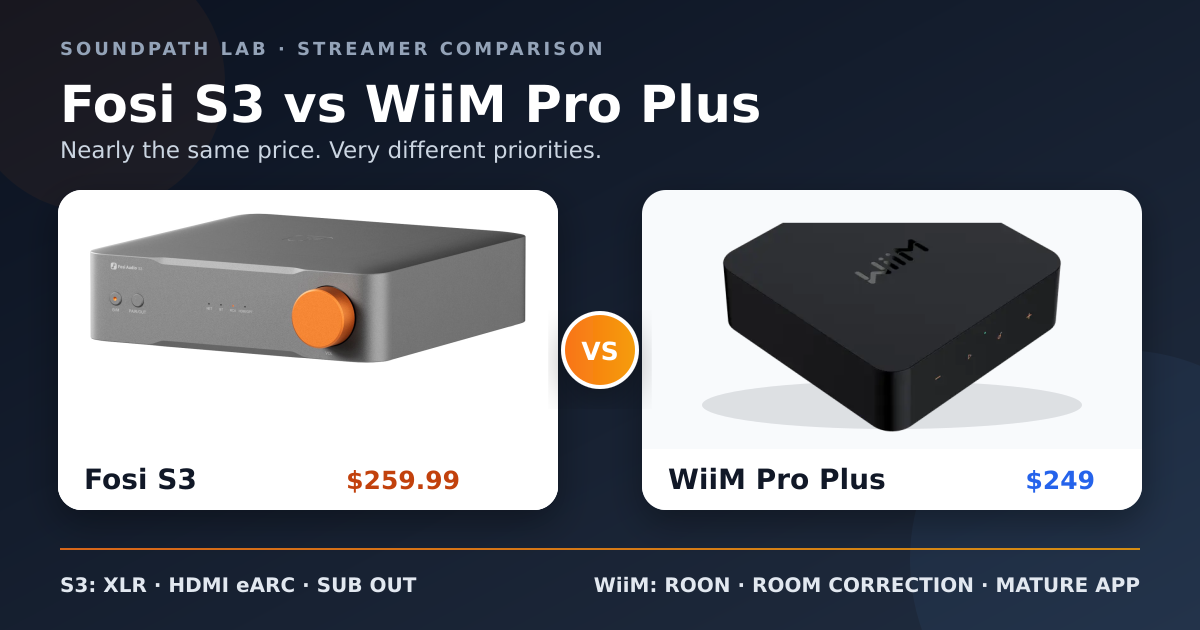
At $259.99 for the Fosi S3 and $249 for the WiiM Pro Plus, these two network streamers now compete at effectively the same price. The old argument that WiiM was the substantially cheaper option no longer applies. Promotions can still reverse which one costs less on a given day, but at normal current pricing the decision should be based on system fit—not an $11 difference.
The short answer is straightforward: WiiM Pro Plus is the safer all-round recommendation for most listeners. Fosi S3 is the more specialized choice for systems that genuinely need XLR balanced output, HDMI eARC or a wired subwoofer output.
Editorial status: evidence-based product comparison using manufacturer specifications, current software documentation, independent measurements and documented owner reports. SoundPath Lab has not performed a controlled hands-on A/B listening test of these two units.
Quick decision
- Choose WiiM Pro Plus for its documented app workflow, room correction, mature EQ, better-documented analogue input, multi-room features and long-term software confidence.
- Choose Fosi S3 for 4Vrms XLR output, HDMI eARC, a physical subwoofer output and a larger rotary volume control.
- Neither is ideal if you need USB audio, USB-drive playback, a headphone output, a phono stage or complete wired 2.1 bass management.
Specifications and feature comparison
| Feature | Fosi S3 | WiiM Pro Plus |
|---|---|---|
| Current U.S. price reference | $259.99 direct from Fosi | $249 current retail |
| DAC | AKM AK4493SEQ | AKM AK4493SEQ |
| Main analogue output | RCA 2Vrms; XLR 4Vrms | RCA approximately 2Vrms |
| Analogue input | RCA; digitized internally at 48kHz in independent testing | RCA; TI PCM1861 ADC, up to 24-bit/192kHz |
| Digital input | Optical; HDMI eARC | Optical |
| Digital output | Optical | Optical and coaxial |
| Wired subwoofer output | Yes | No |
| 12V trigger output | Yes | Yes |
| USB audio or storage | No | No; USB-C is power only |
| Headphone output / phono stage | No / No | No / No |
| Ethernet | 10/100Mbps | 10/100Mbps |
| Wi-Fi | Wi-Fi 6, dual band | Wi-Fi 5, dual band |
| Bluetooth | 5.3, SBC/AAC documented | 5.0, SBC/AAC input and output |
| AirPlay 2 / Google Cast | Yes / Yes | Yes / Yes |
| Spotify / TIDAL / Qobuz Connect | Spotify and TIDAL documented; Qobuz added through the app roadmap, but Fosi documentation remains inconsistent | Yes; mature implementation and documentation |
| Roon | Roon Ready certified; Roon confirmed S3 in its September 2026 roundup | Roon Ready certified |
| EQ and room tools | Graphic EQ, with features varying by app/firmware; no room correction or PEQ documented | 10-band GEQ, 10-band PEQ, per-source EQ and Room Correction |
| Display | No | No |
| Main control | Rotary knob, Bluetooth remote, Fosi Audio app | Capacitive controls, WiiM Voice Remote, WiiM Home app |
| Dimensions | 173 × 173 × 47mm | 140 × 140 × 42mm |
Price references checked on 16 August 2026: Fosi S3 official store, WiiM Pro Plus at EMiUZEK (Listing unavailable) and WiiM Pro Plus at Crutchfield. WiiM's own comparison page still contains an older $219 figure, so live retailer pricing is the more useful current reference.
The same DAC chip does not make them the same product
Both devices use the AKM AK4493SEQ, but a DAC chip is only one part of a streamer. Output stage, power supply, clocking, gain structure, analogue-to-digital conversion and software all influence the finished product.
The S3 has an objective hardware strength: its balanced output reaches 4Vrms. SoundStage's APx555 lab test measured 120.6dB A-weighted SNR, 114.2dB SINAD and below 0.00019% THD+N through XLR. Those are excellent results for a $260 streamer. The same testing found that XLR provided 6dB more gain than RCA, but no appreciable THD+N advantage under the test conditions. See the full S3 measurements.
That distinction matters. XLR is valuable when feeding active studio monitors, a balanced power amplifier or a system with long cable runs and potential ground-noise problems. It should not automatically be described as producing a wider soundstage or audibly better fidelity in an ordinary short-cable home system.
WiiM documents approximately 120–121dB SNR and -110 to -113dB THD+N, depending on the specification page and test condition. Independent measurements have also shown excellent results. The practical conclusion is not that one has a night-and-day sonic advantage: both analogue outputs are capable of transparent performance in a normal system. Choose S3 for the balanced interface, not because the shared AKM chip guarantees a different sound signature.
Analogue input: WiiM has the more convincing implementation
The line input is easy to overlook, but it matters if you plan to connect a CD player, tuner, cassette deck or turntable through a phono preamp and redistribute that source to other rooms.
WiiM Pro Plus uses a TI Burr-Brown PCM1861 ADC and documents conversion up to 24-bit/192kHz. It can send its physical line or optical input to compatible WiiM devices in a multi-room group.
Independent testing found that the Fosi S3 converts its RCA input at 48kHz and begins clipping at approximately 2.28Vrms. That is adequate for ordinary line-level sources, but it is less ambitious and less flexible than the WiiM input path. The S3 is at its strongest as a digital streamer and DAC; it is not the better choice if high-quality analogue-source conversion is central to the system.
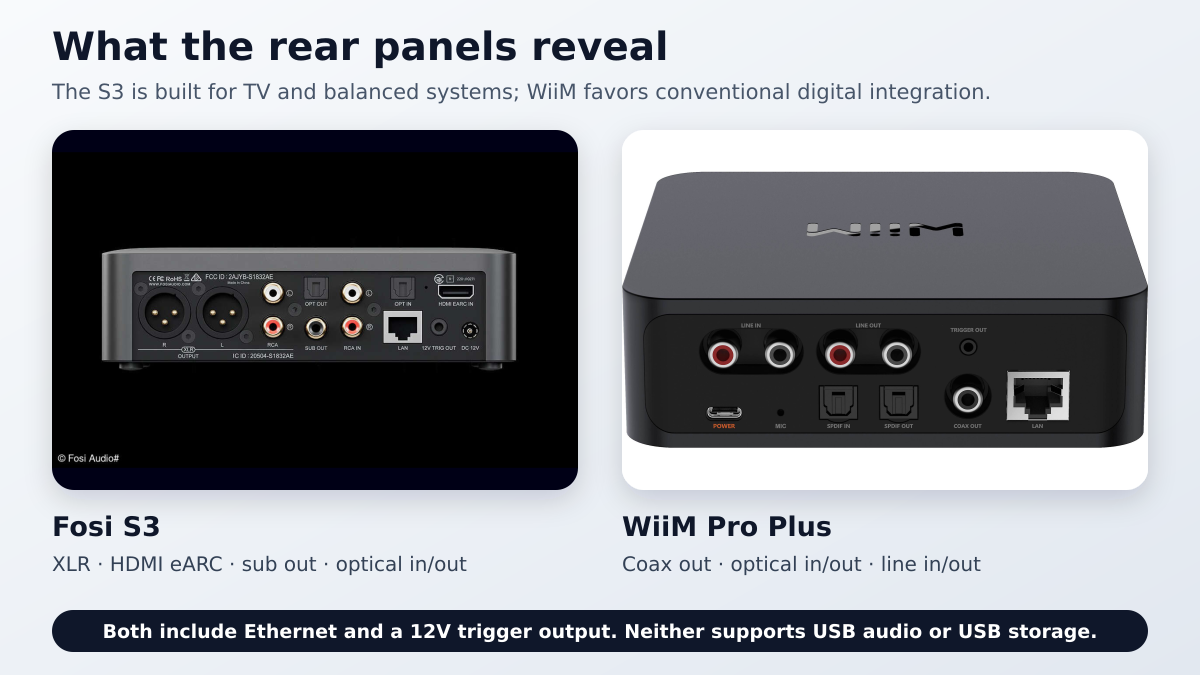
Connections: S3 wins for TV and balanced systems; WiiM is the better digital transport
The rear panels show the products' different priorities.
Fosi provides HDMI eARC, XLR, RCA, optical input and output, subwoofer output, Ethernet and a 12V trigger. It can sit between a television, active speakers or power amplifier and a subwoofer with fewer adapters.
WiiM provides RCA line input and output, optical input and output, coaxial output, Ethernet and a 12V trigger. It lacks HDMI, XLR and wired subwoofer output, but the extra coaxial output makes it more flexible as a transport for an external DAC.
Both omit USB audio, USB storage and headphones. On the WiiM, the USB-C socket is strictly for power. Fosi's own FAQ mentions “coaxial” and “USB” when discussing possible sampling rates, but the S3 chassis has neither input. That is a documentation error, not a hidden feature.
TV use
S3 is the clear hardware winner for television audio. HDMI eARC and CEC allow TV audio and volume control over one cable. WiiM Pro Plus must use optical input, and the TV must output stereo PCM rather than Dolby or DTS.
The qualification is automation. A recent S3 owner reported that the unit could switch from HDMI to TIDAL Connect or AirPlay automatically, but did not switch back to HDMI after network playback stopped. Fosi's own product manager has acknowledged that its current Wi-Fi input priority can prevent automatic return to HDMI and said the behavior was being discussed with R&D. See the current S3 development discussion and the 90-day owner report.
So the S3 has the better TV connection, but not yet the most polished TV workflow.
Software is where WiiM earns the recommendation
A streamer is a software product that happens to contain audio hardware. On that criterion, WiiM Pro Plus has the decisive advantage.
WiiM Home supports a broad service catalogue, NAS and local-network playback, input redistribution, presets, routines and multi-room control. The Pro Plus currently offers 10-band graphic EQ, 10-band parametric EQ, per-source EQ and Room Correction. Current firmware also integrates Room Correction with EQ and continues to receive stability improvements. WiiM's official firmware history documents the pace and scope of those updates.
The Pro Plus is formally Roon Ready certified. The Fosi S3 is now certified too, as confirmed by Roon’s September roundup published 1 October 2026. Roon certification no longer distinguishes this pair; the S3 Lite is a different model.
The Fosi Audio app handles setup, source selection, playback and EQ. Its redesigned interface has already been released; it is no longer accurate to describe the redesign as merely in development. Fosi’s app statement documents the company’s improvement work, rather than proving that every current workflow is fault-free.
Software compatibility: test your own phone and playback path
The US iOS store, checked 20 October, lists 1.4.0, 17 August 2026, with interface, stability and response improvements. The Android Google Play listing, read in English with the browser’s China region, lists 1.4.2, 16 October 2026; its latest note concerns the Roon Ready icon. A separately read US-English listing also shows the 16 October date. These platform/region snapshots are not a claim of identical global rollout, nor are App versions device firmware versions.
There are still conditional owner reports. A 25 September S3 report, post #993, describes iPhone/Fosi app playback from a Synology 920+ media server freezing while seeking, stuck progress and incorrect volume display. The same discussion contains a positive report with the same NAS using MinimServer and Jplay. The Android/Cast discussion contains control and playback complaints, not proof that all Android devices fail. These are owner accounts with incomplete phone/OS/app/firmware combinations, not a measured failure rate or a universal crash finding.
Within the return window, use your own phone, OS, app and device firmware to check setup, reconnection, NAS browsing/seeking, screen locking and input switching. Record all versions and the exact steps if something fails. An app closing on the phone, a stalled controller and an on-device UPnP service restart are different symptoms and must be logged separately. A reader’s broader report of crashes on different phones remains unverified without those conditions. The whole app-store rating includes other Fosi products and cannot be used as an S3 failure percentage.
The S3’s former certification gap is closed by Roon’s own announcement. Native Roon support should be evaluated as a completed S3 feature, while software reliability still needs its own evidence. Do not apply that certification to the S3 Lite: its store wording and 7 October product-manager testing statement remain in conflict; see our S3 Lite versus WiiM Pro comparison.
The S3 subwoofer output is useful—but it is not bass management
Fosi's physical subwoofer output is a real advantage over the Pro Plus, but the implementation is incomplete for a serious 2.1 system.
SoundStage found that the sub output remains active and that the S3 currently provides no user-adjustable low-pass frequency, phase control or high-pass filter for the main outputs. The main speakers therefore continue receiving a full-range signal. Integration must be handled with the controls on the subwoofer or with external DSP. Read the independent S3 review.
WiiM Pro Plus has no wired subwoofer output at all. A subwoofer must be connected through the amplifier, speaker-level inputs, a pass-through crossover or an external device. WiiM can integrate its separate wireless Sub Pro, but that adds substantial cost and changes the comparison.
If a physical sub output is the requirement, S3 wins. If adjustable crossover, main-speaker high-pass, phase and delay are the requirement, neither unit provides a complete wired solution by itself.
Fosi's specification page needs correction
The S3 hardware is stronger than the quality of its documentation. The current official page makes several conflicting claims:
- the promotional section says PCM up to 32-bit/768kHz;
- the product description says 32-bit/384kHz;
- the specification table lists Wi-Fi at 24-bit/192kHz;
- the FAQ claims 384kHz over Wi-Fi and 768kHz over Ethernet;
- the FAQ refers generically to coaxial and USB inputs that the S3 does not have;
- Earlier Roon wording was inconsistent; Roon’s October announcement now confirms the full S3. It does not establish S3 Lite certification.
These discrepancies do not prove that the product sounds poor, but they make purchasing and troubleshooting harder. Until Fosi publishes one consistent signal-path table, buyers should treat 24-bit/192kHz as the clearly documented ceiling for the common Wi-Fi and optical paths, and use Roon’s completed full-S3 certification rather than the old unsupported conclusion.
WiiM's pages are not perfectly synchronized either—the older $219 price remains visible—but its input/output limits, app functions, firmware notes and certification status are documented far more clearly.
What each product gets wrong
Fosi S3 limitations
- Fosi Audio app remains behind WiiM Home in organization, library handling, DSP depth and automation.
- Full S3 certification is complete; exact app/firmware and service behavior still require workflow checks.
- No room correction or parametric EQ is documented.
- The subwoofer output lacks complete crossover, phase and main-channel high-pass controls.
- HDMI input priority and automatic return behavior are not fully mature.
- No coaxial or USB audio connection.
- Analogue input is digitized at 48kHz.
- No display or clear numerical volume readout.
- Official specifications contradict one another.
WiiM Pro Plus limitations
- No HDMI ARC/eARC.
- No XLR balanced output.
- No wired subwoofer output.
- No USB audio or USB-drive playback.
- No headphone output or phono stage.
- Plastic enclosure and no display.
- Bluetooth is limited to SBC/AAC rather than a higher-bitrate codec.
- Room correction is useful but still depends on the measurement device and setup procedure; it is not a substitute for good speaker placement.
Which one should you buy?
Buy Fosi S3 if:
- your active speakers or power amplifier accept XLR and you want a direct balanced connection;
- HDMI eARC is essential for the television;
- you need a physical subwoofer output and can perform crossover adjustment on the sub itself;
- you want a conventional rotary volume control;
- Spotify, TIDAL, AirPlay or Google Cast cover your normal listening, and you can verify any Qobuz requirement on the current regional firmware before buying;
- you are comfortable with a younger app platform and future firmware changes.
Buy WiiM Pro Plus if:
- you want the most complete and predictable daily experience;
- you want WiiM Home NAS playback or integration with an existing multi-room WiiM system; both models are Roon Ready;
- room correction, PEQ and per-source EQ matter;
- you plan to digitize and redistribute an analogue source;
- you use an external DAC and want both optical and coaxial outputs;
- HDMI, XLR and a wired subwoofer socket are not required.
Final verdict
At the old $219 WiiM price, Pro Plus was easier to recommend on value alone. At $249 versus $259.99, price is no longer the deciding factor—but the overall verdict does not change.
WiiM Pro Plus remains the better purchase for most people. Its analogue output is already excellent, and its software platform, room tools, input redistribution, documentation and firmware history make it the more complete ownership proposition.
Fosi S3 is the better hardware fit for a narrower but important group. If a system needs XLR, HDMI eARC and a wired subwoofer output in one compact box, WiiM Pro Plus cannot replace it. The S3's measured digital-to-analogue performance is genuinely excellent. Its weakness is not sound quality; it is the gap between capable hardware and a still-maturing software and documentation platform.
Our recommendation status:
- WiiM Pro Plus: strong default recommendation.
- Fosi S3: recommended with conditions—verify the exact streaming, TV and subwoofer workflow before the return window closes.
Buying options
WiiM Pro Plus: EMiUZEK (Listing unavailable) · Amazon · WiiM product information
Fosi S3: Fosi Audio direct · Amazon
Prices, stock and regional versions can change. Check the seller, included power supply, warranty and return policy before ordering.
Evidence and verification
Evidence basis: manufacturer product pages and firmware notes; SoundStage laboratory measurements and product review; current Fosi development statements; documented owner reports used only for behavior that is clearly identified as an owner report.
Firmware and versions reviewed: the original hardware/measurement discussion retains its August evidence scope. Software and Roon statements were revised throughout on 20 October 2026 using the dated sources above. S3 certification and the released app redesign are completed features; no new SPL listening, installation or regression test is claimed.
Software/certification last checked: 20 October 2026. Original publication and historical hardware evidence are retained.
Limitations: This is not a SoundPath Lab hands-on listening test. Measurements from different laboratories or manufacturer test conditions should not be ranked as if they were collected in one controlled comparison. Streaming services and app behavior can vary by firmware, platform and region.
Commercial disclosure: No payment or manufacturer sample determined this conclusion. Retail links are provided for availability and may be commercial links; they do not alter the product ranking or evidence status.
Images: Manufacturer product images from Fosi Audio and WiiM/Linkplay; comparison layouts by SoundPath Lab.
Related reading: Fosi S3 and ZP3 problems buyers should know · WiiM Pro Plus product profile · How SoundPath Lab scores software and firmware risk
For TV-input format boundaries beyond the feature list, see which HDMI and optical format claims are actually documented.
Historical update — 24 August 2026
- Fosi's official U.S. store still lists the S3 at $259.99 and currently advertises a 15% promotional code. The table above continues to use the normal listed price because temporary discounts can expire or vary by region.
- WiiM Pro Plus firmware 4.8.826050, dated 12 August 2026, adds Auto Headroom to reduce clipping risk and improves multi-room audio quality. This strengthens the software-support case but does not change the comparison verdict.
- At that August check, Fosi advertised Qobuz Connect setup and a 10-band EQ while Roon wording remained inconsistent. That former certification gap was subsequently closed: Roon confirmed the full S3 in its September roundup. Use the updated table and software section above for the current conclusion.
Recommendation status: unchanged. WiiM Pro Plus remains the safer default; Fosi S3 remains the conditional choice for XLR, HDMI eARC and a physical subwoofer output.
Primary sources: Fosi S3 official product page · WiiM Pro Plus firmware release notes
Last checked: 24 August 2026.
Continue the research
Move from this article to a verified product decision
Use descriptive links to move between product records, brand evidence, comparisons, setup or issue guidance, and compatible-system tools. Inclusion reflects subject relevance, not a score or endorsement; product facts, recommendation eligibility, and commercial links remain separate.
Product page
Verify the exact model
Brand center
Check the wider platform
Related comparison
Compare the system role
Setup, firmware & problems
Check behavior before buying
System Builder & compatibility