
Arylic LP20 Explained: Connections, Streaming, Multi-Room Limits, and Who It Is For
A specification-based guide to the Arylic LP20, covering inputs, outputs, streaming services, 2.1 use, multi-room compatibility, and important limits.
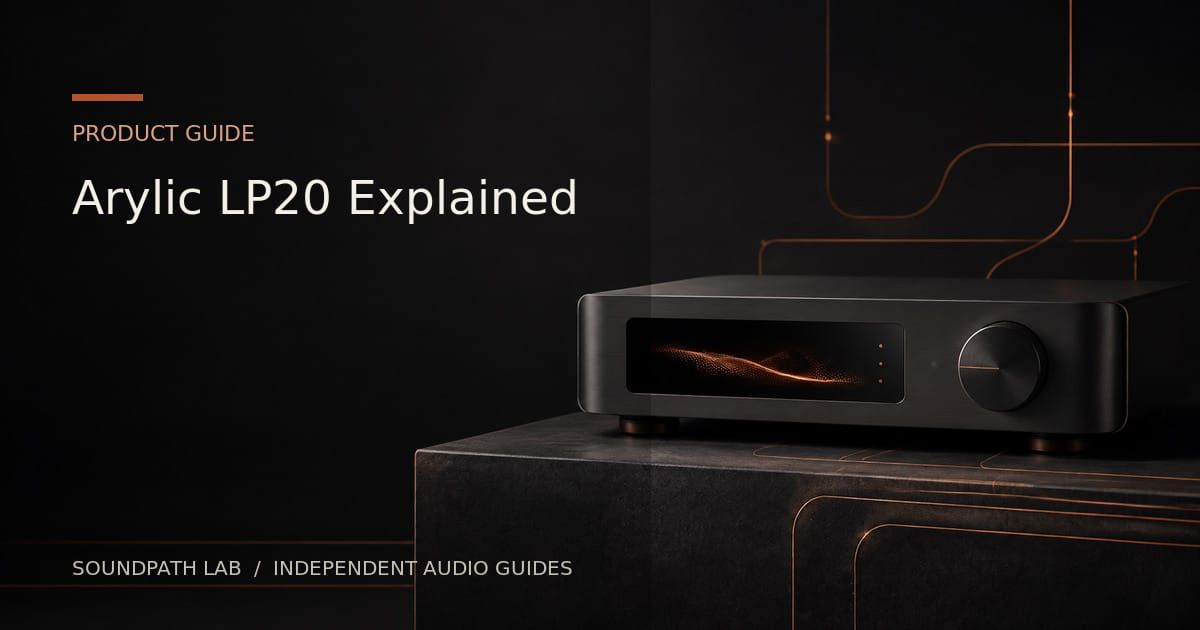
The Arylic LP20 is a network music streamer and preamplifier designed to add modern wireless playback, digital inputs, analog output, and basic 2.1 system functions to an existing amplifier or pair of powered speakers.
It sits above a simple streaming puck because it includes multiple inputs and outputs, an AKM DAC, a volume knob, remote control, subwoofer output, and 12-volt trigger. At the same time, it is not a power amplifier, an HDMI ARC hub, or a universal bridge that can retransmit every physical input through AirPlay 2 or Google Cast.
EDITOR’S NOTE
This is a specification-based product guide prepared from Arylic’s official LP20 documentation available in August 2026. SoundPath Lab has not yet completed an independent hands-on review or laboratory measurement of this model. Firmware behavior, regional streaming-service availability, and package contents should be confirmed before purchase.
WHAT THE LP20 IS DESIGNED TO DO
The LP20 is intended to sit between music sources and an existing audio system. Its RCA output can feed an integrated amplifier, power amplifier with suitable volume control, receiver, or powered speakers. Its optical and coaxial outputs can feed an external DAC or compatible digital input.
It can also accept an analog RCA source, optical digital source, USB storage, and USB audio from a computer. That makes it more flexible than a network-only receiver, particularly for desktop systems and compact living-room setups.
The product does not contain speaker amplification. Passive speakers still require an amplifier.
STREAMING AND CONTROL OPTIONS
Arylic lists AirPlay 2, Google Cast, Spotify Connect, Qobuz Connect, TIDAL Connect, DLNA, and UPnP support. It also supports local music from NAS storage, mobile devices, and USB drives.
This combination gives users several control paths. Apple users can select the LP20 as an AirPlay 2 receiver. Compatible Android and cross-platform apps can use Google Cast. Spotify, Qobuz, and TIDAL users can control playback through their familiar service apps where the relevant Connect feature and regional subscription are available.
A direct service integration can allow the LP20 to retrieve the stream while the phone functions mainly as a controller. AirPlay behavior is different and may keep the Apple source more involved in the playback path.
Arylic advertises Google Cast playback up to 96 kHz/24-bit and TIDAL Max support up to 192 kHz/24-bit. These are maximum pathway claims, not a guarantee that every track, region, subscription, output, or firmware version will use that format.
AIRPLAY 2 AND GOOGLE CAST MULTI-ROOM
The LP20 can join compatible AirPlay 2 or Google Cast multi-room groups. This makes it useful in mixed-brand systems when the other receivers support the same ecosystem.
The important limitation is that AirPlay 2 and Google Cast grouping do not turn the LP20 into a general-purpose transmitter for its physical inputs. Arylic states that an external source such as a turntable connected to the LP20 cannot be retransmitted to a HomePod or another Cast receiver through those systems.
The LP20 belongs to Arylic’s L-series approach to multi-room audio. It should not be assumed to form the same proprietary app-based groups used by every Arylic A-, S-, or H-series product. Arylic’s own documentation describes these as separate grouping systems. If you already own older Arylic devices, confirm the exact grouping method before expecting them to synchronize with the LP20.
This distinction is one of the most important buying checks. “Multi-room supported” describes a capability, but it does not mean that every Arylic model or every input source can join the same group.
ANALOG AND DIGITAL INPUTS
The rear connections include one RCA analog input rated by Arylic at 2 Vrms and one optical input supporting PCM up to 192 kHz/24-bit. The optical input can connect a television, game console, CD transport, or another digital source that can output compatible two-channel PCM.
There is no HDMI ARC input. Television users must rely on optical output and should configure the TV for PCM rather than an unsupported surround bitstream.
A USB Type-C connection provides PC audio, allowing the LP20 to function as an external audio device for a computer. A separate USB host connection supports local playback from USB drives.
Arylic lists FAT16, FAT32, and exFAT storage support up to 128 GB, with MP3, WMA, M4A, AAC, and FLAC among the supported file types. Very large libraries, unusual metadata, gapless playback, and resume behavior should still be tested with the intended drive and firmware.
OUTPUTS AND DAC STAGE
The LP20 uses an AKM AK4490EQ DAC according to Arylic. The analog RCA output is specified at up to 2 Vrms. Chip choice alone does not establish the measured or audible quality of the complete product; power supply, clocking, digital processing, volume implementation, and analog output design also matter.
Optical and coaxial digital outputs are specified for PCM up to 192 kHz/24-bit. These outputs allow the LP20 to serve as a streaming transport for an external DAC or amplifier with digital inputs.
The actual format at a digital output can depend on the source and internal processing. A maximum output specification does not prove that every 44.1 kHz source remains bit-perfect or avoids resampling. That requires source-specific testing.
SUBWOOFER OUTPUT AND 2.1 SYSTEMS
A dedicated subwoofer output is rated at up to 3 Vrms. Arylic’s official specification lists a 250 Hz crossover frequency.
A subwoofer output is useful, but 250 Hz is much higher than the crossover point commonly used with full-range bookshelf or floorstanding speakers. Buyers should verify whether the crossover is fixed, adjustable in current firmware, or intended to interact with settings inside the connected subwoofer.
The product page does not, by itself, establish full bass-management behavior for the main RCA outputs. A proper hands-on test should check whether the main outputs are high-pass filtered, how level and mute commands affect the subwoofer, and whether settings persist after power cycling.
NETWORK AND BLUETOOTH
The LP20 supports dual-band 2.4 GHz and 5 GHz 802.11ac Wi-Fi plus 10/100 Ethernet. Ethernet is useful for fixed installations, larger multi-room systems, and locations with congested wireless networks.
Arylic lists Bluetooth 5.4 reception with SBC and AAC, a claimed 15-metre range, and the ability to connect up to two smartphones. Real range depends on walls, interference, antenna placement, and the source device.
Bluetooth is convenient for guests and quick playback. Wi-Fi or a direct service integration is generally preferable for normal fixed-system use, wider network coverage, and multi-room grouping.
PHYSICAL CONTROL, REMOTE, AND TRIGGER
A rotary control handles mode selection, volume, and power functions. An infrared remote is listed in the package, providing basic control without opening an app.
The 12-volt trigger output can switch compatible downstream equipment on and off with the LP20. This is valuable when the streamer feeds a power amplifier or other component that supports trigger control.
Power is supplied through USB Type-C at 5 V/2 A. The unit measures 148 × 148 × 43 mm and is listed at 500 g.
WHAT IS INCLUDED
Arylic lists the LP20, infrared remote, manual, 5 V/2 A power adapter, stereo RCA cable, and USB Type-C cable in the package. Regional plug type and package contents can change, so confirm the seller’s listing rather than assuming every market receives the same accessories.
WHO THE LP20 IS FOR
The LP20 makes sense for someone who wants to add AirPlay 2, Google Cast, Connect-style services, local network playback, and several source connections to an existing amplifier or powered speakers.
It is also attractive for a compact desktop 2.1 system, a mixed Apple and Google household, or a user who wants both analog output and the option to use an external DAC through optical or coaxial output.
The 12-volt trigger and physical controls make it more suitable for a component-style system than a minimal streaming puck.
WHO SHOULD LOOK ELSEWHERE
Choose another product if you need speaker amplification in the same chassis, HDMI ARC and television volume integration, a phono input for a turntable, balanced analog outputs, advanced room correction, or verified bit-perfect behavior for a particular service and output.
Also look elsewhere—or verify carefully—if the main goal is distributing an analog or television input to other AirPlay 2 or Google Cast rooms. The LP20 can join those groups as a receiver, but it does not convert every attached source into an ecosystem-wide broadcast.
If you already use Arylic’s proprietary app-based multi-room products, confirm cross-model grouping before purchase. Shared branding does not mean the L-series and older app-grouped products use the same synchronization system.
LP20 VS A SIMPLER STREAMER
A simpler product such as the Arylic LP10 may be enough when the goal is only to add network streaming to an existing analog or digital input. The LP20 is aimed at users who value a broader set of connections, an onboard DAC and preamp role, subwoofer output, physical control, and trigger integration.
The extra functions are worthwhile only if they match the system. Buying the more complex model does not improve a setup that needs only one digital output.
THE BOTTOM LINE
The Arylic LP20 is a flexible network streamer and compact preamplifier with AirPlay 2, Google Cast, major Connect-style services, local playback, analog and digital inputs, analog and digital outputs, subwoofer output, and 12-volt trigger.
Its strongest use case is upgrading an existing amplifier or powered-speaker system without committing to one phone ecosystem. Its most important limitations are the absence of HDMI ARC and speaker amplification, uncertainty that should be tested around detailed bass management and resampling, and the separation between ecosystem multi-room grouping and redistribution of physical inputs.
Treat the LP20 as a well-connected receiver and control hub, not as a universal whole-house audio transmitter. Confirm the exact firmware, service availability, grouping method, and output behavior that your system requires.
Evidence & verification
Evidence basis: Official Arylic LP20 specifications and published feature information, followed by editorial analysis of connections, streaming and system fit. This is not a hands-on or long-term reliability review.
Firmware and versions reviewed: LP20 capabilities available on August 7, 2026. Exact shipping firmware, control-app build and every regional streaming service were not independently captured.
Last checked: August 7, 2026.
Limitations: Multi-room behavior, app reliability, HDMI or television interaction, service support and network stability depend on firmware and the surrounding system. Those conditions were not exhaustively tested.
Commercial disclosure: No paid placement or sample determined this guide. Any retailer or affiliate link will be labeled and will not change the conclusion. Full disclosure: https://www.soundpathlab.com/disclosure-funding/
Primary source: https://www.arylic.com/products/lp20-music-streamer
Related reading: https://www.soundpathlab.com/arylic-lp20-vs-wiim-pro-plus-which-streamer-fits-your-system/ | https://www.soundpathlab.com/multi-room-audio-explained-airplay-2-chromecast-and-app-based-systems/ | https://www.soundpathlab.com/product-issues-limitations/
Continue the research
Move from this article to a verified product decision
Use descriptive links to move between product records, brand evidence, comparisons, setup or issue guidance, and compatible-system tools. Inclusion reflects subject relevance, not a score or endorsement; product facts, recommendation eligibility, and commercial links remain separate.
Product page
Verify the exact model
Brand center
Check the wider platform
Related comparison
Compare the system role
Setup, firmware & problems
Check behavior before buying
System Builder & compatibility