
How to Choose a Subwoofer: Room Size, Output, DSP and Hidden Costs
Choose a subwoofer by usable output, connection path, room and seating demands—not driver size. Compare sealed, ported, DSP and ecosystem trade-offs.
Buying Guide · Speakers & Subwoofers
Choose a subwoofer by usable output, connection path, room and seating demands—not driver diameter or a promise of “more bass.” This guide explains the trade-offs before a heavy box and a costly return arrive at your door.
Who should buy a subwoofer—and who should wait?
A subwoofer can be a high-value upgrade when compact speakers run out of bass, movie effects sound weightless, or the main amplifier and speakers would benefit from proper bass management. It can also make response more consistent when placement and calibration are handled well.
It is a poor first purchase when the real problem is a badly placed listening seat, reversed speaker polarity, a missing bi-wire jumper, or an amplifier with no safe way to control subwoofer volume. Fix those first. The relevant checks are covered in How to Position Stereo Speakers and the Listening Seat and How to Wire Passive Speakers.
| Buy now if… | Pause if… |
|---|---|
| Your speakers lose useful output before the lowest music or movie content you care about. | Your source has only a fixed line output and you have not planned a master volume control. |
| Your AVR or stereo component provides documented bass management or a variable subwoofer output. | Apartment or family noise limits mean you cannot use low-frequency output at the times you listen. |
| You can test at least two realistic cabinet positions and keep ventilation or port clearance. | The only acceptable location is already known to create a deep cancellation at the listening seat. |
| You want more even bass across multiple seats and can accommodate two units plus calibration. | You are buying solely because the new model has a larger driver or a higher peak-watt number. |
Start with the job, not the driver size
Before comparing products, write down four things: room layout, listening distance, number of important seats, and the loudest use case. A closed 12 m² office at moderate volume is a different load from an open-plan living room connected to a kitchen, even if the tape-measured listening area looks similar.
Verified fact: CTA-2010-C defines a standardized method for measuring passive and powered subwoofer performance. When independent reviews publish output at the same frequencies and under the same version of the method, those figures are more useful than driver diameter or amplifier peak power alone.
Editorial inference: Room volume is only a starting proxy. Distance, open doorways, desired playback level, low-frequency target, placement and the number of seats determine how much output headroom is sensible. There is no responsible “10-inch for small rooms, 12-inch for medium rooms” rule that works across unrelated products.
What to compare on a specification sheet
- Frequency response with tolerance: “20 Hz” without a ±dB window, measurement condition or maximum level does not show how loudly the subwoofer can play there.
- Standardized output data: Prefer CTA-2010 or another documented, repeatable method from a credible independent source.
- Continuous amplifier rating: RMS/continuous figures are more useful than unexplained peak power, but power still cannot be compared without driver, enclosure, limiter and efficiency data.
- Maximum cabinet dimensions and weight: Include grille, feet, connectors and the cable bend—not just the bare enclosure.
- Control range: Check low-pass frequency, phase or delay, polarity, level, presets, parametric EQ and whether settings survive a power cycle.
Sealed or ported: choose the trade-off, not the stereotype
A sealed enclosure has no vent. A ported or bass-reflex enclosure uses a tuned opening; passive-radiator designs pursue a related tuning benefit without an open port. All three can be engineered well or badly.
Verified fact: SVS documents that, within comparable product families and price ranges, its ported designs provide materially higher deep-bass dynamic output but require larger enclosures. It also describes sealed counterparts as smaller and generally lower in maximum deep-bass output. This is manufacturer evidence about design trade-offs, not proof that every ported product beats every sealed product.
| Choice | Practical advantage | Important cost or risk |
|---|---|---|
| Sealed | Usually the easier physical fit; a gradual low-frequency roll-off can work well with room gain and DSP. | Comparable compact models may reach their clean-output limit sooner in the deepest octave. |
| Ported | Often more output around and above the tuning region for a comparable product family. | Larger cabinet; the port needs clearance; poor operation near the limit may make port noise more obvious. |
| Passive radiator | Can provide tuned low-frequency support without an open vent. | Do not assume compact dimensions mean sealed behavior; compare measured output and limiter behavior. |
Experience-based recommendation: For a space-limited stereo system at moderate levels, start by comparing competent sealed models. For high-level movie playback in a large or open room, compare ported models with credible deep-bass output data. Do not use “sealed for music, ported for movies” as a rule; implementation, room response and integration matter more than that slogan.
One larger subwoofer or two smaller ones?
If there is one main seat and the budget is fixed, one stronger subwoofer often buys more extension and headroom than splitting the money between two very small units. If several seats matter, the decision changes.
Verified fact: The AES paper by Todd Welti and Allan Devantier examined multiple-subwoofer placement and processing with the goal of reducing seat-to-seat low-frequency variation. Its results support the use of multiple appropriately positioned subwoofers in the tested room and seating conditions; they do not prove that any two random locations will outperform one well-placed subwoofer.
Editorial inference: A second subwoofer is primarily a consistency purchase. It can reduce the difference between seats and may add output, but it also doubles cabinet space, outlets, cabling and calibration work. Two units beside each other behave more like extra output from one location than a spatial-smoothing strategy.
When planning a later second unit, check whether the receiver provides independent subwoofer outputs, distance and level controls. Some outputs are merely parallel copies. If an app or wireless system permits two subs, verify the exact generation combinations before buying; Sonos, for example, publishes model-specific dual-Sub rules.
DSP is worth paying for when it controls the right things
Useful subwoofer DSP may include a variable low-pass filter, continuous phase or delay, polarity, parametric EQ, room correction, volume-linked presets and limiter protection. App control is especially convenient when the rear panel is difficult to reach.
DSP cannot create unlimited acoustic output, and aggressive boost into a deep cancellation wastes headroom. Genelec recommends choosing placement through listening and measurement before final calibration, while its automated systems align level, time of flight and crossover phase after the physical layout is established.
- Pay more for DSP when the controls are documented, available without a subscription, and stored reliably in the hardware.
- Treat phone-only calibration as a convenience, not proof of accuracy; microphone differences and measurement positions still matter.
- Check whether room correction requires a separate microphone, computer, license or higher receiver tier.
- Ask what remains adjustable if the app, cloud account or manufacturer support disappears.
Confirm the connection before choosing the cabinet
Most home subwoofers are active: the cabinet contains its own amplifier and accepts a line-level, LFE, speaker-level or proprietary wireless signal. A passive subwoofer needs a suitable external amplifier and crossover and is not a drop-in replacement.
AV receiver or processor
Use the receiver's documented subwoofer output and bass management. Denon manuals show 80 Hz as a common default and explain that speakers set with a crossover redirect low-frequency content to the subwoofer. The correct value still depends on the speakers and room; 80 Hz is a starting point, not a universal target.
Stereo amplifier, streamer or powered speakers
Confirm that the output follows the master volume. A fixed line output feeding a subwoofer while another control changes the speakers can produce a dangerous level mismatch. If the source has no subwoofer output, a subwoofer with a manufacturer-approved high-level input may be an option. Do not improvise speaker-to-RCA adapters.
Wireless and ecosystem subwoofers
Wireless rarely means universal. Sonos publishes exact product and app compatibility for Sub generations and Sub Mini; several portable, unamplified and legacy products cannot be paired. Bluesound describes PULSE SUB+ pairing through BluOS Fixed Groups and separately documents wired connections for supported players. Sony states that BRAVIA Theatre Sub models work only with specified main devices and may require current software.
A proprietary wireless subwoofer can be the cleanest option inside a compatible soundbar or multi-room system. Its resale and reuse value may be lower if you later change ecosystems. Check whether a conventional RCA input is also present and usable outside the brand system.
Placement flexibility is a buying specification
A subwoofer that fits only one visually acceptable location may be a poor match even when its output is excellent. Low-frequency response changes with boundaries and seating position. Genelec recommends measurement or trial placement and notes that wall or corner locations increase output; its general single-sub starting point is slightly off-centre along the front wall.
Measure every candidate position before choosing cabinet size. Leave the clearance stated in the manual around ports, heat sinks, controls and connectors. Include the depth of a stiff RCA plug. A downward-firing driver or passive radiator may also need the specified floor clearance and a stable surface.
If only one seat matters, test for the smoothest response there. If a sofa or second row matters, compare all important seats. Buying more output will not fix a position where one seat sits in a strong null.
The hidden costs buyers often miss
- Delivery and return freight: A large subwoofer may require two-person handling, original packaging and expensive regional return shipping. Read the exact local policy before ordering.
- Cables and adapters: Long shielded RCA/XLR cables, Y-adapters approved by the manual, speaker-level cables or a proprietary wireless transmitter may be extra.
- Calibration: A measurement microphone, stand, computer software or Dirac/Audyssey license may not be included.
- Second-sub planning: Matching the original model later may be difficult after a revision or discontinuation.
- Electrical and placement needs: You may need another outlet, cable routing, furniture changes or isolation from a rattling floor—not a promise that neighbours will hear less bass.
- Import and service: Warranty freight, battery or app restrictions for wireless products, customs and taxes vary by country. A grey-market discount can become expensive if the cabinet must be returned abroad.
A practical decision sequence
- Define the target: music, films or both; desired extension; normal and maximum volume; one seat or several.
- Map the room: dimensions, open areas, listening distance and at least two viable subwoofer locations.
- Map the signal path: AVR LFE, variable stereo sub out, pre-out, high-level input or proprietary wireless connection.
- Set the output tier: use comparable measured data when available, not driver size or watts alone.
- Choose enclosure trade-offs: cabinet size versus deep-bass headroom, without assuming a sound-quality stereotype.
- Decide one versus two: prioritize one stronger unit for a single-seat/headroom problem; consider two for multiple-seat consistency.
- Check control and lifecycle: hardware controls, app, firmware, OS support, presets, account requirements and offline behavior.
- Price the whole purchase: tax, delivery, cable, calibration, optional wireless hardware and return freight.
- Verify locally: confirm warranty territory, authorized service and return conditions in writing.
Good alternatives to buying a subwoofer
If the problem is a narrow peak or null, moving the speakers or seat may outperform a new cabinet. If your amplifier cannot high-pass small speakers, a processor or streaming amplifier with real bass management may improve integration more than a premium subwoofer connected through an awkward path. In an apartment, near-field listening, lower playback levels and tactile isolation from rattling furniture may be more useful than chasing 20 Hz output.
If you already own a capable subwoofer, spend first on placement and calibration. Follow How to Integrate a Subwoofer into a Two-Channel Stereo System before replacing it. For amplifier and speaker compatibility, use How to Match an Amplifier to Passive Speakers.
What is verified, inferred and still unknown
Applicability, regional limits and disclosure
Applies to: powered home-audio subwoofers used with stereo amplifiers, powered speakers, streamers, AV receivers and soundbars. The decision framework is worldwide.
Regional and version limits: mains voltage, plugs, wireless approvals, app availability, Sonos/Bluesound/Sony compatibility, warranty, return freight, tax and included accessories vary by country and can change with firmware. Check the exact shipping model and current manual. Prices are intentionally omitted because this guide is not tied to one market or date-limited promotion.
Not covered: passive cinema subwoofers, professional arrays, infinite-baffle construction, automotive systems, structural vibration engineering or DIY amplifier design.
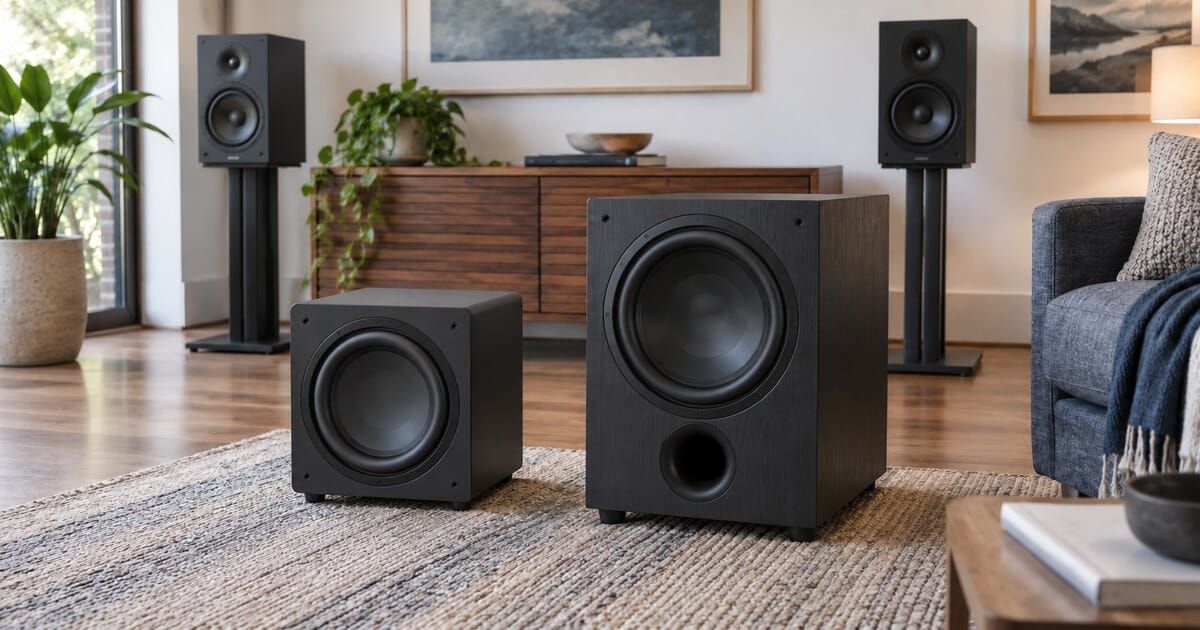
Disclosure: SoundPath Lab did not perform hands-on output measurements for this guide and received no payment or product from the cited organizations. Manufacturer documents establish features and stated compatibility; they do not determine the editorial recommendation. Any retailer link added later must be disclosed and will not change the ranking logic. The cover is an original AI-generated editorial image of unbranded equipment, not a product test photograph.
Sources
- Consumer Technology Association — CTA-2010-C Standard Methods of Measurement for Subwoofers.
- Audio Engineering Society — Welti & Devantier, “Low-Frequency Optimization Using Multiple Subwoofers”.
- Denon AVR-X6700H manual — Crossovers.
- Genelec — Monitor and subwoofer placement and subwoofer-position support guidance.
- SVS — Sealed vs. Ported Subwoofers. Manufacturer design guidance; not treated as an independent ranking.
- Sonos — Set up your Sonos Sub, Sub Mini compatibility, and third-party subwoofers with Amp/Connect:Amp.
- Bluesound — Pairing PULSE SUB+ with a Bluesound player.
- Sony — BRAVIA Theatre Sub 8 help guide and compatibility limits.
Continue: Browse Speakers & Subwoofers, compare documented products in the Product Profiles, check Product Issues & Limitations, or map the complete signal path with the System Builder.
Continue the research
Move from this article to a verified product decision
Use descriptive links to move between product records, brand evidence, comparisons, setup or issue guidance, and compatible-system tools. Inclusion reflects subject relevance, not a score or endorsement; product facts, recommendation eligibility, and commercial links remain separate.
Product page
Verify the exact model
Brand center
Check the wider platform
Related comparison
Compare the system role
Setup, firmware & problems
Check behavior before buying
System Builder & compatibility