
FiiO FT1 vs FT1 Pro: Which Headphone Should You Buy?
FiiO FT1 or FT1 Pro? Compare closed-back vs open-back design, sound, isolation, comfort, amplification and the best use cases for each.
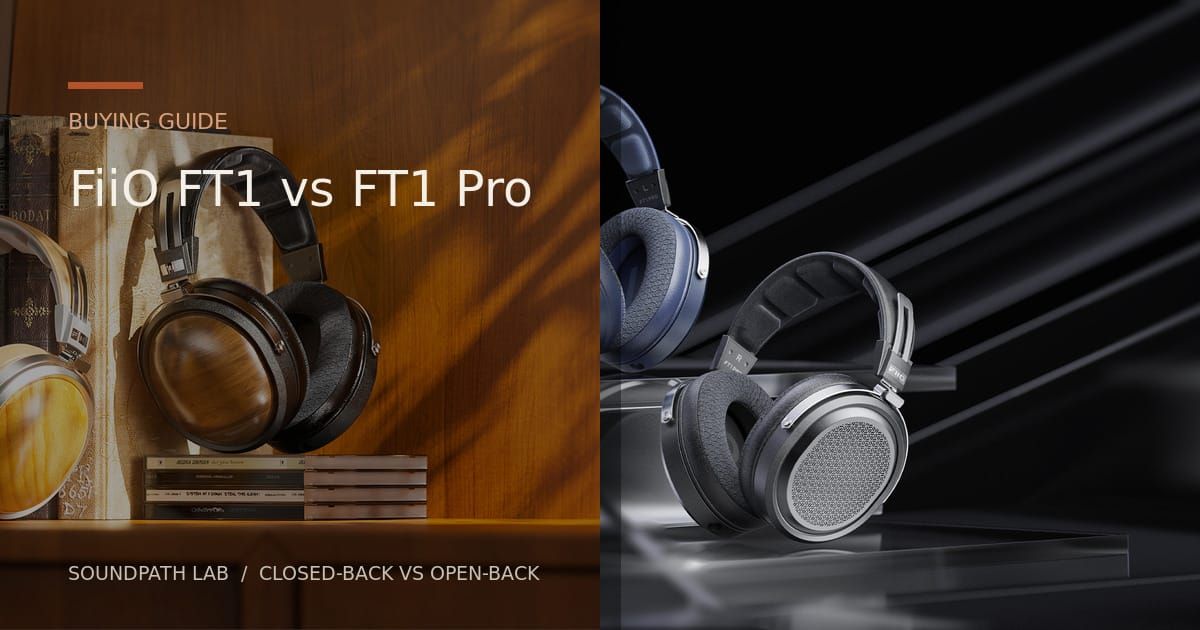
Short answer: buy the FiiO FT1 if you need isolation, fuller bass and an easy everyday headphone. Choose the FT1 Pro if you listen in a quiet room and care more about openness, speed and separation. Despite the name, the FT1 Pro is not simply a better FT1. It is a different kind of headphone.
The FT1 is a closed-back dynamic headphone. The FT1 Pro is an open-back planar magnetic headphone. That single difference changes where they work, how they sound and what kind of listener each one suits.
FT1 vs FT1 Pro at a glance
| FiiO FT1 | FiiO FT1 Pro | |
|---|---|---|
| Design | Closed-back, dynamic driver | Open-back, planar magnetic |
| Driver | 60mm dynamic, nanowood-fibre composite diaphragm | 95 × 86mm planar, 1μm diaphragm |
| Impedance | 32Ω | 20Ω |
| Weight | About 340g without cable | About 374g |
| Isolation | Good for a passive wired headphone | Almost none |
| Sound leakage | Limited | High |
| General sound | Warmer, fuller and more relaxed | More open, quicker and more neutral |
| Best use | Office, shared rooms, travel, recording and general listening | Quiet-room listening, mixing checks, acoustic and complex music |
Both include detachable 3.5mm and 4.4mm cables, so choosing the Pro is not necessary just to get a balanced connection. Official specifications and accessories can be checked on FiiO’s FT1 page and FT1 Pro page.
The most important choice: closed or open?
This matters more than the word “Pro”.
The FT1’s closed wooden earcups reduce outside noise and keep more of your music from disturbing people nearby. It makes sense at a desk shared with another person, in an office, in a bedroom at night, or while recording near an open microphone. FiiO claims passive isolation of up to 26dB under its test conditions. It is not active noise cancelling, but it is far more practical than the FT1 Pro in a noisy or shared environment.
The FT1 Pro is intentionally open. Air and sound pass through the earcups, so you will hear the room and people nearby will hear your music. It is a poor choice for commuting, libraries, flights and shared offices. In return, it usually creates a less enclosed presentation, with more apparent space around instruments.
If you are unsure where you will use the headphone, the FT1 is the safer purchase.
How their sound differs
FT1: fuller bass and an easy, enjoyable balance
The FT1 has more low-frequency weight and warmth. Kick drums, bass guitars and electronic music sound substantial without requiring EQ. Its presentation is smooth enough for long casual listening and forgiving of bright or compressed recordings.
The trade-off is that the fuller bass and closed construction can make the middle frequencies feel less open than on the Pro. Listeners seeking strict neutrality or maximum separation may find it slightly rich. But for pop, rock, hip-hop, films and everyday mixed playlists, that extra body is often exactly why the FT1 is enjoyable.
FT1 Pro: cleaner separation and a more spacious view
The FT1 Pro sounds faster and less enclosed. Its planar driver handles busy arrangements cleanly, and bass notes are generally tighter rather than bigger. The open structure makes positioning and layers easier to follow, especially with acoustic recordings, orchestral music, jazz and detailed electronic productions.
It is not automatically more musical. Some listeners may find its presentation drier, leaner or more direct than the FT1. Independent comparisons also disagree on which model has the more natural timbre, which is a useful reminder that “more detail” is not the same as “better for everyone”.
Do you need a headphone amplifier?
Both models have low nominal impedance and can make sound from many portable sources, but impedance alone does not tell the full story.
The FT1 is the easier all-purpose pairing. A competent phone dongle, laptop output, portable player or desktop DAC/amp should normally be enough. A balanced 4.4mm output is optional, not required.
The FT1 Pro can also reach useful volume from modest sources, but a clean DAC/amp with some current reserve gives more confidence with dynamic peaks and EQ. You do not need an expensive amplifier. Start with the source you already own; upgrade only if maximum volume is inadequate, bass loses control, or audible noise is present.
Do not buy a powerful amplifier simply because the FT1 Pro uses a planar driver. More power does not keep improving a headphone after clean listening volume and headroom are already available.
Comfort and build: try the headband if possible
The FT1 is lighter at roughly 340g, while the FT1 Pro is about 374g. Both use large pads and an adjustable metal headband. Weight distribution, however, matters more than the number on the specification sheet.
Some owners and reviewers report pressure at the top of the head because the headband padding is fairly narrow. Others find both models comfortable for long sessions. Head size changes the result considerably, so this is one area where a short audition is more useful than another frequency-response graph.
The FT1’s solid-wood cups look more premium than its price suggests, but wood grain and colour naturally vary. The FT1 Pro also uses wood elements, yet its open grille gives it a more technical appearance. Neither folds into a compact travel headphone.
Which one suits your music?
- Pop, hip-hop, EDM and films: FT1 is usually the more satisfying first choice because of its bass weight and closed-back impact.
- Rock and metal: FT1 for body and relaxed listening; FT1 Pro for cleaner separation in dense mixes.
- /html
- /htmlClassical, jazz and acoustic recordings: FT1 Pro more clearly reveals space, layering and low-level detail.
- Vocals and small ensembles: both work. FT1 sounds warmer and more intimate; FT1 Pro sounds more open and explicit.
- Gaming: FT1 Pro for positional openness in a quiet room; FT1 where isolation and microphone bleed matter.
- Recording: FT1. The FT1 Pro leaks too much sound for tracking near a microphone.
Who should buy the FiiO FT1?
Choose the FT1 if most of these statements describe you:
- You need to block some outside sound.
- You listen around family, colleagues or other people.
- You prefer full bass and a slightly warmer balance.
- You want a headphone that works well from simple sources.
- You record vocals, stream or use a nearby microphone.
- You want one wired headphone for many different situations.
For most first-time hi-fi headphone buyers, the FT1 is the lower-risk recommendation because it is easier to use in everyday life.
Who should buy the FiiO FT1 Pro?
Choose the FT1 Pro if most of these statements describe you:
- You listen mainly in a quiet private room.
- Sound leakage will not disturb anyone.
- You value separation, speed and openness over bass quantity.
- You listen closely to complex arrangements and acoustic recordings.
- You already have a suitable dongle, player or desktop DAC/amp.
- You understand that an open headphone cannot replace a travel headphone.
The Pro is the stronger specialist choice, but the FT1 is often the more useful product.
Common buying mistakes
“Pro” must mean better
Not here. The two models solve different problems. The FT1 Pro may reveal more space and separation, while the FT1 can be more enjoyable, more private and more practical.
Buying the FT1 Pro for an office
Open-back leakage is not subtle. If people sit close to you, assume they will hear the music.
Buying an amplifier before trying the headphone
Both models are relatively friendly loads. Test your existing source first and spend on an amplifier only when a real limitation appears.
Expecting the FT1 to behave like noise-cancelling headphones
The FT1 provides passive isolation, not ANC. It reduces ordinary room noise but will not cancel aircraft or train rumble like a good active model.
Final recommendation
Buy the FiiO FT1 for versatility, privacy and fuller bass. It is the sensible choice for shared spaces, general listening, films, gaming with isolation and recording work.
Buy the FiiO FT1 Pro for a quiet-room listening system. It offers a more open, fast and separated presentation, especially valuable with acoustic music and complex mixes.
If you can own only one and your listening environment changes frequently, choose the FT1. If you already have a practical closed-back headphone and want a different, more spacious experience at home, the FT1 Pro is the more meaningful addition.
Specifications and product positioning were checked against FiiO’s official product pages. Sound and comfort descriptions reflect a synthesis of published comparisons and user reports; individual fit and listening preference can differ.
Evidence basis: Buying Guide — not independently tested side by side by SoundPath Lab. Last verified: 7 August 2026.
Evidence & verification
Evidence basis: Official FiiO specifications, product documentation and clearly labeled editorial interpretation. This is a public-information buying guide, not a controlled listening or measurement comparison.
Firmware and versions reviewed: FT1 and FT1 Pro are passive headphones, so device firmware is not applicable. Product specifications available on August 7, 2026 were reviewed.
Last checked: August 7, 2026.
Limitations: Comfort, fit, seal, perceived bass and treble balance vary by listener, glasses, pad condition and source equipment. Sound-stage and tonal judgments require direct controlled listening and are not presented here as measurements.
Commercial disclosure: No payment or sample determined this comparison. Any future retailer or affiliate links will be labeled and will not change the recommendation.
Primary sources: https://www.fiio.com/ft1 and https://www.fiio.com/ft1pro
Related reading: https://www.soundpathlab.com/tag/buying-guides/ | https://www.soundpathlab.com/questyle-m12i-vs-m15c-vs-m15i-vs-m18i-which-portable-dac-amp-should-you-buy/ | Open System Builder
Keep what you already have: if your current headphone already provides the isolation, comfort and tonal balance you need, neither model is an automatic upgrade. Move to the FT1 for closed-back isolation and fuller bass; move to the FT1 Pro only when an open-back planar presentation in a quiet room solves a specific limitation.
Decision boundary: choose the FT1 for offices, shared rooms, travel or microphone use. Choose the FT1 Pro for quiet-room listening when openness and separation matter more than isolation. If those conditions are unclear, keep the current headphone until you can test fit, leakage and source power.
Continue the research
Move from this article to a verified product decision
Use descriptive links to move between product records, brand evidence, comparisons, setup or issue guidance, and compatible-system tools. Inclusion reflects subject relevance, not a score or endorsement; product facts, recommendation eligibility, and commercial links remain separate.
Product page
Verify the exact model
Brand center
Check the wider platform
Related comparison
Compare the system role
Setup, firmware & problems
Check behavior before buying
System Builder & compatibility