
How Much Speaker Cable Do You Really Need?
You do not need luxury speaker cable for most home systems. You do need enough copper, reliable connections and the right gauge for the cable length and speaker load.
A practical guide to gauge, length, speaker impedance—and when expensive cable is just expensive
Technical review: Systems & Measurements Editor · Reviewed August 7, 2026
Evidence status: Engineering guide · Public technical sources · Not a cable-brand listening review
There is a familiar moment in almost every first stereo build. The amplifier and speakers are finally chosen. The hard decisions appear to be over. Then the salesperson, installer or late-night shopping page presents a pair of speaker cables that costs as much as the amplifier.
The promise is rarely modest. The new cable will supposedly open the soundstage, tighten the bass, uncover detail and remove a veil you did not know was there. After spending weeks choosing the system, it is easy to wonder whether ordinary wire will quietly ruin it.
Usually, it will not.
A speaker cable has a real electrical job, and choosing the wrong one can cause measurable loss. A cable that is too thin for a long run or a low-impedance speaker adds resistance. Loose, oxidized or shorting strands can create far more obvious trouble. But once a cable has enough copper for the distance and load, secure connections and suitable insulation, price stops being a useful measure of performance.
The sensible question is not “How expensive should my cable be?” It is “How little cable resistance can my system tolerate, and what construction will make the installation reliable?”
What a speaker cable can actually change
The amplifier does not send a delicate digital message to a passive speaker. It sends an analogue voltage and current through a complete circuit: out to the speaker and back again. The cable adds resistance, inductance and capacitance to that circuit.
For ordinary home-length speaker cables, resistance is normally the first number worth caring about. It rises as the cable becomes longer and thinner. Added resistance reduces the voltage reaching the speaker, wastes a small amount of power as heat and changes the effective source impedance seen by the loudspeaker. Because a real speaker's impedance varies with frequency, too much series resistance can also produce a small change in frequency response rather than only making everything uniformly quieter.
That is the engineering case for thicker wire. It is not an argument for unlimited spending.
Yamaha's speaker-wire guidance identifies gauge, length and speaker impedance as the practical variables. Klipsch's published gauge chart follows the same logic: lower-impedance speakers and longer runs need thicker conductors. Neither rule requires precious metal, a battery box on the cable or a price that tracks the value of the speakers.
The short answer for most homes
For real copper cable—not copper-clad aluminium—these are conservative starting points for a single one-way run from amplifier to speaker:
| One-way cable length | 8-ohm speaker | 6-ohm speaker | 4-ohm speaker |
|---|---|---|---|
| Up to 3 m / 10 ft | 16 AWG / 1.3 mm² | 16–14 AWG / 1.3–2.1 mm² | 14 AWG / 2.1 mm² |
| 3–7.5 m / 10–25 ft | 14 AWG / 2.1 mm² | 14 AWG / 2.1 mm² | 12 AWG / 3.3 mm² |
| 7.5–15 m / 25–50 ft | 14–12 AWG / 2.1–3.3 mm² | 12 AWG / 3.3 mm² | 12 AWG / 3.3 mm², then calculate the loss |
| More than 15 m / 50 ft | Calculate the complete run and installation requirements; do not choose by a generic shopping chart |
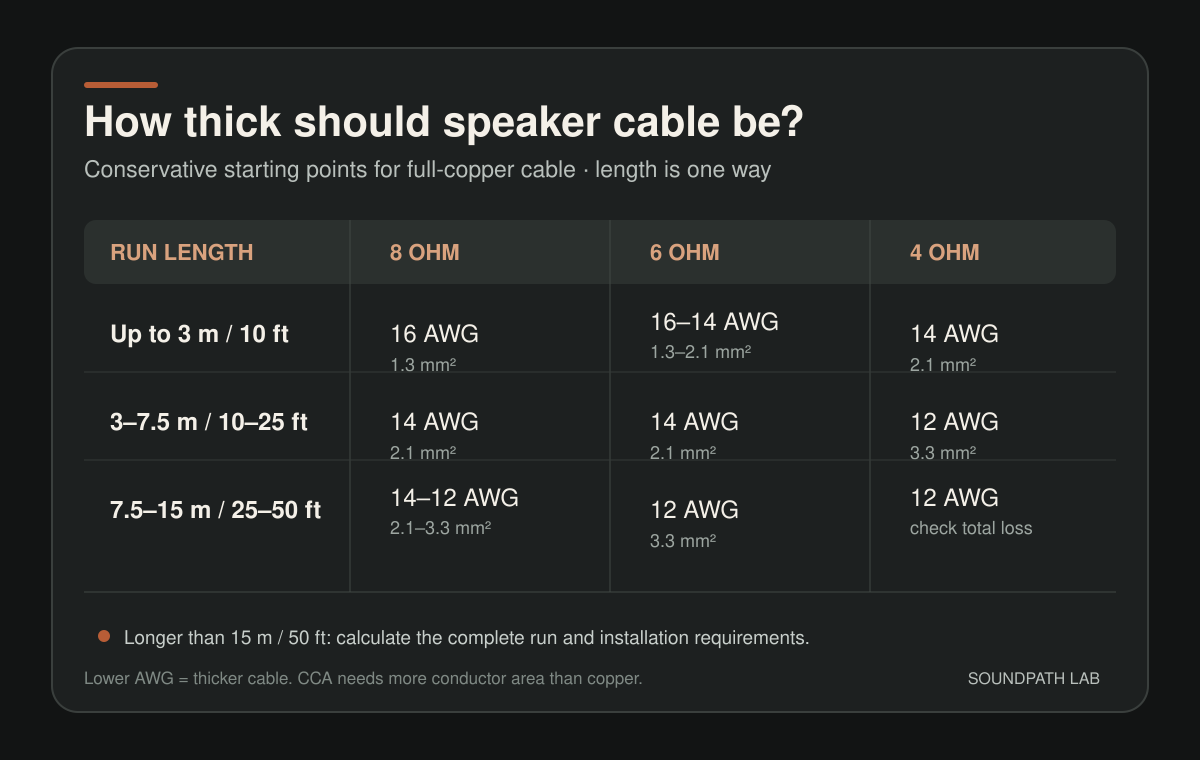
This table deliberately leaves comfortable headroom. It is not a claim that stepping one size thinner will suddenly sound bad. For example, Klipsch's chart permits 16 AWG copper for an 8-ohm load up to 48 ft. Choosing 14 AWG for a 20-ft living-room run is simply inexpensive insurance and often gives a tougher cable to work with.
Remember that AWG numbers run backwards: 12 AWG is thicker than 14 AWG, and 14 AWG is thicker than 16 AWG.
Four systems, four sensible choices
A bookshelf system beside the TV
The amplifier sits in the cabinet, each 8-ohm speaker is about 2.5 m away, and listening levels are normal. Good 16 AWG copper cable is electrically adequate. Buy 14 AWG if the price difference is small or if you want a more robust cable, but do not expect a transformation merely because the jacket looks expensive.
Four-ohm floorstanders with a powerful amplifier
The speakers are 3 m from the amplifier and their impedance drops below the nominal figure at some frequencies. Use 14 AWG copper as a sensible minimum; 12 AWG is a reasonable choice where high output, future changes or extra margin matter. Here, paying a little more for more copper is rational. Paying hundreds for an exotic geometry still needs evidence.
Long home-theater surround runs
The front speakers may need only 2 m of cable, while the rear channels snake around the room for 10 or 12 m. There is no rule that every channel must use the same gauge or identical length. Use the gauge appropriate to each run. For 6- or 8-ohm surrounds at those distances, 14 AWG copper is a straightforward choice; use installation-rated cable when it passes inside a wall or ceiling.
Powered speakers on a desk
Stop before ordering speaker cable. Many powered speakers accept a line-level, USB or digital input and do not use conventional amplifier-to-speaker wire at all. Some pairs have one powered master speaker and a proprietary or passive link to the second cabinet; follow that model's manual. Buying thick speaker cable cannot improve a connection the product does not use.
Oxygen-free copper, CCA, silver and other labels
Copper is the easy default
For home audio, properly sized copper cable is the uncomplicated choice. “Oxygen-free copper” is common and perfectly suitable, but the OFC label by itself is not proof of superior sound. Gauge, actual conductor material and honest construction matter more than a dramatic purity percentage printed on the box.
Copper-clad aluminium needs more thickness
Copper-clad aluminium, usually marked CCA, uses an aluminium core with a copper coating. Aluminium has higher resistance than copper, so a CCA cable needs a larger conductor to achieve similar resistance. It can work, but online listings do not always make the conductor size and material easy to verify. Full copper avoids that uncertainty, especially for long or concealed runs.
Silver can conduct; the price still needs a reason
Silver is a highly conductive metal. That does not mean a thin or expensive silver cable automatically outperforms a correctly sized copper cable in a home system. If the comparison changes conductor resistance, connector quality, length or level at the same time, it is not isolating the material. Buy silver cable for construction, appearance or ownership pleasure if those things matter to you—not because the word “silver” guarantees an audible upgrade.
Do banana plugs improve the sound?
Banana plugs and spades are conveniences, not mandatory sound processors.
Bare wire makes a perfectly valid connection when the strands are clean, tightly captured and unable to touch the neighboring terminal. A good banana plug makes repeated connection easier, protects against stray strands and can be useful behind a crowded receiver. A properly crimped or firmly secured plug is worth paying for. A large decorative connector with a weak internal screw is not.
Check the terminals once after the system has been moved. Many “cable problems” are actually loose connections, reversed polarity or a stray strand touching the other post.
Equal lengths, cable risers and bi-wiring
Left and right cables do not need to be precisely identical down to the centimetre. The small resistance difference between a 2.5 m and 3 m run of adequate cable is not a reason to hide an unnecessary coil behind the rack. Keep the lengths reasonably similar when practical and avoid waste.
Cable risers can make a floor easier to clean and may protect a cable from feet, pets or moisture. Those are real benefits. Claims that lifting a short, ordinary speaker cable off a domestic floor produces a large sonic improvement require a controlled comparison, not a photograph of an expensive system.
Bi-wiring also needs to be separated from bi-amping. Removing the terminal jumpers and running two cable pairs from the same amplifier channel does not create another amplifier or more total power. If the speaker manufacturer supports bi-wiring, it is safe when connected correctly, but it should not be treated as an automatic upgrade. Active bi-amping, passive bi-amping and bi-wiring are different arrangements.
When spending more is reasonable
“You do not need luxury cable” is not the same as “buy the cheapest roll you can find.” Extra money is justified when it buys something you can identify:
- enough conductor area for a long run or low-impedance speaker;
- verified copper rather than ambiguous CCA labeling;
- flexible insulation that will not split, harden or fight the terminals;
- reliable factory termination when you do not want to strip and fit cable yourself;
- a flat, outdoor, direct-burial or in-wall construction made for the installation;
- clear polarity marking and honest specifications;
- durability for a system that is connected and moved frequently;
- appearance, provided you are consciously paying for appearance.
In-wall cable is a safety and building-code decision, not a sound-quality upgrade. Use the rating required where you live, and do not conceal ordinary decorative cable inside a wall simply because its jacket feels thick. For permanent or commercial installations, follow local code and an installer who understands it.
One more caution: unusual ultra-high-capacitance cable designs can be a difficult load for some amplifiers. “More exotic” is not automatically electrically safer. If a cable has an unconventional network box or geometry, check both the cable data and amplifier manufacturer's guidance.
Where the money usually makes a larger difference
Suppose a normal stereo system already has correctly sized copper cable and secure terminals. Another $300 is available. In most rooms, the more productive questions are:
- Can the speakers be moved away from a wall or out of a corner?
- Is the listening position sitting in a severe bass null?
- Would stands place the tweeters correctly and stabilize the cabinets?
- Does the system need a subwoofer, measurement microphone or room correction?
- Is the amplifier actually clipping, noisy or unsuitable for the speaker load?
- Are the speakers themselves the limiting part of the system?
A cable cannot correct poor speaker placement. It cannot remove a 10 dB room-mode problem, give a small speaker another octave of bass or make an underpowered amplifier stop clipping. This is why cable spending should come after the system's larger, audible problems are under control.
A fair way to compare two speaker cables
If you still hear a difference, test it in a way that gives the claim a fair chance.
Use the same route and length. Confirm secure polarity and connections. Keep the playback level matched; even a small level difference can be interpreted as greater clarity or impact. Ask another person to swap the cable without telling you which one is playing, and repeat the comparison more than once. Most importantly, compare the expensive cable with an ordinary cable that is already thick enough—not with a thin, damaged or badly connected cable.
A failed blind comparison does not mean the listener is foolish. It means the proposed difference was not reliably identified under those conditions. A successful repeatable comparison is a reason to investigate what electrical variable changed.
The practical verdict
For most domestic systems, 14 or 16 AWG copper cable over short runs is enough. Four-ohm speakers, high power and long cable routes justify moving to 12 or 14 AWG. Reliable connectors, accurate conductor material and the correct installation rating are worth paying for.
Beyond that point, the burden of proof belongs to the expensive cable—not to the listener who prefers to spend the money on speakers, placement, bass integration or music.
Good speaker cable should be boring. It should fit, stay connected, carry the required current and then disappear from the story.
Evidence and scope note
This is an engineering selection guide, not a SoundPath Lab listening review of named cable brands. It does not claim that every cable has identical electrical properties. Its conclusion is narrower: once resistance, length, gauge, conductor material, connection quality and installation requirements are controlled, retail price alone does not predict a useful improvement.
Sources
- Yamaha — Are Expensive Speaker Cables Worth It?
- Yamaha — Chart to Determine the Proper Speaker Cable Gauge
- Klipsch — What Gauge Wire Should I Use?
- Klipsch — High-End Audio Cables
- Klipsch — AW-650: Connecting to an Amplifier
- Audio Engineering Society — Pro Audio Reference: impedance
Continue the research
Move from this article to a verified product decision
Use descriptive links to move between product records, brand evidence, comparisons, setup or issue guidance, and compatible-system tools. Inclusion reflects subject relevance, not a score or endorsement; product facts, recommendation eligibility, and commercial links remain separate.
Product page
Verify the exact model
Brand center
Check the wider platform
Related comparison
Compare the system role
Setup, firmware & problems
Check behavior before buying
System Builder & compatibility