
HiFiMuse Q7 vs TOPPING DX5 II: What Does the Higher Price Actually Buy?
The Q7 covers the essential Bluetooth, DAC, headphone and balanced-preamp roles for less; DX5 II charges more for stronger documented power, PEQ, web control and more explicit output management.
Direct conclusion
Choose the HiFiMuse Q7 if you need a lower-cost Bluetooth DAC, headphone amplifier and balanced preamplifier with straightforward controls and socketed op-amp experimentation. Choose the TOPPING DX5 II if you will actually use its much stronger documented headphone output, parametric EQ, web/device control, broader Bluetooth codec set, preset system and explicit fixed/variable line modes.
At the checked prices, DX5 II costs US$140 more. That premium buys capability and documentation, not an automatic guarantee of audibly better sound in every system. If the extra functions remain unused, Q7 is the more economical system hub. If PEQ or difficult-headphone drive solves a real problem, DX5 II can justify the price before any subjective comparison begins.
Scope, operator and editorial independence
SoundPath Lab is operated by FASTHiFi in Hong Kong. SoundPath Lab uses HiFiMuse Q7 as the product name. The canonical Q7 record and evidence retain one identity and one set of test records; the existing product URL and evidence associations are preserved. Commercial context is documented in the disclosure policy. Neither HiFiMuse nor TOPPING paid for placement. Official claims, owner/editorial observations, calculations and unresolved gaps are labelled separately.
Prices were checked on 29 September 2026. EMiUZEK listed Q7 at US$159, reduced from US$198. Authorized retailer Apos listed DX5 II at US$299. Local tax, shipping, stock, warranty route and promotions may alter the final cost.
Comparison table
Mobile: swipe left or right inside the comparison table to view all columns.
| Decision point | HiFiMuse Q7 | TOPPING DX5 II |
|---|---|---|
| Checked price | US$159 sale | US$299 at Apos |
| Digital inputs | USB-B, optical, coaxial | USB, optical, coaxial, Bluetooth |
| Bluetooth codecs | aptX HD, aptX LL, aptX, AAC, SBC | LDAC, aptX Adaptive, aptX HD, aptX, AAC, SBC |
| Analog input | None documented | None documented |
| Line outputs | RCA and XLR, variable behavior observed | RCA and XLR; PRE variable or DAC fixed level |
| Headphone outputs | 6.35 mm and 4.4 mm | 6.35 mm, 4.4 mm and 4-pin XLR |
| Published 32-ohm power | No directly comparable 32-ohm figure | 6.35: 2,200 mW ×2; balanced: 6,400 mW ×2, THD+N below 1% |
| DSP/control | No app or PEQ listed | PEQ presets, user configurations, crossfeed, remote and web/device control |
| DIY | Socketed op-amps | No user op-amp program documented |
| Current checked firmware | No verified public version page | V2.53, dated 17 September 2026 |
Official references: Q7 product page, TOPPING DX5 II product page, and DX5 II manual.
Connections and system role
Both products can be the digital center of a desktop system. Each accepts USB, optical, coaxial and Bluetooth, then feeds headphones, active speakers or a downstream amplifier through RCA or balanced XLR. Neither checked official page lists an RCA analog input. A turntable, tape deck or analog-only source therefore needs another route or an analog preamplifier.
Q7’s Bluetooth list covers aptX HD and aptX Low Latency but not LDAC. The supplied sample paired successfully, reconnected in about one second, and completed a one-hour session without a reported dropout. No instrumented latency or range test was completed.
DX5 II adds LDAC and aptX Adaptive, plus a display, remote and additional four-pin XLR headphone connection. Codec availability still depends on the source device, operating system and radio environment. A long codec list is not proof of better sound by itself.
For speaker systems, Q7’s sample showed variable RCA and XLR level. DX5 II makes the routing explicit: PRE mode provides variable line control; DAC mode provides fixed maximum line output when only line output is active. TOPPING specifies 2.5 Vrms RCA and 5.0 Vrms XLR at 0 dBFS. Fixed mode can be dangerously loud into a power amplifier if downstream gain is not reduced first.
Q7 line evidence and calculation boundary
SoundPath Lab’s owner/editorial record used USB from a computer, a 1 kHz, -3 dBFS, 48 kHz/24-bit stereo WAV file, Q7 volume 100 and a UNI-T UT61E+ multimeter. Unit A measured 1.611 / 1.6097 Vrms at RCA, left/right; the calculated 0 dBFS equivalents are 2.276 / 2.274 Vrms. These are estimates, not direct 0 dBFS readings or verified maximum unclipped output.
At XLR pins 2–3, Unit A measured 2.951 / 2.915 Vrms and Unit B measured 2.936 / 2.924 Vrms, left/right. Their calculated 0 dBFS equivalents are 4.168 / 4.118 Vrms and 4.147 / 4.130 Vrms. Unit B’s channel order and matching conditions were explicitly reconfirmed.
DX5 II’s published line values are maker specifications under documented conditions. Q7’s figures are a combination of operator measurement and calculation. The two evidence types should not be silently mixed, and neither establishes audible superiority.
Headphone ability: power with conditions
DX5 II has the stronger published power envelope. TOPPING lists 2,200 mW per channel from 6.35 mm and 6,400 mW per channel from its balanced headphone path into 32 ohms, at THD+N below 1%. Its manual states test context including 96 kHz USB input and AC power conditions. Users should still match gain and volume to headphone sensitivity; unused power is not a quality score.
Q7’s official page lists 360 mW at 16 ohms and 28 mW at 300 ohms from 6.35 mm, plus 1,000 mW at 16 ohms and 56 mW at 600 ohms from 4.4 mm. Because the loads differ from DX5 II’s table, a simple multiplier would mislead. SoundPath Lab has not measured Q7 maximum unclipped headphone voltage, loaded power, THD+N, output impedance or protection behavior.
The Q7 operator heard no obvious noise with the tested 6.35 and 4.4 mm headphones at about 20–50% volume. The headphone model, impedance and sensitivity were not recorded, so the observation cannot support “zero noise” or universal sensitive-IEM compatibility.
For hard-to-drive headphones or buyers who require a documented 32-ohm condition, DX5 II has the clearer case. For moderate loads, buying surplus wattage may deliver less practical value than spending on headphones, room treatment or music.
PEQ, web control and daily operation
DX5 II’s largest functional advantage is not its DAC chip count; it is correction and control. TOPPING documents parametric EQ for USB, coaxial, optical and Bluetooth within stated sample-rate and bit-depth limits, five built-in configurations and five user configurations. Crossfeed is available only within its documented 44.1–48 kHz, 24–32-bit boundary. Web control requires compatible firmware; TOPPING’s Home WEB note specifies V2.39 or later for DX5 II.
PEQ can correct a headphone’s broad tonal balance or integrate a desktop speaker system more rationally than speculative component swapping. It cannot fix every time-domain, distortion or room problem, and careless boosts can reduce headroom or cause clipping. Save an unmodified reference preset and apply gain compensation.
Q7 has no verified control app or PEQ layer. Its sample started in about 1.07 seconds, retained the tested input and volume, woke normally, accepted optical input and muted without an observed pop. A 24-hour playback note reports no interruption, but path, load and logging details are incomplete. The enclosure was not obviously warm after one hour; that is touch observation, not thermal measurement.
DX5 II firmware V2.53, dated 17 September 2026, addresses AutoEQ preview loudness, Home/web/device synchronization, C1/C2 output reversion and DC-detection behavior. That active update path is valuable, but it also means owners must read release notes and preserve settings. Firmware should solve a defined issue, not be installed merely because a larger version number exists.
DIY boundaries
Q7’s official page confirms socketed, user-replaceable JRC5532DD op-amps. The supplied sample record identifies three socketed, user-replaceable op-amp positions; the official page does not state their count. Use three separate workflows: keep a stock reference, conduct tuning only with electrically compatible parts and recorded orientation, and repeat measurements after each change.
An operator reported an audible change after a swap, but no level-matched ABX or repeatability program was completed. Socket count does not prove quality. Incorrect orientation, supply limits, current demand, oscillation or physical fit can damage equipment and may affect warranty.
DX5 II offers the opposite philosophy: leave the analog hardware closed and change response through repeatable PEQ presets. That is generally easier to document and reverse. Users interested in component experimentation may prefer Q7; users interested in controlled tonal adjustment should value DX5 II’s software more highly.
Evidence, limitations and recommendation
Official product pages, manuals and firmware notes are primary sources. Q7 hands-on observations and voltage readings are operator-supplied secondary evidence. SoundPath Lab did not complete a simultaneous level-matched listening comparison, Audio Precision bench run, thermal survey or controlled headphone-power test of both units.
Buy Q7 when the goal is an affordable Bluetooth DAC/headphone/preamp with XLR line output and cautious DIY potential. Buy DX5 II when PEQ, web control, broader codec support, explicit output management or demanding-headphone power has a defined use. Do not pay US$140 more merely for a higher model position.
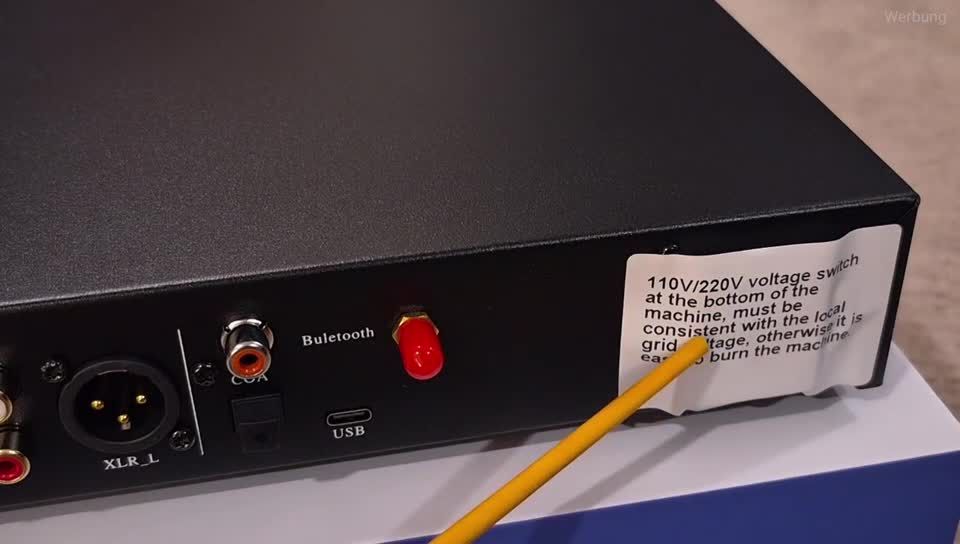
The linked Christian Schwarzbeck / China-HiFi Q7 video on YouTube visibly displays “Werbung” (advertising). It is external commentary, not SoundPath Lab measurement evidence. Controlled test conditions remain pending, and no numerical result from the video is imported here. Additional sources: DX5 II V2.53 firmware note, TOPPING Home WEB requirements, and checked authorized-retailer price.
Internal records: Q7 product profile and DX5 II product profile.
Future verification and update log
Checked 29 September 2026. Price, connection, line mode, PEQ limits, web-control requirement, power conditions and firmware V2.53 were rechecked. Q7 direct measurements remain separated from calculations and maker claims.
Next priorities are controlled Q7 32/150/300-ohm load tests including 4.4 mm, documented headphone identity, one fully documented stock-versus-DIY comparison, and a matched DX5 II/Q7 operating session. No additional line-voltage retest is required for this publication.
Full commercial policy: Disclosure & Funding.
Continue the research
Check the products and evidence behind this comparison
These links lead to the exact models, the retained Q7 evidence and related setup guidance. A related article is not a new test result or an endorsement.
Product records
Verify both models
Brand evidence
Check identity and support context
Related comparisons
Compare another system role
Evidence and setup
Read the conditions behind the claims
System planning