
HiFiMuse Q7 vs FiiO K7: System Flexibility or a Headphone-First Setup?
The Q7 adds Bluetooth and balanced XLR preamp outputs at a lower checked price; the regular FiiO K7 adds an analog input, fixed or variable RCA output and stronger documented headphone power.
Direct conclusion
Choose the HiFiMuse Q7 when Bluetooth input, balanced XLR line output, a lower current price and user-replaceable op-amp experimentation are central to the system. Choose the regular FiiO K7 when an RCA analog input, clearly separated fixed and variable RCA modes, and stronger officially documented headphone power matter more.
The Q7 is the more flexible wireless and balanced-line hub. The K7 is the more defensible headphone-first choice based on published load tests. Neither is universally better, and this article is about the regular K7, not the separate K7 BT model. Mixing the two versions would incorrectly give the regular K7 Bluetooth capability.
Scope, operator and editorial independence
SoundPath Lab is operated by FASTHiFi in Hong Kong. SoundPath Lab uses HiFiMuse Q7 as the product name. The canonical Q7 record and evidence retain one identity and one set of test records; the existing product URL and evidence associations are preserved. Commercial context is documented in the disclosure policy. Neither HiFiMuse nor FiiO paid for placement.
Prices were checked on 29 September 2026. EMiUZEK listed Q7 at US$159, reduced from US$198. Authorized retailer B&H listed the regular K7 at US$219.99. Tax, shipping, stock, plug type and warranty route may change the real cost.
Comparison table
Mobile: swipe left or right inside the comparison table to view all columns.
| Decision point | HiFiMuse Q7 | FiiO K7 (regular model) |
|---|---|---|
| Checked price | US$159 sale | US$219.99 at B&H |
| Digital inputs | USB-B, optical, coaxial | USB-B, optical, coaxial |
| Wireless | Bluetooth 5.2; aptX HD, aptX LL, aptX, AAC, SBC | None; K7 BT is a separate product |
| Analog input | None documented | Stereo RCA |
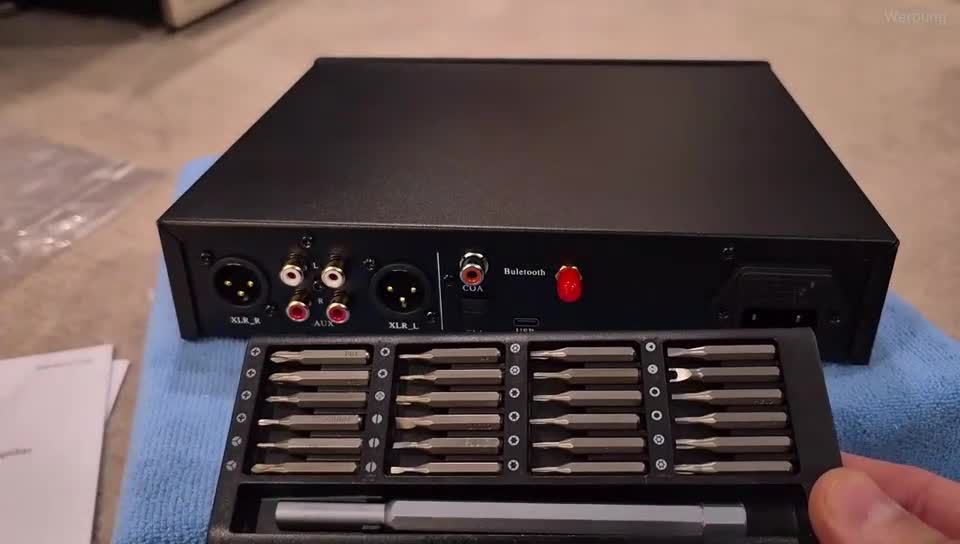
| Line output | Variable RCA and balanced XLR observed in the supplied sample | RCA only; LO fixed and PRE variable are officially defined |
| Headphone outputs | 6.35 mm and 4.4 mm | 6.35 mm and 4.4 mm |
| Published 32-ohm power | No directly comparable official 32-ohm figure | 6.35: at least 1,220 mW ×2; 4.4: at least 2,000 mW ×2, THD+N below 1% |
| Gain/control | Front volume control | High/low gain; PO/PRE/LO output selector |
| DIY/software | Socketed op-amps; no control app listed | No user op-amp program; Windows driver and special-purpose XMOS firmware packages |
Official references: Q7 product page, FiiO K7 overview and FiiO K7 parameters.
Connections and system role
Both products cover the standard desktop digital sources: computer by USB, television or streamer by optical, and legacy digital transport by coaxial. Q7 adds Bluetooth. Its listed codecs include aptX HD and aptX Low Latency, but not LDAC. In the supplied sample record, initial pairing worked, reconnection took about one second, and a one-hour session completed without a reported dropout. That is one environment, not a controlled range or latency test.
K7 trades wireless reception for RCA analog input. That input can accept a phono preamp, streamer, tape deck or another DAC. A bare turntable cartridge still requires a phono stage. This makes K7 useful when digital listening shares one headphone amplifier with an analog source.
Q7 is more suitable when balanced XLR line connection is required. Its RCA and XLR outputs changed with the sample’s volume control, supporting preamp use with active speakers or a power amplifier. K7 provides rear RCA only, but its behavior is unusually clear: PO drives headphones with variable level, PRE sends variable level to rear RCA, and LO sends fixed line level to rear RCA. Always lower downstream gain before switching modes.
Line output and volume behavior
SoundPath Lab’s owner/editorial record used USB from a computer, a 1 kHz, -3 dBFS, 48 kHz/24-bit stereo WAV file, Q7 volume 100 and a UNI-T UT61E+ multimeter. Unit A measured 1.611 / 1.6097 Vrms at RCA, left/right; the calculated 0 dBFS equivalents are 2.276 / 2.274 Vrms. These are estimates, not direct 0 dBFS readings or verified maximum unclipped output.
At XLR pins 2–3, Unit A measured 2.951 / 2.915 Vrms and Unit B measured 2.936 / 2.924 Vrms, left/right. Their calculated 0 dBFS equivalents are 4.168 / 4.118 Vrms and 4.147 / 4.130 Vrms. Unit B’s channel order and matching conditions were explicitly reconfirmed.
FiiO specifies K7 line output at at least 2 Vrms under its stated USB and load conditions. That figure is not evidence that one product sounds better. It is a system-level clue for matching amplifier gain. Q7’s balanced output can help with long cables or equipment designed for balanced input; K7’s explicit fixed line mode is useful when an integrated amplifier should control volume.
Headphone ability: official claims versus tested evidence
K7 has the stronger documented headphone case. FiiO publishes at least 1,220 mW per channel from 6.35 mm and 2,000 mW per channel from 4.4 mm into 32 ohms, both at THD+N below 1%. At 300 ohms it lists at least 140 mW per channel from 6.35 mm and 560 mW per channel from 4.4 mm. Output impedance is listed below 1 ohm under the stated condition. These are manufacturer figures, not SoundPath Lab measurements, but the load and distortion limit make them more actionable than a power number without conditions.
Q7’s official page lists 360 mW at 16 ohms and 28 mW at 300 ohms for 6.35 mm, plus 1,000 mW at 16 ohms and 56 mW at 600 ohms for 4.4 mm. Those mismatched loads prevent a clean watt-for-watt chart. SoundPath Lab has not measured Q7 maximum unclipped headphone voltage, loaded power, THD+N, output impedance or low-volume channel balance.
The operator heard no obvious noise from the tested 6.35 and 4.4 mm headphones at roughly 20–50% volume, but headphone model, impedance and sensitivity were not recorded. That supports only the session observation—not “zero noise,” universal IEM suitability or a laboratory noise result.
For demanding headphones, K7 is the safer evidence-led recommendation today. For typical moderate-load headphones plus active speakers, Q7’s lower price, Bluetooth and XLR path may matter more than unused power reserve.
Operation, drivers and firmware
The Q7 sample started in about 1.07 seconds, retained the tested input and volume, woke normally, accepted optical input and muted without an observed pop. A 24-hour playback note reports stability, but path, load and logging details are incomplete. The case was not obviously warm after one hour; that is touch observation, not thermal measurement.
On the tested PC, Q7 USB worked without a manually installed driver. This does not prove driver-free behavior on every operating system. K7 officially recommends its Windows USB driver; FiiO states that macOS does not require one and describes Linux as theoretically driver-free without guaranteeing every distribution or hardware combination.
FiiO published special XMOS packages for K7, including versions intended to disable RGB behavior and later remediation packages for affected units. They should not be presented as a routine universal upgrade. Use the package that matches the unit and purpose, follow FiiO’s instructions, and do not substitute K7 BT firmware. Q7 has no verified public firmware version page in the checked sources.
DIY and software boundaries
Q7’s official sales page confirms socketed, user-replaceable JRC5532DD op-amps. The supplied sample record identifies three socketed, user-replaceable op-amp positions, while the official page does not state the count. A responsible program separates three paths:
- Stock / Reference: keep the original devices and document the baseline.
- DIY / Tuning: use electrically compatible parts, record orientation and compare at matched level.
- DIY / Measurement: repeat output, noise, distortion and stability checks after each change.
An operator reported an audible change after a swap, but no level-matched ABX or reproducibility study was completed. More sockets do not mean better performance. Wrong orientation, supply-voltage limits, current demand, oscillation or physical fit can cause failure and may affect warranty.
K7 is intentionally less experimental. Its value is the documented THX AAA 788+ headphone stage, gain switching and fixed/variable line routing. Its downloadable software concerns USB operation and narrowly defined firmware behavior rather than sound-profile tuning.
Evidence, limitations and recommendation
Official manufacturer pages and support notes are the primary sources. Q7 hands-on notes and voltage readings are operator-supplied secondary evidence. No simultaneous, level-matched listening comparison or matched laboratory bench test was completed.
Buy Q7 for Bluetooth, balanced XLR line connection, a US$61 lower checked price and carefully controlled op-amp experimentation. Buy regular K7 for RCA analog input, unambiguous fixed/variable RCA modes and better documented headphone drive. Buy neither as a passive-speaker amplifier or HDMI ARC receiver.
The linked Christian Schwarzbeck / China-HiFi Q7 video on YouTube visibly displays “Werbung” (advertising). It is external commentary, not SoundPath Lab measurement evidence. Controlled test conditions remain pending, and no numerical result from the video is imported here. Additional sources: K7 output-mode instructions, K7 computer connection guidance, K7 XMOS firmware note, and checked authorized-retailer price.
Internal records: Q7 product profile and regular K7 product profile. K7 BT remains a separate record.
Future verification and update log
Checked 29 September 2026. Regular K7 identity, price, inputs, line modes, power-test conditions, driver guidance and special-purpose firmware notes were rechecked. Q7 measured values remain separated from calculations and official claims.
Next priorities are controlled Q7 32/150/300-ohm load tests including 4.4 mm, documented headphone identity for the noise observation, one fully documented stock-versus-DIY comparison, and a matched K7/Q7 listening and operating session. No additional line-voltage retest is required for this publication.
Full commercial policy: Disclosure & Funding.
Continue the research
Check the products and evidence behind this comparison
These links lead to the exact models, the retained Q7 evidence and related setup guidance. A related article is not a new test result or an endorsement.
Product records
Verify both models
Brand evidence
Check identity and support context
Related comparisons
Compare another system role
Evidence and setup
Read the conditions behind the claims
System planning