Gaming Headsets in 2026: What Changes at $50, $150 and $350—and Who Should Pay More
Most players do not need a $350 headset. Some absolutely do. The difference is whether the premium solves a real problem: noise, routing, platform switching, battery downtime or music quality.
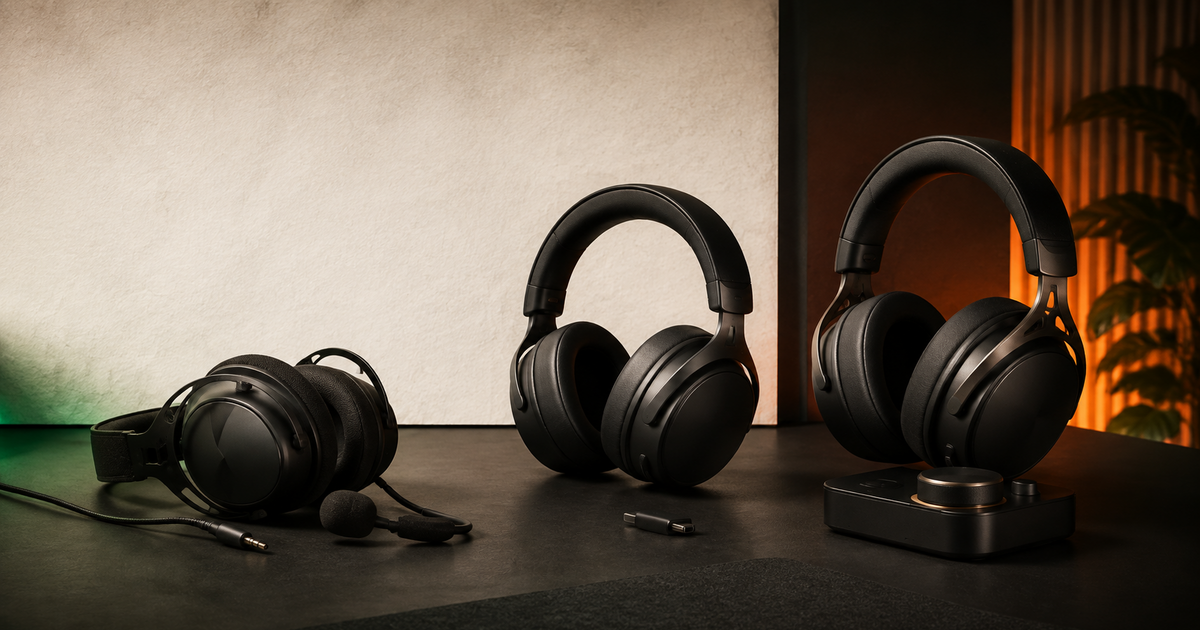
A $50 gaming headset can deliver clear team chat and reliable stereo sound. A $150 model may add low-latency wireless, Bluetooth and app-based EQ. At $350, the extra money often buys active noise cancellation, a charging or control base, hot-swappable batteries, multi-console routing or planar-magnetic drivers.
What it does not buy automatically is better footstep placement, a more comfortable fit or a microphone that sounds three times better.
That is the central lesson of the 2026 market:
For most players, the rational sweet spot is roughly $80–$150. Above $200, the purchase should be justified by a specific feature or specialist use—not by price alone.
We compared 22 representative current products or current manufacturer listings from FiiO, Razer, HyperX, SteelSeries, Logitech G, Astro, Audio-Technica, Audeze, beyerdynamic and Turtle Beach. This is a source-backed buying guide, not a claim that every model was tested side by side on the same head, console and firmware.
The answer in 60 seconds
| Your priority | Start with | Why it makes sense | Main warning |
|---|---|---|---|
| Lowest-cost conventional headset | Razer BlackShark V2 X or SteelSeries Arctis Nova 1 | Simple 3.5 mm connection, low weight, no battery or software dependency | Basic feature set; verify cable and controller routing |
| Safest all-round wired buy | HyperX Cloud III | Broad 3.5 mm/USB compatibility, metal frame, detachable mic | Closed-back and roughly 318 g with mic; fit remains personal |
| Budget USB DSP plus 3.5 mm | FiiO FG3 | USB processing, web EQ, virtual 7.1 modes and analogue fallback at a low China launch price | DSP features depend on USB and compatible host; regional availability varies |
| Quiet-room open-back value | Audio-Technica ATH-GDL3 | Very light, spacious open design, detachable cables and mic | Leaks sound and provides little isolation |
| Cheapest current wireless esports route | Razer BlackShark V3 X HyperSpeed | $99.99 starting price, 2.4 GHz, Bluetooth and USB, 70-hour claim | Buy the correct PC/PlayStation/Xbox version |
| Best mainstream wireless feature balance | SteelSeries Arctis Nova 5 Wireless | 60+ hour claim, 2.4 GHz/Bluetooth switching and mobile-accessible game presets | Nova 5, 5P and 5X are not interchangeable for every platform |
| PC-first mic and software features | Logitech G522 LIGHTSPEED | 48 kHz microphone path and Blue VO!CE, LIGHTSPEED and Bluetooth | Its strongest software value is PC-centric |
| Wireless open-back comfort concept | Turtle Beach Atlas Air | 301 g, open-back design, removable mic and 24-bit PC mode | Not for noisy rooms, nearby people or native Xbox wireless |
| Premium competitive wireless | Razer BlackShark V3 Pro | 10 ms manufacturer latency claim, full-band mic, ANC and 70-hour battery claim | $249.99 is paying for the whole competitive feature package, not just sound |
| Music and cinematic sound first | Audeze Maxwell 2 | 90 mm planar drivers, 24-bit/96 kHz paths and 80+ hour claim | 560 g; weight can matter more than the specification sheet |
| Three-system desk | Astro A50 Gen 5 | Base station and three-system audio switching | The $399 A50 X is only necessary if HDMI video switching is also required |
| Premium ANC and control hub | SteelSeries Nova Pro Wireless or Turtle Beach Stealth Pro II | Multi-system routing, simultaneous Bluetooth, ANC and swappable batteries | Platform/version details are a hard gate; neither is an automatic sound-value winner |
Those are starting points, not universal winners. Head shape, glasses, room noise, platform and microphone expectations can reverse a recommendation.
A gaming headset is eight products hiding in one box
Comparisons go wrong when reviewers collapse every requirement into a single score. A headset can be excellent for one job and frustrating for another.
1. The headphone
Tonality, distortion, bass control, dialogue clarity and spatial presentation all matter. Driver size alone does not establish any of them. A well-tuned 40 mm dynamic driver can be more useful than a poorly implemented 50 mm or 90 mm design.
For competitive games, the useful question is not "Does it have a lot of treble?" It is whether directional cues remain distinct when gunfire, music, voice chat and environmental effects overlap. For story games and music, tonal balance and bass extension may matter more than an aggressively highlighted footstep region.
2. The microphone
A detachable boom, flip-to-mute arm, sidetone and a visible mute indicator can improve daily use more than a dramatic "AI" label. Microphone processing may also depend on a Windows app, USB connection or particular wireless mode. A headset that sounds polished through PC software may behave differently when connected by 3.5 mm to a controller.
If you stream professionally, record voice-over or host a podcast, a convenient boom microphone should not automatically replace a properly positioned USB or XLR microphone.
3. The fit
Weight is only one part of comfort. Clamp, pad depth, heat, headband pressure, ear shape and glasses all matter. Even so, the spread in this guide is meaningful: the ATH-GDL3 is about 220 g, the Atlas Air is 301 g, the beyerdynamic MMX 150 wireless is 336 g, and the Audeze Maxwell 2 is 560 g.
No sound upgrade is valuable if the headset comes off after 45 minutes.
4. The acoustic design
Open-back headsets usually feel airier, leak sound and provide little isolation. They suit a quiet private room and players who dislike sealed-ear pressure.
Closed-back headsets isolate more effectively and keep game audio from disturbing someone nearby. They can feel warmer and may create a more enclosed presentation.
Active noise cancellation is a separate electronic feature. It can help with fans, HVAC, travel and household noise, but it is not proof of better tuning or better positional accuracy.
5. The connection
- 3.5 mm wired: simple, broadly compatible and battery-free, but the controller or computer supplies the analogue output.
- USB wired: can carry the manufacturer's DAC, EQ, microphone processing and spatial features, but compatibility is host-specific.
- 2.4 GHz wireless: usually the preferred wireless path for low-latency gaming.
- Bluetooth: excellent for phones, calls and music; do not assume every Bluetooth path is appropriate for competitive play.
- Simultaneous wireless: lets a phone/Discord source and a game source play together. "Quick switch" may only toggle between them. These are different features.
6. The platform licence
Xbox compatibility is the most common expensive mistake in this category. Manufacturers frequently sell separate Xbox and PlayStation/PC versions. A 3.5 mm fallback may produce audio while USB wireless, chat mix or app functions remain unavailable.
Buy the exact version for the exact console. A family name is not a compatibility guarantee.
7. The software and spatial layer
EQ, mic noise reduction, sidetone, chat mix and game presets can be valuable. They may also be restricted to Windows, a mobile app or one connection mode. SteelSeries Sonar, Logitech G HUB/Blue VO!CE, Razer Synapse/THX and HyperX NGENUITY should be treated as part of the product—not as footnotes.
Virtual 7.1 and height processing are not automatic upgrades. Many games already provide headphone HRTF or platform spatial audio. Stacking two spatial processors can alter cues and tonal balance. Compare native stereo/HRTF with one spatial layer at a time.
8. The ownership system
Battery endurance, replacement pads, detachable cables, replaceable batteries, dongle availability, firmware support and the return window determine long-term value. A $60 wired headset with replaceable pads may outlive a sealed-battery wireless model that costs three times as much.
What changes at each price?
Prices below are official manufacturer list/store references observed on August 14, 2026, before tax. A slash separates the normal reference price from a checked promotional price where the manufacturer displayed both. Stock, color, region and platform version can change the number.
Up to $60: simple wired value—and one unusual USB option
| Product | Official price reference | What the money buys | Best for | Main catch | Verdict |
|---|---|---|---|---|---|
| FiiO FG3 | ¥399 China launch price | USB DAC/DSP, 50 mm + 16 mm coaxial drivers, web EQ, virtual 7.1 modes, detachable ENC mic, 3.5 mm fallback | PC users wanting tuning features on a tight budget | USB-dependent features and regional availability | Strong value for the exact USB/3.5 mm job |
| Razer BlackShark V2 X | From $59.99 | Lightweight 3.5 mm esports-style headset with 50 mm drivers | First headset, controller use, simple competitive setup | Few premium controls; fixed ecosystem is basic | Sensible budget default |
| SteelSeries Arctis Nova 1 | $59.99 launch reference | Lightweight 3.5 mm design, retractable mic and broad analogue compatibility | Multi-platform users who want a simple cable | Sonar's advanced processing is PC software, not a universal console feature | Sensible budget alternative |
At this price, wired is usually the honest choice. You avoid battery, radio and charging costs, so more of the budget can go into the physical headset. The FiiO FG3 is the exception: it adds a real USB DSP feature set, but those extras are only valuable on a compatible USB host.
$60–$100: the wired sweet spot and the beginning of credible wireless
| Product | Official price reference | Design | Best for | Main catch | Verdict |
|---|---|---|---|---|---|
| HyperX Cloud III wired | $99.99 / $79.99 checked | Closed, 3.5 mm, USB-C and USB-A | Ordinary buyer needing one reliable headset for PC and consoles | No wireless; closed pads may run warm | Our safest conventional wired shortlist |
| Audio-Technica ATH-GL3 | $109 / $79 checked | Closed, 3.5 mm, about 230 g | Quiet-looking, very light closed-back setup | At similar money, Cloud III adds USB connection options | Good only when low weight and ATH fit are the priority |
| Audio-Technica ATH-GDL3 | $139 / $99 checked | Open, 3.5 mm, about 220 g | Quiet-room FPS, long sessions, users who dislike sealed cups | Sound leakage and almost no isolation | Excellent open-back value for the right room |
| Razer BlackShark V3 X HyperSpeed | From $99.99 | 2.4 GHz, Bluetooth and USB; about 270 g | Lowest-cost current wireless competitive setup | Exact PC/PlayStation/Xbox version matters | Strong wireless value |
This is where a normal wired buyer can stop. The Cloud III gives broad connection support and durable construction without demanding software. The ATH-GDL3 is a better-shaped answer for a quiet room, not a universally better headphone.
$100–$180: the mainstream wireless sweet spot
| Product | Official price reference | What stands out | Best for | Main catch | Verdict |
|---|---|---|---|---|---|
| SteelSeries Arctis Nova 5 Wireless | $129.99 | 60+ hour claim, 2.4 GHz/Bluetooth quick switch, mobile game presets | Console/PC player wanting useful wireless features without a base station | Select Nova 5, 5P or 5X by platform; quick switch is not the same as mixed audio | One of the strongest ordinary wireless starting points |
| Logitech G522 LIGHTSPEED | $159.99 / $129.99 checked | LIGHTSPEED, Bluetooth, 48 kHz mic path and Blue VO!CE | PC-first player who values chat quality and G HUB controls | Much of its differentiation is software-dependent | Strong PC-first value |
| Turtle Beach Atlas Air | $179.99 / $129.99 checked | Open-back wireless, 301 g, removable mic, 24-bit PC mode | Quiet-room player wanting wireless freedom and ventilation | Leaks sound; no native Xbox wireless claim | Distinctive and worthwhile for the right room |
| Razer BlackShark V3 | From $149.99 | 10 ms manufacturer latency claim, wider-band mic, simultaneous 2.4 GHz/Bluetooth, USB | Competitive player who wants most Pro functions without ANC | Still platform-version specific | Better value than many older $200-class headsets |
| HyperX Cloud III S Wireless | $179.99 MSRP | Up to 120 hours on 2.4 GHz and 200 hours on Bluetooth, detachable and internal mics | Long-battery PC/PS5/Switch user | No native Xbox listing; official US page showed stock/variant inconsistency | Good feature set, verify stock before ranking it as a live buy |
| beyerdynamic MMX 150 wireless | $229.99 / $179.99 checked | Velour pads, 50-hour claim, detachable mic, app tuning | Gaming plus everyday listening, especially for velour-pad fans | 336 g; Xbox uses included analogue cable rather than native wireless | Conditional comfort-and-lifestyle value |
This is the most competitive price band. A good $130–$180 wireless model already covers low-latency game audio, Bluetooth, useful battery life, detachable chat and app tuning. Moving above it should buy a feature you can name.
$180–$280: premium competitive features and the start of diminishing returns
| Product | Official price reference | What the premium buys | Best for | Main catch | Verdict |
|---|---|---|---|---|---|
| Logitech G PRO X 2 LIGHTSPEED | $279.99 / $229.99 checked | 50 mm graphene drivers, 50-hour claim, LIGHTSPEED/Bluetooth/3.5 mm, metal frame and two pad materials | Logitech ecosystem user or esports-style setup wanting build and connection flexibility | At checked pricing, newer rivals may add stronger mic or ANC features | Conditional; compare directly with BlackShark V3/V3 Pro |
| Razer BlackShark V3 Pro | From $249.99 | 10 ms manufacturer latency claim, full-band 12 mm mic, hybrid ANC, simultaneous wireless and 70-hour claim | Serious competitive player in a noisy environment | The non-Pro V3 is much cheaper and retains many core functions | Worth it only when ANC and top mic package matter |
| HyperX Cloud Alpha 2 | $299.99 / $249.99 checked | 250-hour claim, simultaneous 2.4 GHz/Bluetooth and programmable RGB base station | PC desk where extreme battery life and a control hub are valuable | Official US page showed out of stock; Xbox is 3.5 mm only | Interesting specialist, not a default recommendation until stock is reliable |
| Astro A50 Gen 5 | $299.99 / $259.99 checked | Charging base, three-system USB audio switching, graphene drivers and 48 kHz mic path | Player moving between PC, Xbox and PlayStation at one desk | You are paying for routing and dock convenience more than portability | Clear value for a real multi-system desk; overkill otherwise |
The ordinary buyer receives much smaller acoustic gains here than the price jump suggests. The strongest reasons to spend are a better microphone chain, ANC, simultaneous audio, premium materials or a base station that solves daily routing.
$280–$400: specialist systems, not simply “better headsets”
| Product | Official price reference | Specialist value | Best for | Main catch | Verdict |
|---|---|---|---|---|---|
| Audeze Maxwell 2 | About $349 official reference | 90 mm planar drivers, 24-bit/96 kHz USB/wireless paths, 80+ hour claim, broad wired/wireless codec support | Music, cinematic games and users who prioritize sound over weight | 560 g and version-specific Xbox/PlayStation features | Sound-first specialist, not a universal competitive pick |
| SteelSeries Arctis Nova Pro Wireless | $349.99 reference | ANC, simultaneous Bluetooth, two-system base station and two hot-swappable batteries with up to 22 hours each | Player who needs no-downtime power and easy source switching | Correct Xbox version is essential; Sonar's deepest control is PC software | Premium workflow value, not automatic sound value |
| Turtle Beach Stealth Pro II | $349.99 MSRP | 2026 platform, ANC, 24-bit/96 kHz compatible path, dual 40-hour swappable batteries and CrossPlay 2.0 transmitters | Noisy multi-platform desk, especially buyers wanting expandable source switching | 393 g with boom mic; some high-resolution and chat functions vary by platform | Strong current alternative to Nova Pro for a defined system |
| Astro A50 X | $399.99 | Base station switches console audio and HDMI video; 24-hour battery reference | One-TV setup switching PS5, Xbox and PC through the headset base | If audio switching alone is enough, A50 Gen 5 costs less | High mis-buy risk without a real HDMI-switching need |
This tier has three different answers to three different problems. Maxwell 2 is the sound-first option. Nova Pro Wireless and Stealth Pro II are control, ANC and battery systems. A50 X is an HDMI routing appliance attached to a headset. Their prices are similar; their jobs are not.
Above $400: luxury routing and ownership experience
| Product | Official price reference | What it actually adds | Who can justify it | Who should not buy it |
|---|---|---|---|---|
| SteelSeries Arctis Nova Elite | $599.99 | 96 kHz/24-bit wireless processing, GameHub, mixing up to four sources, ANC, on-board mic noise rejection and hot-swappable batteries | Multi-system enthusiast who will use four-source mixing, mobile/PC control and the complete desk hub | Anyone seeking only "better footsteps" or one-console wireless audio |
Nova Elite may be an excellent product for its intended workstation. It is also the clearest example of diminishing returns for an ordinary buyer. Its price funds a complete routing, control, ANC and battery ecosystem. If those jobs are unused, a large part of the purchase becomes lifestyle hardware rather than game performance.
The ordinary-buyer shortlist
HyperX Cloud III wired — the safest conventional recommendation
For someone who says, "I need one headset for PC and consoles and I do not want to troubleshoot wireless," the Cloud III is the cleanest place to start. The manufacturer includes 3.5 mm, USB-C and USB-A connection paths, a detachable 10 mm mic and a metal frame. Its official US page was showing $79.99 against a $99.99 reference price at our check.
It is not the lightest or most feature-rich model here. That is precisely why it works as a default: the buyer is paying for a complete wired headset rather than a software ecosystem.
Buy it when: reliability, broad compatibility and durability matter more than wireless freedom.
Skip it when: you need open-back ventilation, simultaneous phone audio or a charging-free couch setup without a controller cable.
FiiO FG3 — unusual value if its USB features match your host
FiiO's ¥399 China launch price is aggressive for a headset with USB DAC/DSP, a 50 mm + 16 mm coaxial driver layout, web-based EQ, hardware sidetone, game modes, virtual 7.1 and a detachable ENC microphone. It also includes a 3.5 mm route.
The trap is assuming every feature follows every cable. The DSP, virtual modes and control functions depend on USB and a compatible host. The correct way to position FG3 is as a feature-rich budget USB headset with analogue fallback—not as a universal replacement for every console headset.
Buy it when: PC/USB use is central and you will use the tuning features.
Skip it when: local support, console-specific certification or completely platform-independent behavior matters more than feature density.
Audio-Technica ATH-GDL3 — the quiet-room comfort pick
At about 220 g, with an open-back design, detachable boom mic and separate PC/console cables, the ATH-GDL3 solves a problem expensive wireless headsets sometimes make worse: heat and head weight.
Open-back is not a quality badge. It is a room choice. The GDL3 will leak sound and let outside noise in. In a private office or bedroom, that trade can feel natural and spacious. Beside a sleeping partner, a television or a loud fan, it can be the wrong product.
Buy it when: the room is quiet and long-session comfort is more important than isolation.
Skip it when: anyone nearby needs silence or you need to block household noise.
Razer BlackShark V3 X HyperSpeed — the $100 wireless threshold
Razer lists the V3 X HyperSpeed from $99.99. The company specifies 2.4 GHz, Bluetooth and USB modes, about 270 g and up to 70 hours of playtime. That combination makes it a credible first wireless headset rather than a convenience-only compromise.
The family has platform-specific versions. The name on the side of the box is less important than the exact PC, PlayStation or Xbox designation.
Buy it when: low-cost wireless and low weight are the priorities.
Skip it when: you need premium ANC, the V3 Pro's full-band mic or multi-source routing through a desk hub.
SteelSeries Arctis Nova 5 Wireless — the mainstream feature balance
Nova 5's value is not one dramatic component. It is a useful combination: 60+ hour claimed battery life, 2.4 GHz and Bluetooth quick switching, and game-specific presets that can be selected from a mobile companion app. That last point is helpful for console users who cannot run a PC audio suite during play.
Do not confuse switching with simultaneous mixing, and do not assume the Nova 5, 5P and 5X have identical console support.
Buy it when: you want a mature wireless feature set around $130 and do not need a base station.
Skip it when: you need to hear phone and game audio at the same time, ANC or hot-swappable batteries.
Logitech G522 — the PC chat-and-software pick
Logitech positions G522 around PC gaming, with LIGHTSPEED, Bluetooth, synchronized PRO-G drivers, a 48 kHz microphone path and Blue VO!CE processing. At the checked $129.99 promotion, it sits directly in the value-wireless fight rather than the old premium bracket.
The microphone and software story should be evaluated on the connection you will actually use. A PC feature is not automatically available through every console path.
Buy it when: G HUB, Blue VO!CE and PC team chat are part of the daily workflow.
Skip it when: you want a software-light cross-console device or do not care about RGB and mic processing.
Turtle Beach Atlas Air — the open-back wireless outlier
Atlas Air combines two things that rarely meet: a wireless gaming connection and an open-back 301 g design. Turtle Beach lists PC, PlayStation and Bluetooth-equipped mobile compatibility, a removable mic and a high-fidelity 24-bit PC mode.
This is not the right recommendation for a noisy room, and it is not a native Xbox wireless solution. For the right quiet desk, however, it offers a genuinely different wearing and acoustic experience from the many sealed wireless models.
Buy it when: you want open-back ventilation without returning to a cable.
Skip it when: isolation, Xbox wireless or private listening is required.
Who should pay $250–$600?
Competitive FPS players
Pay for low-latency 2.4 GHz, stable fit, usable sidetone and a microphone that remains clear under keyboard noise. The Razer BlackShark V3 at $149.99 already covers most of that feature brief. The $249.99 V3 Pro becomes rational when hybrid ANC and the upgraded full-band mic are valuable.
Logitech G PRO X 2 remains a viable ecosystem and build choice, but its official $279.99 reference price now faces newer feature competition. Do not buy it on the assumption that "pro" branding guarantees a personal fit or an audible competitive advantage.
Music and cinematic-game listeners
Audeze Maxwell 2 is the clearest sound-first premium candidate in this group. Its planar drivers, high-resolution connection paths, codec support and long battery claim are relevant to someone using one headset for games and serious music listening.
The 560 g weight is not a small footnote. Buyers should treat a return window or an in-person fit check as part of the purchase plan.
Multi-console desk owners
Astro A50 Gen 5 is the sensible first premium step because its base station can connect and switch among three systems for audio. A50 X costs more because its PLAYSYNC system also handles console video switching over HDMI.
If you already use the television's HDMI inputs or an AV receiver and only need audio switching, paying $399.99 for A50 X can be unnecessary duplication.
SteelSeries Nova Pro Wireless offers a different desk workflow: two direct USB systems, simultaneous Bluetooth, a control base and hot-swappable batteries. Turtle Beach Stealth Pro II adds a current 2026 alternative with CrossPlay 2.0 and optional additional transmitters.
Noisy-room players
ANC is worth real money when HVAC, a desktop fan, travel noise or a shared room repeatedly masks low-level detail. Razer BlackShark V3 Pro, SteelSeries Nova Pro Wireless, Turtle Beach Stealth Pro II and SteelSeries Nova Elite all target this problem at different prices.
ANC is much less valuable in a quiet private room. In that case, an open-back GDL3 or Atlas Air may be more comfortable and cost less.
Long-session and accessibility-focused users
The premium choice is not always the humane choice. A 220 g wired open-back model can be easier to live with than a 560 g planar wireless flagship. For neck sensitivity, heat sensitivity, glasses or limited reach, prioritize weight, pad material, control placement, audible status prompts, a reliable mute indicator and charging behavior before driver technology.
Streamers and creators
Headsets such as Logitech G522 and Razer BlackShark V3 Pro emphasize higher-bandwidth microphone paths and processing. They can be excellent for team chat and casual streaming. For consistent broadcast voice, the better use of a premium budget may be a comfortable $100–$150 headset plus a separate microphone on a boom arm.
The premium-feature reality check
| Premium feature | Worth paying for when… | Mostly wasted when… |
|---|---|---|
| Active noise cancellation | repeatable room or travel noise masks game detail | the room is already quiet |
| Simultaneous Bluetooth | calls, Discord or music must coexist with game audio | you only use one source |
| Base station / control hub | you switch systems or adjust chat/EQ every session | the headset stays on one PC and software already handles routing |
| Hot-swappable batteries | charging interruptions are genuinely unacceptable | a 60–120 hour conventional battery already covers the week |
| HDMI switching | one television regularly switches between supported consoles | an AV receiver, TV inputs or monitor already solve video routing |
| Planar-magnetic drivers | music quality and low-distortion full-range playback are priorities | low weight and pure competitive use matter more |
| 24-bit/96 kHz wireless | the source, platform and content path support it and music playback matters | it is treated as proof of better footsteps |
| Four-source mixing | a creator or multi-system desk actually mixes several sources | one console and one phone are the whole setup |
| RGB | visual integration is part of the desired desk experience | the lights are disabled after setup |
The rule is simple: if you cannot name the source, platform and weekly action that uses a premium feature, do not pay for it yet.
The traps that cause the most returns
Trap 1: buying the wrong console version
This is not a minor detail. Audeze, Razer and SteelSeries sell version-specific products, and Xbox support can require the Xbox-designated model. Confirm game audio, microphone, chat mix, USB wireless and app behavior separately.
Trap 2: treating Bluetooth as the gaming connection
Bluetooth is useful for phones and secondary audio. For timing-sensitive play, use the headset's supported 2.4 GHz dongle, USB path or cable unless a documented low-latency Bluetooth workflow exists end to end.
Trap 3: assuming virtual 7.1 improves every game
Spatial processing can help immersion or preference. It can also duplicate a game's HRTF or the console's own spatial layer. Start with stereo or the game's native headphone mode, then compare one additional processor at a time.
Trap 4: buying by driver diameter
Forty, fifty and ninety millimetres describe physical dimensions, not a finished performance ranking. Tuning, enclosure, diaphragm behavior, pad seal and DSP all affect the result.
Trap 5: paying for microphone software you cannot run
Blue VO!CE, Sonar AI noise reduction, THX/Synapse features and other tools may depend on Windows or a particular connection. A console player should verify what processing remains on-device.
Trap 6: ignoring open-back leakage
Open-back headphones can be comfortable and spacious, but nearby people will hear them and the player will hear the room. They are not the "better" version of closed-back; they are a different environmental choice.
Trap 7: ignoring weight because reviews praise the sound
Maxwell 2's 560 g specification is the obvious example, but clamp and pad pressure can make lighter products uncomfortable too. Buy from a seller with a workable return policy if you cannot try the headset.
Trap 8: buying a dock without checking the desk
A base station consumes USB ports, power, cable space and surface area. Check whether it switches audio only or audio plus video, how many sources it accepts, and whether the required ports conflict with a dock, capture card or display.
Trap 9: buying a current-looking product that is unavailable
At our check, HyperX's older Cloud III Wireless listing was discontinued/out of stock, while Cloud III S Wireless was the current replacement path. Cloud Alpha 2 and some Cloud III S variants also showed stock limitations. A product page is not proof of immediate availability.
A five-minute buying decision
- Write down the exact platform or platforms: PC, PS5, Xbox, Switch/Switch 2, mobile.
- Choose the primary connection: 3.5 mm, USB, 2.4 GHz dongle or Bluetooth.
- Decide whether the room needs isolation, ANC or an open-back design.
- Set a maximum comfortable weight and identify whether glasses or heat are recurring problems.
- Decide whether phone audio must play simultaneously with game audio or only switch between sources.
- List the software-only features you can actually run on your platform.
- If spending above $200, name the premium function that a $130–$180 model cannot perform.
- Verify the exact platform version, not just the product family.
- Check replacement pads, dongle availability, warranty and return terms.
If step 7 has no clear answer, stop in the mainstream tier.
Final verdict
There is no universal "best gaming headset" because the category combines headphone, microphone, radio, software, platform licence and ergonomics. Price increases do not improve all six at the same rate.
For most people, the best value sits in three places:
- Around $60: simple wired models such as BlackShark V2 X or Arctis Nova 1.
- Around $80–$100: HyperX Cloud III for conventional wired use, ATH-GDL3 for quiet-room open-back use, or BlackShark V3 X HyperSpeed for entry wireless.
- Around $130–$180: Arctis Nova 5, Logitech G522, Atlas Air, BlackShark V3, Cloud III S Wireless or MMX 150 wireless, selected by platform and room rather than brand rank.
Above $200, buy a specialist solution. BlackShark V3 Pro targets competitive wireless plus ANC. Maxwell 2 targets sound and music. A50 Gen 5 targets three-system desks. Nova Pro Wireless and Stealth Pro II target ANC, battery continuity and multi-source control.
A50 X and Nova Elite can be worth their high prices, but only when HDMI switching or four-source mixing is part of the real daily system. For a single PC or console, they carry a high mis-buy risk because the owner pays for infrastructure that may never be used.
The most sensible gaming headset is not the one with the longest feature list. It is the lightest, least expensive model that fits your head, supports your exact platform and performs every job you will use.
Evidence / Sources
Product capabilities, platform notes and canonical records were cross-checked against the SoundPath Lab System Builder v2.3 baseline and current manufacturer information. Key public sources include:
- FiiO FG3 official product page
- FiiO FG3 launch and China pricing announcement
- Razer BlackShark V2 X official product page
- Razer BlackShark V3 X HyperSpeed official product page
- Razer BlackShark V3 official product page
- Razer BlackShark V3 Pro official product page
- HyperX Cloud III wired official product page
- HyperX Cloud III S Wireless official product page
- HyperX Cloud Alpha 2 official product page
- SteelSeries Arctis Nova 1 official product page
- SteelSeries Arctis Nova 5 official product page
- SteelSeries Nova 5 price and battery announcement
- SteelSeries Arctis Nova Pro Wireless official product page
- SteelSeries Arctis Nova Pro model-connection differences
- SteelSeries Arctis Nova Elite official product page
- SteelSeries Nova Elite price announcement
- SteelSeries Sonar official overview
- Logitech G522 LIGHTSPEED official product page
- Logitech G PRO X 2 LIGHTSPEED official product page
- Logitech Astro A50 Gen 5 official product page
- Logitech Astro A50 X official product page
- Logitech PLAYSYNC audio/video switching explanation
- Audio-Technica ATH-GL3 official product page
- Audio-Technica ATH-GDL3 official product page
- Audeze Maxwell 2 official product page
- beyerdynamic MMX 150 wireless official product page
- Turtle Beach Atlas Air official product page
- Turtle Beach Stealth Pro II official product page
- Turtle Beach Stealth Pro II price announcement
Evidence labels
- Verified fact: a capability, compatibility statement, weight, price or availability state observed in a current manufacturer record at the stated check date.
- Manufacturer claim: latency, battery-life, noise-reduction, spatial-accuracy and sonic-performance descriptions supplied by the manufacturer. These are not treated as independently proven comparative results.
- Editorial judgment: the value, conditional-value and high-mis-buy-risk conclusions in this guide.
Tested firmware / app / hardware revision
This is a source-backed buying guide, not a simultaneous hands-on test of all 22 products. No single firmware, app or hardware revision applies across the comparison. Software processing, platform support, battery performance and console behavior can change.
Last checked
August 14, 2026. Prices are manufacturer list/store references where available, before tax and subject to region, stock, color, platform version and promotion changes. A crossed-out or sale price is a dated snapshot, not a promise of the current lowest price.
Limitations
- The 22-product comparison is representative, not exhaustive.
- We did not perform controlled, level-matched listening, microphone and latency tests of every headset on the same head, PC, console and firmware.
- Comfort is anatomy-dependent. Weight and materials inform fit but do not predict it completely.
- Manufacturer battery figures use their own test conditions and are not directly comparable without a shared protocol.
- Platform compatibility can differ by model suffix, connection mode and firmware. Unknown compatibility must not be treated as support.
- Official pages for HyperX Cloud III S Wireless and Cloud Alpha 2 showed stock limitations at the check date.
- Promotional prices can move a product between tiers without changing its hardware.
Retailer link disclosure
Retailer availability, stock position and commercial status had zero weight in the verdicts. Some published buying links may generate revenue at no additional cost to the reader. Official product sources are shown separately from third-party buying options, and retailer links do not convert manufacturer claims into verified facts.
Continue the research
Move from this article to a verified product decision
Use descriptive links to move between product records, brand evidence, comparisons, setup or issue guidance, and compatible-system tools. Inclusion reflects subject relevance, not a score or endorsement; product facts, recommendation eligibility, and commercial links remain separate.
Product page
Verify the exact model
Brand center
Check the wider platform
Related comparison
Compare the system role
Setup, firmware & problems
Check behavior before buying
System Builder & compatibility