
Eversolo T10 + External DAC vs DMP-A8 Gen 2: Better Sound or More Boxes?
Compare the complete T10-plus-DAC chain with the integrated DMP-A8 Gen 2 by DAC choice, volume control, TV and subwoofer use, cost and upgrade risk.

This comparison is easy to frame badly. The T10 is a digital transport and cannot drive an analog amplifier by itself. The DMP-A8 Gen 2 is a streamer, DAC and analog preamplifier. A fair decision therefore compares a complete T10 system—transport, external DAC, volume control where required and cables—with the A8 Gen 2 as a complete source and preamp.
The T10 route offers freedom. The A8 Gen 2 offers integration. Neither is automatically the higher-fidelity choice.
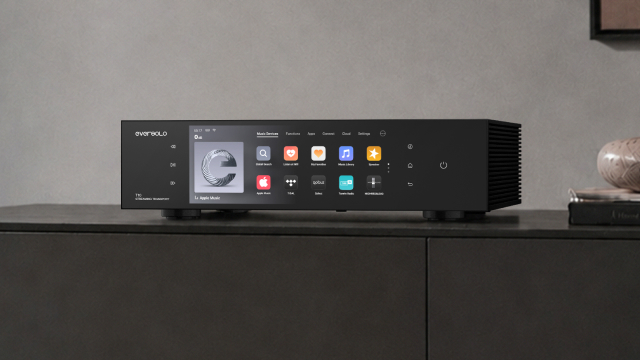
Eversolo T10. Official product image; manufacturer-supplied.
The decision in one minute
Buy the DMP-A8 Gen 2 if you want one chassis to handle streaming, digital and analog inputs, DAC conversion, analog volume control, TV audio and subwoofer integration. It is the safer default for an active-speaker system or a power-amplifier-based stereo.
Buy the T10 plus an external DAC if you already own a DAC you intend to keep, need a DAC topology or output stage the A8 does not provide, want to upgrade transport and conversion independently, or require the T10's isolated digital outputs and external-clock input.
Do not assume that separating the boxes improves sound. A separate DAC adds another power supply, interface, cable and compatibility layer. It can be better, equal or worse.
What each purchase actually includes
| Capability | T10 + external DAC | DMP-A8 Gen 2 |
|---|---|---|
| Streaming and local library | T10 | Built in |
| DAC | Buyer chooses; required | AK4191EQ + AK4499EXEQ architecture built in |
| Analog volume control | Depends on DAC or separate preamp | R-2R resistor-ladder analog volume control |
| Analog inputs | Depends on DAC/preamp | RCA and balanced XLR pre-input |
| TV input | Depends on DAC | HDMI ARC/eARC, stereo PCM up to 192 kHz/24-bit |
| Subwoofer integration | Depends on DAC/preamp | Dedicated subwoofer functions are part of the A8 Gen 2 platform |
| Digital-output specialization | Isolated USB and IIS; 10/25 MHz clock input | USB, IIS, coaxial, optical and AES outputs, but no T10-style external-clock input listed |
| Upgrade path | Transport and DAC can change separately | Simpler, but replacing the DAC section normally means adding another DAC or replacing the unit |
| Box and cable count | At least two components | One component |
Why the A8 Gen 2 is more than “a T10 with a DAC”
The A8 Gen 2's value is system control. It accepts USB-B, optical, coaxial, HDMI ARC/eARC, Bluetooth and analog sources. Its analog outputs can feed a power amplifier or active speakers, and its R-2R ladder changes volume in the analog domain rather than relying only on digital attenuation.
Eversolo publishes analog performance figures of 0.000075% THD+N for XLR output and 0.000086% for RCA, with dynamic range above 129 dB and 127 dB respectively. These are manufacturer specifications, not yet independently verified by SoundPath Lab, but they describe an analog stage that should not be dismissed as a convenience feature.
The A8 Gen 2 also uses 8 GB DDR5 memory, 64 GB eMMC storage, an optional M.2 NVMe SSD up to 8 TB, Wi-Fi 6 and SFP networking. For most owners, it supplies the same daily library and streaming experience without requiring a second manufacturer’s app or remote.
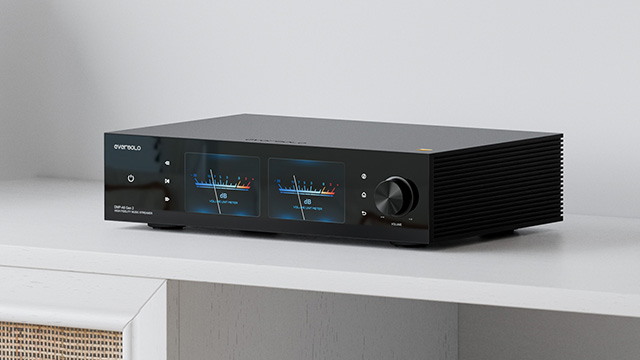
Eversolo DMP-A8 Gen 2. Official product image; manufacturer-supplied.
When the T10 route is genuinely better
You already own the DAC
If the DAC is proven, compatible and has the analog outputs or headphone stage you need, the T10 avoids paying for another conversion and preamp stage. This is the cleanest case for the transport.
You need a different conversion architecture
Some buyers deliberately choose R-2R, FPGA-based, multibit or tube-output DACs. Others need studio-level output, headphone drive, multiple analog zones or a specific digital filter. The T10 keeps those choices open.
You want independent lifecycle control
Streaming platforms and DAC design age at different rates. A modular chain lets you replace a transport when software support ends while retaining the DAC, or upgrade the DAC without rebuilding the library interface. The benefit is strongest when both products have good long-term support; more boxes do not guarantee a longer useful life.
You have a verified interface or noise problem
The T10's isolated USB and IIS outputs may help when a measurable ground-noise or digital-interface issue exists. The phrase “may help” matters: the external DAC's own isolation and input receiver determine the outcome.
When the A8 Gen 2 is the smarter system
You connect directly to a power amplifier or active speakers
The A8 supplies analog volume control and balanced or RCA outputs in one unit. With a T10, the external DAC must provide safe volume control or you need a separate preamp. Never connect a fixed full-scale DAC output directly to a power amplifier unless the system has another confirmed volume-control stage.
TV and subwoofer use matter
HDMI ARC/eARC, source switching and subwoofer management can be worth more than a small theoretical improvement in digital timing. A system used every day should be judged by reliable wake-up, volume control, lip-sync, input switching and family usability as well as two-channel music performance.
You want fewer failure points
One chassis removes a digital cable, a power cable, an input handshake and one vendor-support boundary. Troubleshooting is easier. That is a real ownership advantage.
The budget trap
Buyers often compare the T10's price with the A8 Gen 2 and mentally treat the external DAC as free. It is not free even if it is already owned: it occupies space, uses power, has resale value and may still require a preamp or subwoofer solution.
Compare total system cost:
T10 + DAC + preamp if needed + digital cable + analog cables + clock and clock cables if planned.
Then ask whether the extra cost improves a measured limitation, supplies a required feature, or simply creates a more elaborate rack.
Connection recommendations for a T10 system
- Start with asynchronous USB if the DAC has a stable, well-supported UAC input. It offers the broadest PCM/DSD support and avoids IIS pinout uncertainty.
- Use AES/EBU when both devices implement it well and cable length or balanced interfacing matters.
- Use optical when breaking an electrical ground path is the priority and 192/24 plus DoP64 is sufficient.
- Try IIS only after confirming pinout, clock polarity and DSD mode. “HDMI cable fits” is not compatibility evidence.
- Add an external master clock only after the transport–DAC chain works normally and you have a way to verify the result.
Our verdict by owner type
| Owner | Better starting point | Reason |
|---|---|---|
| Starting a high-quality stereo from zero | DMP-A8 Gen 2 | Complete, lower-risk signal and control path. |
| Already owns a favorite DAC with volume control | T10 | Avoids duplication and preserves DAC choice. |
| Active speakers plus TV and subwoofer | DMP-A8 Gen 2 | Integration is likely more valuable than transport specialization. |
| High-end DAC with documented IIS/clock compatibility | T10 | Its dedicated outputs and reference input can be used intentionally. |
| Constant DAC upgrader | T10 | Modular path and easier component rotation. |
| Wants the fewest boxes | DMP-A8 Gen 2 | One chassis covers the complete source/preamp role. |
Final position
A T10 plus external DAC is not an automatic upgrade over the DMP-A8 Gen 2. It is a platform for choosing a different DAC and a different system architecture. If those choices solve a specific requirement, it can be the better long-term purchase. If they do not, the A8 Gen 2's integrated analog stage, volume control and input flexibility are likely to deliver more usable value with less risk.
Sources and evidence status
- Eversolo T10 official product page
- Eversolo DMP-A8 Gen 2 official product page
- Evidence level: official specifications and system-design analysis; no SoundPath Lab controlled listening or bench comparison yet.
- Last verified: 10 September 2026.
Continue the research
Move from this article to a verified product decision
Use descriptive links to move between product records, brand evidence, comparisons, setup or issue guidance, and compatible-system tools. Inclusion reflects subject relevance, not a score or endorsement; product facts, recommendation eligibility, and commercial links remain separate.
Product page
Verify the exact model
Brand center
Check the wider platform
Related comparison
Compare the system role
Setup, firmware & problems
Check behavior before buying
System Builder & compatibility