
Built-in Phono Preamp vs External Phono Stage: What Actually Matters?
Choose a built-in or external phono stage by cartridge compatibility, gain, noise, connections and upgrade needs—not by price or box count.

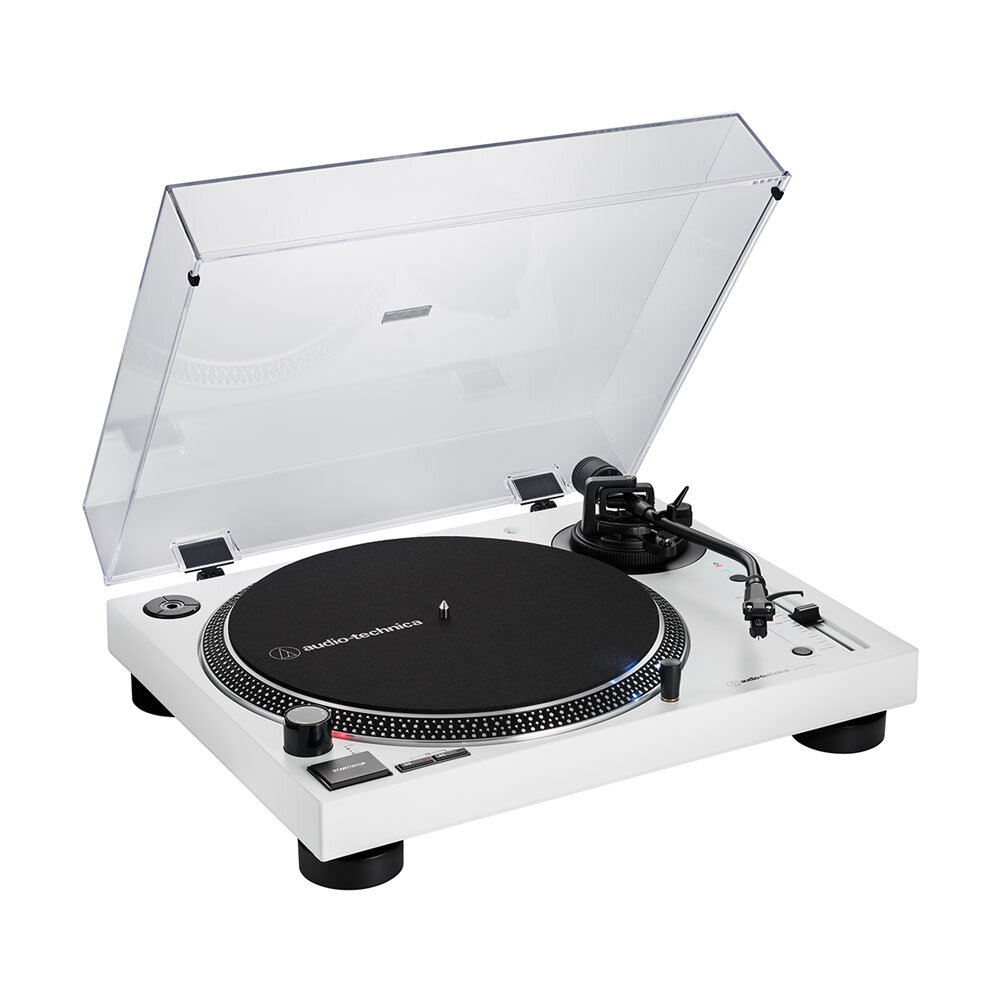
Evidence label: Buying Guide / Technical Analysis — based on phono-stage requirements, manufacturer documentation and system design. This is not a simultaneous listening test of specific products.
Short answer: use the built-in phono preamp when it provides the correct cartridge compatibility, enough gain, acceptable noise and the connections you need. Buy an external phono stage only when it solves a defined problem. “External” does not automatically mean quieter, more accurate or better sounding.
Why a phono stage is required
A conventional phono cartridge produces a much lower signal than a normal line-level source. The playback chain also needs RIAA equalization. A phono preamp supplies the required gain and equalization before the signal reaches an AUX, CD or LINE input, powered speaker or normal preamplifier.
Your system should normally contain one active phono stage:
- Turntable set to PHONO → amplifier PHONO input.
- Turntable set to LINE → amplifier AUX/CD/LINE input.
- Turntable set to PHONO → external phono stage → amplifier AUX/CD/LINE input.
Do not run a turntable’s LINE output into another PHONO input. That places two phono stages in series and can produce excessive gain, strong tonal error and distortion.
When the built-in preamp is the sensible choice
- You use the cartridge supplied with the turntable.
- The turntable connects directly to powered speakers or an amplifier without a PHONO input.
- You want fewer cables, power supplies and grounding variables.
- The noise level is inaudible from the listening position at normal volume.
- You do not need adjustable gain, loading or mono/filter functions.
For a first system, this route often has the lowest hidden cost. It avoids another box, another power supply and another pair of interconnects. It can also make fault-finding easier because there are fewer places for hum or level mistakes to enter.
When an external phono stage can be useful
- Cartridge compatibility: the cartridge is moving-coil, unusually low-output, or requires gain/loading options the built-in stage does not provide.
- Noise or overload: you have verified that the existing stage—not grounding, cabling or downstream gain—is the source of audible noise or overload.
- Adjustment: you need selectable gain, impedance, capacitance, a subsonic filter or mono function.
- System architecture: the turntable is far from the amplifier, the amplifier lacks a phono input, or a justified cable run requires another output arrangement.
- Upgrade path: you plan to keep the stage while changing turntables or cartridges.
An external unit is a tool for matching and control. Its separate chassis and price are not proof of better performance.
MM and MC are not interchangeable labels
Moving-magnet cartridges commonly produce more output than low-output moving-coil cartridges. A stage designed only for MM may not provide enough gain for a low-output MC cartridge, while an MC setting can overload or add unnecessary noise with the wrong source. Check the cartridge’s output and recommended load against the phono stage’s documented input settings.
If a manufacturer does not publish gain, supported cartridge type or loading information, treat compatibility as unknown. Do not assume that a high price or an “audiophile” description fills the missing specification.
What can actually change
Two compatible phono stages can differ in gain accuracy, noise, overload margin, input capacitance or resistance, channel matching and filtering. Those differences can matter, especially with a cartridge that is sensitive to loading. But a different tonal balance is not automatically more accurate, and extra gain can create a misleading “more detailed” impression when levels are not matched.
The cartridge, stylus condition, alignment and record quality remain part of the result. A new phono stage cannot repair wear, mistracking or incorrect setup.
Hidden costs buyers forget
- An additional pair of short, suitably specified interconnects.
- A power outlet and another power supply near sensitive analogue wiring.
- Space away from transformers, routers and switching supplies.
- Grounding arrangements and time spent diagnosing hum.
- Possible cartridge replacement or stylus wear that no phono stage can repair.
- Return costs if the gain or loading range does not fit the cartridge.
How to compare fairly
- Confirm both signal paths use exactly one phono stage.
- Use the same cartridge, record, amplifier, speakers and listening position.
- Match playback level. More gain can sound more exciting even when it is not more accurate.
- Listen for hum and hiss between tracks as well as music.
- Check whether a perceived difference remains after repeated level-matched switching.
Common symptoms and the first check
| Symptom | First check |
|---|---|
| Very quiet, thin sound | A PHONO-level signal may be feeding a normal line input without a phono stage. |
| Very loud, distorted sound | A LINE-level signal may be feeding a PHONO input, creating double amplification/equalization. |
| Hum | Check grounding, cable routing and connection sequence before buying another stage. |
| Hiss | Check gain setting, cartridge output and downstream amplifier/speaker gain. |
| Uneven channels | Check stylus, cartridge alignment, headshell contacts and cables before blaming the preamp. |
Verdict
Keep the built-in phono preamp when it is compatible, quiet enough and operationally simple. Choose an external stage when you can name the missing capability: correct MC gain/loading, lower verified noise, a useful filter, better control or a reusable upgrade path. If you cannot identify the problem it solves, spend first on setup, stylus condition, cartridge alignment, records or speakers.
Sources
- Audio-Technica — What the PHONO/LINE switch means
- Audio-Technica — Phono preamplifier function
- Audio-Technica AT-LP120XUSB — selectable built-in phono preamp example
Last checked: 5 September 2026. Manufacturer sources establish functions and routing, not the editorial verdict. The pictured product is illustrative only. No product received ranking preference.
Continue the research
Move from this article to a verified product decision
Use descriptive links to move between product records, brand evidence, comparisons, setup or issue guidance, and compatible-system tools. Inclusion reflects subject relevance, not a score or endorsement; product facts, recommendation eligibility, and commercial links remain separate.
Product page
Verify the exact model
Brand center
Check the wider platform
Related comparison
Compare the system role
Setup, firmware & problems
Check behavior before buying
System Builder & compatibility