
$500 / $1,000 / $2,000 Audio Budget: Where Should the Money Go?
A practical way to split a $500, $1,000 or $2,000 audio budget without letting the most exciting box become the system's real bottleneck.
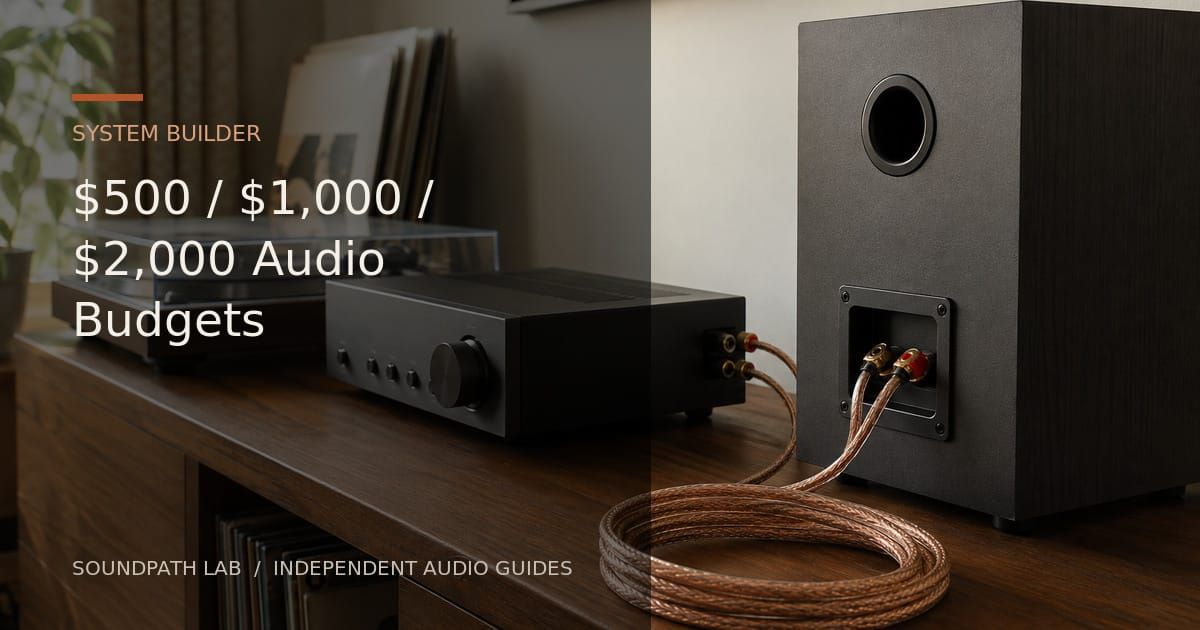
A friend once sent me a photo of his desk and asked a very familiar question: “I have about $1,000. Which DAC should I buy?”
The photo told a different story. His speakers were pushed against the wall, one sat partly behind a monitor, and both were firing across a bare glass desk. The DAC was not the first problem. It was simply the most exciting box to shop for.
That is why a useful audio budget should not begin with product names. It should begin with the part of the system that is most likely to limit the result.
There is no universal percentage
The numbers below are starting points, not laws. A headphone system, a pair of powered speakers and a passive living-room setup do not divide money in the same way. Before spending anything, answer four ordinary questions:
- Are you listening at a desk, on a sofa, or while travelling?
- Do you already own speakers or headphones you actually like?
- Is the problem sound quality, low volume, noise, missing inputs, or simply inconvenience?
- Will the system need to work with a TV, game console or streaming service?
If the current system already plays loudly, has no audible noise and connects to everything you use, a new amplifier or DAC may solve very little.
If the total budget is $500
At this level, keep the chain short. For a desktop speaker system, a sensible starting split is roughly 60% for speakers, 15–20% for the source or volume control, 10% for placement and stands, and the rest as a reserve for the cable or adapter you did not realise you needed.
For headphones, put about 55–65% into the headphones themselves. A modest USB DAC/headphone amplifier is usually enough unless the headphones are unusually insensitive or difficult to drive.
The common mistake is spending $250 on electronics and leaving $200 for the thing that actually makes the sound. A beautifully machined DAC cannot turn tiny speakers in a bad position into full-range speakers.
If the total budget is $1,000
Now there is room to solve convenience as well as sound. A practical split is 50–60% for speakers or headphones, 15–25% for amplification, 10–15% for the source, and 10% for placement, basic room treatment or useful accessories.
This is also the budget where people accidentally buy the same feature twice. A streaming amplifier, a separate streamer and a DAC may all contain digital-to-analogue conversion and volume control. Before buying three boxes, draw the signal path on paper. If two devices do the same job, decide which one you actually want to control every day.
With passive speakers, the amplifier naturally takes a larger share. With powered speakers, the amplifier is already inside the speaker, so more of the budget can stay with the speakers and the room.
If the total budget is $2,000
At $2,000, the danger is not buying something too cheap. It is building a complicated system because the budget allows it.
For speakers in a real room, a useful starting point is 45–55% for speakers, 15–25% for amplification, 10–15% for source and control, and 10–20% for stands, subwoofer integration or room improvement. If the room has obvious echo, asymmetric placement or a sofa pressed against the rear wall, spending part of the budget on the room can beat spending the same amount on a more expensive DAC.
For a headphone system, it is still reasonable for the headphones to remain the single largest purchase. Do not assume a $2,000 budget requires a $700 amplifier. Buy power for the headphones you own, not for an imaginary future collection.
Three signs the money is going to the wrong place
- The electronics cost more than the transducers, but the original problem remains unclear.
- You are upgrading before fixing placement, gain, noise or connection problems.
- The purchase is justified by words such as “more musical” but has no clear job in the signal chain.
A better way to start
Write down the current chain from source to ear. Circle the part that causes a real problem. Then price the smallest change that removes that problem.
Sometimes the answer is a new pair of speakers. Sometimes it is a $20 stand, a different input, a firmware setting, or moving the desk ten centimetres away from the wall. The goal is not to spend the budget evenly. The goal is to stop one weak link from deciding the result for everything else.
SoundPath Lab note: These ratios are planning guides, not universal rules. We will adjust them as we publish measured systems and real user cases. If you already own part of the chain, the “saved” budget should not automatically be spent elsewhere.
Continue the research
Move from this article to a verified product decision
Use descriptive links to move between product records, brand evidence, comparisons, setup or issue guidance, and compatible-system tools. Inclusion reflects subject relevance, not a score or endorsement; product facts, recommendation eligibility, and commercial links remain separate.
Product page
Verify the exact model
Brand center
Check the wider platform
Related comparison
Compare the system role
Setup, firmware & problems
Check behavior before buying
System Builder & compatibility