
$300 Desktop Near-Field Audio System: A Practical Chain Before You Overspend
A realistic $300 desktop chain that spends money on speakers, placement and daily usability before adding extra boxes.
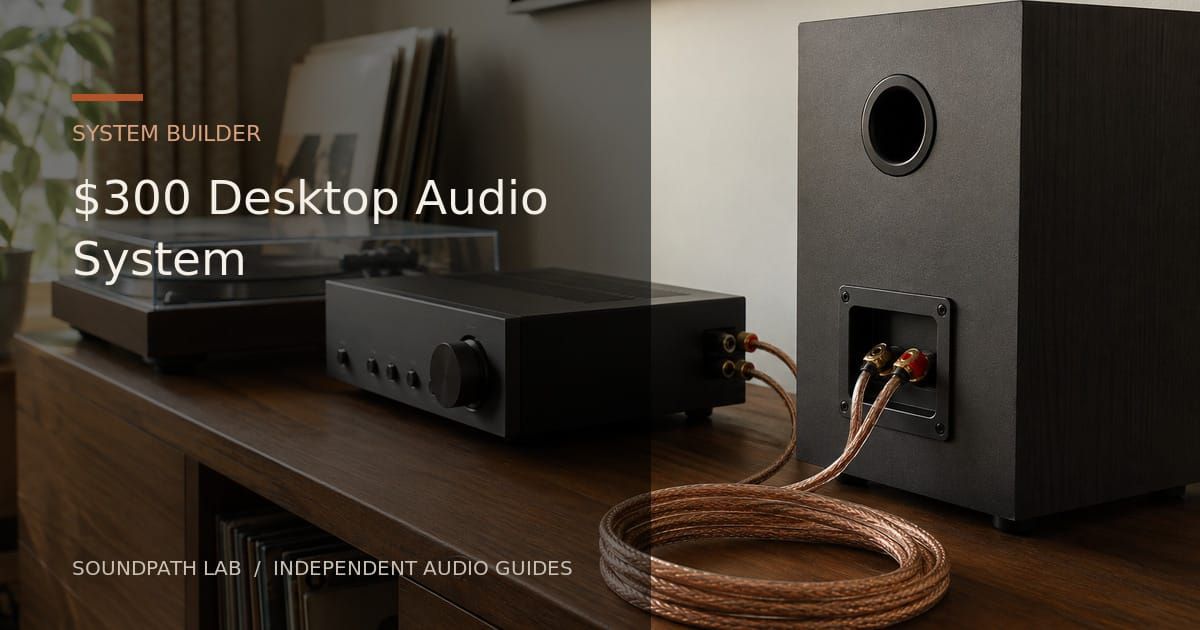
Most small desktop systems do not fail because the owner chose the “wrong” DAC chip. They fail because the speakers are too large for the desk, the volume knob is awkward to reach, or the left speaker is tucked behind a laptop.
With about $300, the best system is usually the one with the fewest unnecessary boxes.
The reference chain
Computer → USB DAC or simple audio interface with volume control → compact powered speakers → small stands or isolation pads
This is a reference build, not a claim that every product in this price range has been bench-tested by SoundPath Lab. The point is the chain itself: one digital connection, one reachable volume control, amplification inside the speakers, and enough money left to place them properly.
Where the $300 goes
- $170–210: powered speakers. This is where most of the audible result comes from.
- $50–90: USB DAC or interface. It should provide stable output, a physical volume control and the connections the speakers need.
- $20–40: stands, pads and the correct cable. Not glamorous, but often more useful than moving to the next DAC tier.
- $0–30 reserve. Keep it until the system is connected. You may need a longer cable, a USB adapter or a ground-noise fix.
Why powered speakers make sense here
A passive system can be excellent, but at $300 it forces the budget to cover speakers, an amplifier and usually a volume control. Powered speakers combine two of those jobs. They also reduce the chance of buying an amplifier that is physically too large for the desk.
The trade-off is future flexibility. If the amplifier inside the speaker fails, or you later want to change amplification, the system is less modular. That is acceptable for many desks, but it should be a conscious choice.
Set it up before judging it
Place the tweeters roughly at ear height. Keep the left and right speakers at similar distances from your head. If the desk allows it, form a small triangle rather than firing the speakers straight past you.
Do not push a rear-ported speaker hard against the wall and then immediately shop for a “tighter” amplifier. Move it forward first. If the bass is still boomy, try the speaker's boundary or desk setting, if it has one.
Set the computer near full digital output unless the software or device manual says otherwise, then use the hardware volume control for daily listening. Start quietly. A near-field system does not need to fill the whole house to sound convincing at the desk.
Three versions of the same idea
For music and everyday work
Prioritise quiet operation, a convenient volume knob and speakers that fit beside the monitor. Bluetooth is useful, but USB should remain the main computer connection when stability matters.
For gaming and films
Check latency and console compatibility before buying. A USB device that works perfectly with a PC may not be recognised by a game console. If the monitor or TV has optical output, that can be the simpler shared route.
For recording or microphones
Choose an audio interface rather than a consumer DAC. You may give up some streaming features, but you gain microphone inputs and direct monitoring. Do not pay for both devices unless you have a clear reason.
When this chain is the wrong choice
Skip it if you need a living-room TV system, very deep bass without a subwoofer, high volume across a large room, or an easy path to passive-speaker upgrades. A desktop system should be judged at desktop distance.
The useful test
After one week, ask three questions: Can you reach the volume control without thinking? Is dialogue clear at normal levels? Can you work for an hour without the sound becoming tiring?
If the answer is yes, do not let a forum convince you that the system is unfinished because it only has two boxes.
Chain status: reference build. Specific product combinations will be labelled “tested” only after SoundPath Lab has verified the complete chain or documented a repeatable owner case.
Continue the research
Move from this article to a verified product decision
Use descriptive links to move between product records, brand evidence, comparisons, setup or issue guidance, and compatible-system tools. Inclusion reflects subject relevance, not a score or endorsement; product facts, recommendation eligibility, and commercial links remain separate.
Product page
Verify the exact model
Brand center
Check the wider platform
Related comparison
Compare the system role
Setup, firmware & problems
Check behavior before buying
System Builder & compatibility