
Eight Desktop DACs Compared: Choose by System, Features and Evidence
A scenario-based shortlist of dedicated DACs and DAC/headphone amplifiers, including two Q7 voltage checks, DIY limits and current TOPPING software considerations.
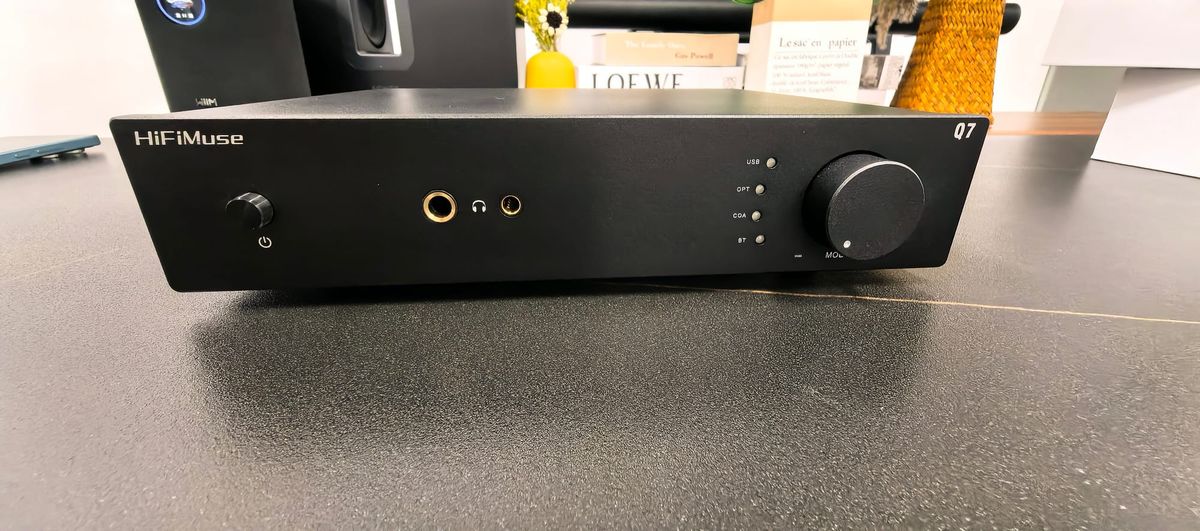
Sources reviewed: 29 September 2026. Prices are dated references; measurement and verification limits are noted below.
The right desktop DAC is the one that fits the rest of your system. If an amplifier already handles headphones and speaker volume, a dedicated converter may be enough. If one box must serve headphones and powered speakers, output modes, load capability and daily operation deserve just as much attention as its conversion chip.
This shortlist compares eight products in two groups. It does not assign an overall sound-quality rank or a numerical total score. Product order within each group is not a performance ranking, and we have not tested all eight on one measurement bench.
Operator and independence: SoundPath Lab is operated by FASTHiFi in Hong Kong. SoundPath Lab uses HiFiMuse Q7 as the product name. The canonical Q7 record and evidence retain one identity and one set of test records; the existing product URL and evidence associations are preserved. Commercial context is documented in the disclosure policy. No manufacturer paid for placement in this shortlist.
Mobile: swipe left or right inside tables to view all columns.
Start with the system you already own
| Your need | Start with | What decides the choice |
|---|---|---|
| RCA conversion for an existing amplifier | SMSL SU-1 | Whether the rest of the system already provides volume control. |
| TV ARC plus balanced speaker connections | Fosi ZD3 | ARC/CEC behavior with the actual television; no headphones. |
| Computer-fed line DAC with PEQ | TOPPING D50 III | USB-only PEQ; balanced TRS rather than XLR sockets. |
| DIY-oriented DAC/amp with XLR line output | HiFiMuse Q7 | Willingness to verify combinations and accept pending load tests. |
| Analog input and accessible tone controls | Fosi ZH3 | No Bluetooth; verify line-output routing. |
| Headphone-first desktop use | FiiO K7 | Documented load ratings; RCA-only line output; standard model has no BT. |
| PEQ and a broad set of headphone outputs | TOPPING DX5 II | Installed firmware and PEQ format limits. |
| Exploring R2R and NOS/OS | FiiO K11 R2R | Architecture preference, rather than assuming higher accuracy. |
Prices: one review date, with source freshness shown
These are displayed USD references reviewed on 29 September 2026, not a survey of the lowest worldwide checkout prices. Coupons, tax, shipping and regional warranty have not been normalized. Cached pages cannot establish a live same-day offer.
| Product | Displayed reference | Source and availability qualification |
|---|---|---|
| HiFiMuse Q7 | USD159 displayed; EMiUZEK; fresh regional checkout/tax/shipping Pending. | HiFiMuse Q7 manufacturer-supplied specifications hosted by retailer EMiUZEK |
| SMSL SU-1 | USD79.99; HiFiGo; displayed reference, tax/shipping not normalized. | HiFiGo SU-1 listing |
| Fosi Audio ZD3 | USD179.99 displayed from Fosi; variant and checkout total Pending. | Fosi ZD3 official product/store page |
| Fosi Audio ZH3 | USD199.99; Fosi US selection; coupon excluded. | Fosi ZH3 official store |
| FiiO K7 (standard, non-BT) | USD219.99 on retrieved B&H black/non-BT listing; cached ~3 months; fresh price Pending. | B&H FiiO K7 black, without Bluetooth |
| FiiO K11 R2R | USD175.99 on retrieved B&H silver listing; cached ~1 month; fresh price Pending. | B&H FiiO K11 R2R silver |
| TOPPING D50 III | USD229; Headphones.com; back order displayed. | Headphones.com D50 III listing |
| TOPPING DX5 II | USD299; Apos; Add to cart displayed. | Apos DX5 II listing |
K7 and K11 R2R need fresh checkout verification before we describe the table as a fully current same-day price comparison. A listing remaining online is not proof of ongoing production, and a back order is not proof of discontinuation.
How we use evidence
O means official or manufacturer-supplied commercial documentation. H means a physical test reported by the SoundPath Lab owner/editorial team. S means a subjective observation. I means an external measurement source. These describe provenance, not quality scores. An external measurement index is useful for locating a review, but its single summary number cannot replace the original graphs, conditions and sample disclosure.
All power figures identified as rated are manufacturer claims. We do not mix different loads, distortion thresholds or output connections into a power ranking. We also do not turn a DMM voltage reading into a SINAD, noise-floor or maximum-clean-power measurement.
A. You already have amplification: dedicated DACs
SMSL SU-1
- Evidence
- Official product specifications; an exact ASR review link is recorded, with the original test body still awaiting successful retrieval.
- Strengths
- A simple RCA-only DAC with a small functional scope and the lowest displayed reference price in this shortlist.
- Limits
- Requires an amplifier or powered speakers with volume control; provides no headphones, balanced line output or Bluetooth.
- Best for
- An existing RCA system where conversion is the only missing function.
- Pending
- Readable manual; exact size/weight; independent measurement conditions; USB resume behavior in the intended system.
Documentation: SMSL SU-1 official product page; ASR SU-1 review candidate.
Fosi Audio ZD3
- Evidence
- Official specifications and an ASR measurement-index entry; no independent numerical result is republished here.
- Strengths
- HDMI ARC, balanced line output, volume control and triggers address a speaker-system use case. Swappable op-amps also make it relevant to DIY buyers.
- Limits
- No headphone output. Its DIY provision means Q7 cannot be presented as the only configurable product in this group.
- Best for
- TV and speaker systems needing ARC and balanced line connections.
- Pending
- Full independent plots, exact size/weight, official manual and source-specific ARC/CEC behavior.
Documentation: Fosi ZD3 official product/store page; ASR multifunction DAC measurement index; ASR Fosi ZD3 review.
TOPPING D50 III
- Evidence
- The model manual identifies the line connections and USB-only PEQ limitation. A community measurement lead is preserved for follow-up.
- Strengths
- Balanced TRS line connections and configurable USB PEQ suit a computer-fed speaker system.
- Limits
- PEQ does not apply to optical, coaxial or Bluetooth. TRS line sockets are not headphone outputs. The checked retailer is back-ordered.
- Best for
- A USB-based system that already has amplification and needs onboard EQ.
- Pending
- DAC/USB chip re-verification from official imagery; firmware; fixed output levels; PEQ bit-depth discrepancy; measurement source body.
Documentation: TOPPING D50 III official product page; ASR community D50 III measurement candidate.
B. You need a DAC, headphone amplifier and preamp
HiFiMuse Q7
- Evidence
- Manufacturer-supplied listing plus SoundPath Lab owner/editorial use tests and DMM voltage readings. A supplied Christian Schwarzbeck / China-HiFi video is labelled as third-party context and is not used as SoundPath Lab measurement evidence.
- Strengths
- Adjustable RCA/XLR, useful headphone connections and three socketed, user-replaceable op-amp positions. Fast operation was reported in the tested setup.
- Limits
- No loaded headphone measurements, distortion sweep or controlled blind op-amp comparison. Line levels apply to the tested samples and conditions.
- Best for
- Best DIY flexibility candidate among these eight products, for buyers who accept the remaining measurement and compatibility work.
- Pending
- 32/150/300 Ω loads; 4.4 mm load test; stock-versus-one-documented-DIY test; controlled test conditions; exact stock op-amp markings.
Documentation: HiFiMuse Q7 manufacturer-supplied specifications hosted by retailer EMiUZEK; Christian Schwarzbeck / China-HiFi Q7 video on YouTube.
Fosi Audio ZH3
- Evidence
- Official loaded-power specifications and a verified ASR index entry. Full ASR test conditions remain Pending.
- Strengths
- Analog input, tone controls and three gain levels provide practical desktop flexibility without opening the unit.
- Limits
- No Bluetooth. Manufacturer power figures are not measurements made by SoundPath Lab.
- Best for
- Users mixing analog and digital sources who want front-panel tonal adjustment.
- Pending
- Original ASR plots and sample disclosure; line-output routing/level; exact socketed op-amp details; firmware and dimensions.
Documentation: Fosi ZH3 official store; ASR multifunction DAC measurement index; ASR Fosi ZH3 review.
FiiO K7 (standard, non-BT)
- Evidence
- FiiO specifications, explicit output-mode documentation, and the original L7AudioLab measurement page.
- Strengths
- Documented power at both 32 Ω and 300 Ω, analog input, and clear fixed/variable RCA modes support a headphone-first system.
- Limits
- The standard K7 has no Bluetooth or XLR line output. Its 4.4 mm socket is a headphone output, not an XLR preamp replacement.
- Best for
- A headphone-first buyer who wants documented load ratings and straightforward controls.
- Pending
- Fresh same-day retail quote; current XMOS firmware; a matched-bench comparison with Q7.
Documentation: FiiO K7 / K7 BT product page; L7AudioLab measurements of FiiO K7.
TOPPING DX5 II
- Evidence
- Official manual, manufacturer architecture information, ASR index entry and a dated firmware release.
- Strengths
- Broad headphone/line connectivity and PEQ across supported inputs provide a feature-rich desktop hub.
- Limits
- Power depends on load and test conditions. Firmware behavior matters; an official fix note is not proof that every unit and setup is corrected.
- Best for
- Buyers prioritizing EQ, output choices and a documented software-control workflow.
- Pending
- Independent original plots; controller verification; load-specific power/distortion table; hands-on V2.53 regression.
Documentation: TOPPING DX5 II official product page; ASR multifunction DAC measurement index; ASR TOPPING DX5 II review.
FiiO K11 R2R
- Evidence
- FiiO architecture and load-specific specification sheets. Independent measurements have not been verified for this draft.
- Strengths
- NOS/OS selection offers a clearly defined way to explore a resistor-ladder DAC, with both common desktop headphone sockets.
- Limits
- R2R is a design choice rather than a guarantee of better sound; no XLR line or Bluetooth.
- Best for
- Buyers specifically interested in R2R and NOS/OS operation, rather than a lowest-distortion contest.
- Pending
- Independent measurements; fresh price; fixed-LO wording; installed firmware.
Documentation: FiiO K11 R2R product page.
What the Q7 tests establish
The Q7 owner/editorial report describes approximately 1.07 seconds to start, retained input and volume settings, USB operation without manually installing a driver, successful USB sleep/wake, and working optical input. Bluetooth pairing and reconnection were both reported below one second, with no dropouts or stutter over one hour. An additional 24-hour playback run reportedly continued without stopping; the input used for that run has not yet been documented.
Input switching produced no audible pops in the reported setup. Mute worked, both line outputs followed volume changes, and the 6.35 mm and 4.4 mm headphone outputs had no audible hiss or electrical buzz at 20–50% volume with the headphones used. The case did not feel obviously warm after an hour. These are useful operational observations; headphone models, sensitivity, gain and ambient conditions are still missing. They do not establish a universal noise-floor specification, zero digital latency or measured thermal performance.
The line-voltage tests used USB input from a computer, a 1 kHz signal at −3 dBFS, Q7 Volume 100 and a UNI-T UT61E+. The second unit's channel order and same test conditions were explicitly confirmed by the operator.
| Sample/output | Measured at −3 dBFS L/R (Vrms) | Estimated 0 dBFS L/R (Vrms) | Calculated L/R difference |
|---|---|---|---|
| Q7-A RCA | 1.611 / 1.6097 | 2.276 / 2.274 | 0.007 dB |
| Q7-A XLR | 2.951 / 2.915 | 4.168 / 4.118 | 0.107 dB |
| Q7-B XLR | 2.936 / 2.924 | 4.147 / 4.130 | 0.036 dB |
The right-hand voltage estimates use V(0 dBFS)=V(−3 dBFS)×10^(3/20). They assume linear operation with no clipping; they are not direct 0 dBFS measurements. The 0.107 dB and 0.036 dB XLR differences describe these particular readings, without compensation for meter uncertainty or connection repeatability. Two units cannot establish a factory tolerance or a population-wide consistency claim.
RCA was recorded on unit A only. The unit B measurement must not be substituted for unit A, and the two should not be averaged into a supposedly universal specification. Meter range, calibration, repeat counts, external load and exact playback-chain settings remain open fields in the test record.
A supplemental Bluetooth XLR reading was 1.3244/1.3082 Vrms, L/R. Source volume, codec and Bluetooth absolute-volume settings were not controlled in the supplied record. This demonstrates a level difference between those setups, not an inherent limitation of Bluetooth or the Q7's maximum output.
The line-output values adopted here are the SoundPath Lab readings above, for the tested samples and stated conditions. The calculated full-scale values remain estimates; these voltage checks do not establish maximum unclipped output.
Q7 DIY: three paths, with a reference configuration
The precise description is Three socketed, user-replaceable op-amp positions — 三处插座式可更换运放位. This is not a claim that three arbitrary DAC or processing chips can be swapped.
- Stock / Reference: Keep the supplied configuration as the baseline. Record its exact markings, position, unit identity and settings before making a comparison.
- DIY / Tuning: Explore a specifically checked combination and record listening preferences. Match output levels and record the comparison method before interpreting a repeatable impression.
- DIY / Measurement: Repeat the same voltage, load, noise and distortion tests on stock and one documented alternative. Identify the modified sample so its result is never presented as a factory-wide specification.
The owner reports repeatedly recognizing differences between combinations and finding the same stock configuration in the batches examined. No blind-test protocol, trial counts, batch identifiers or complete parts list has been supplied. We therefore describe these as owner reports, without claiming universal audible improvements or production-wide uniformity.
Socket fit alone does not establish electrical compatibility. Supply limits, pinout, stability and physical clearance matter, and an alternative may worsen performance. The current record supports the positioning Best DIY flexibility candidate; it does not establish the best DAC sound or the best-performing modified configuration. Fosi's ZD3 also offers swappable op-amps, so configurability is not exclusive to Q7.
Q7 vs Fosi ZH3
Choose between these first by source and control needs. Q7 provides the Bluetooth path observed in the owner tests and the documented three-position DIY proposition. ZH3 provides analog RCA input, tone controls and three gain settings in the manufacturer's specification. ZH3 has no Bluetooth input.
ZH3's 4.4 mm rating is 2,570 mW per channel into 32 Ω at THD+N<1%. Q7 has no matching loaded result yet, so there is no defensible power winner from the SoundPath data. Its quiet behavior at moderate volume says nothing about maximum clean output into a demanding load. These are different tests.
For a user seeking ordinary tone adjustment without hardware experimentation, ZH3's controls are the more direct route. For a user who specifically wants Bluetooth plus an owner-documented DIY project, Q7 is the relevant candidate. The ASR index now supplies a ZH3 measurement lead, but we still need the original conditions before using its figures in a comparison. Fosi ZH3 official specification page.
Q7 vs FiiO K7
The standard K7 makes sense for a headphone-first system: FiiO provides load-specific ratings and explicit output modes, and an original L7AudioLab measurement page is available. Q7 offers XLR line output and Bluetooth that the standard K7 lacks. K7 BT is a separate version and should not be silently substituted into this comparison.
For the headphone-power question, K7's rated balanced output at 32 Ω and 300 Ω is documented; Q7's matched tests are Pending. If the system requires balanced line connections to active monitors, Q7 fits that connection requirement more directly. If the main requirement is documented headphone load capability with RCA speakers on the side, K7 has the more complete load evidence in this comparison. Neither statement is a claim about an audible sound-quality winner. FiiO K7 parameters; FiiO K7 input/output modes.
Q7 vs TOPPING DX5 II
DX5 II is the stronger feature fit when software EQ, several headphone connectors and configurable output behavior are central to the system. Q7 is the more focused DIY candidate at its lower displayed price. Shared DAC-chip branding would not establish equal implementation, noise, distortion or headphone capability.
Firmware deserves a dated note: TOPPING V2.53, released 17 September 2026, says it corrects brief loudness increases during AutoEQ preview, intermittent HOME/device synchronization and transient output selection during C1/C2 changes, and revises DC detection. This is the manufacturer's fix claim; SoundPath Lab has not reproduced the old issues or regression-tested the new firmware.
DX5 II's PEQ is available across supported inputs, within the format limits in its model manual. That is a different capability from the D50 III's USB-only PEQ. Q7's alternative approach is physical op-amp experimentation; it should not be presented as a replacement for repeatable parametric EQ. TOPPING DX5 II manual V1.6.
Third-party Q7 video perspective
The Christian Schwarzbeck / China-HiFi Q7 video on YouTube visibly displays “Werbung”, the German disclosure for advertising. The video is presented as an external reviewer perspective. It is not a SoundPath Lab test, and no frequency-response, THD, THD+N, IMD, noise, dynamic-range, crosstalk, channel-balance, multitone or Bluetooth number from it has been imported into this article.
Complete timestamps, sample configuration, measurement chain and controlled conditions remain pending. The YouTube video therefore supports product inspection and third-party context only; it does not change the owner/editorial voltage results or create a numerical sound-quality ranking.
Evidence limits and next tests
D50 III PEQ bit-depth documentation and K11 R2R fixed line-output behavior remain Pending. For D50 III, this comparison uses the model manual's conservative 24-bit PEQ scope. A generic 32-bit software statement does not establish model-specific support.
The next Q7 work is specific: load tests at 32 Ω, 150 Ω and 300 Ω; a separate 4.4 mm balanced test; and stock versus one documented DIY combination. The linked YouTube video visibly discloses Werbung (advertising), while complete timestamps, sample configuration and controlled test conditions remain pending. Its measurement topics remain a source checklist, not measurements independently checked by SoundPath Lab. No additional Q7 line-voltage retest is required for this publication.
The K7 and K11 R2R price references come from cached listings; current prices require checkout verification. Several independent measurement reports remain unverified in full. These gaps limit the comparison and are not grounds for a numerical sound-quality ranking.
Continue the research
Move from this article to a verified product decision
Use descriptive links to move between product records, brand evidence, comparisons, setup or issue guidance, and compatible-system tools. Inclusion reflects subject relevance, not a score or endorsement; product facts, recommendation eligibility, and commercial links remain separate.
Product page
Verify the exact model
Brand center
Check the wider platform
Related comparison
Compare the system role
Setup, firmware & problems
Check behavior before buying
System Builder & compatibility